


Isotoma axillaris Seeds | Rock Isotome
LATIN NAME: Isotoma axillaris
COMMON NAME: Rock Isotome
Plant Profile
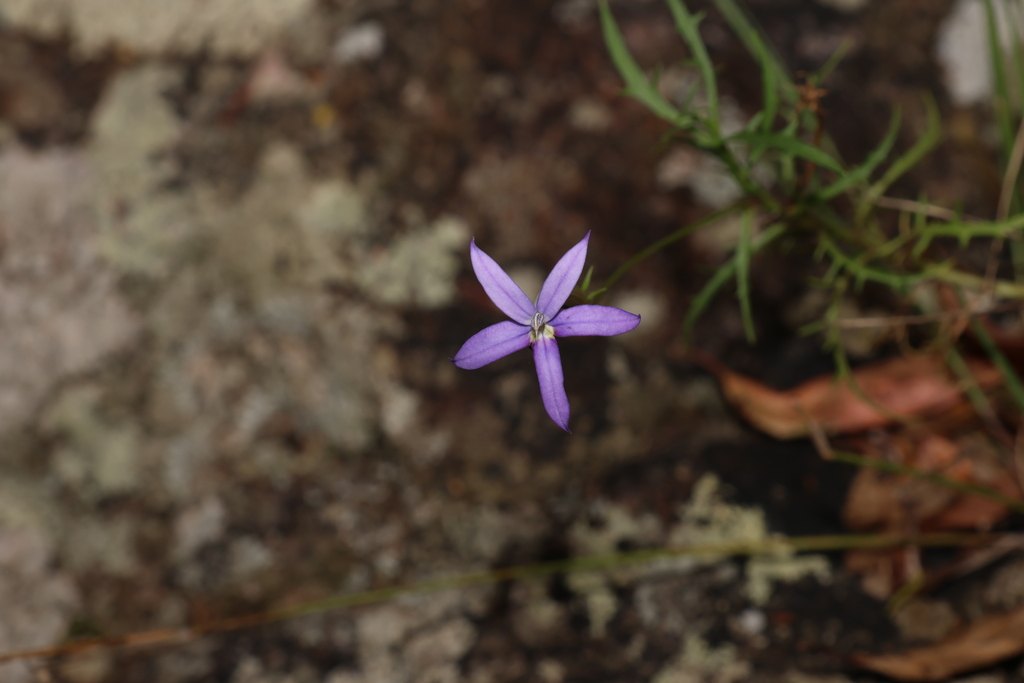
Rock isotome is an upright perennial herb to 50 cm, with ascending stems that are often purplish and covered in soft hairs that wear off with age. The leaves are 1.5 to 15 cm long and 0.5 to 5 mm wide, cut into deep, toothed, linear lobes with sharp points.
John Lindley described it in 1826 in Edwards’s Botanical Register. The genus name comes from the Greek isos, equal, and tomos, a part, the epithet axillaris means of the axil, because the flowers sit in the leaf axils. Lindley placed it in the Lobeliaceae, a family now folded into the Campanulaceae.
In the trade it is sold as laurentia, or as blue star, and the trade name has drifted so far from the botanical one that a packet labelled laurentia may hold this species or a close relative. The flowers are blue to mauve, occasionally white or pink, with a throat that can be white, greenish or yellow, and they appear from September to May in the southern hemisphere.
Science & Biotechnology
The flower is built on a plan that is unusual in its family. The corolla tube is 15 to 35 mm long, and the five lobes at its mouth are 8 to 18 mm and are not joined to one another, so the face of the flower is a star rather than a bell. Most Campanulaceae fuse the lobes into a tube or a bell, and free lobes here change how the flower presents itself.
The combination has a function. Nectar sits at the bottom of a tube 3.5 cm deep, which is beyond the reach of a short-tongued fly, while the star of free lobes gives a landing platform wide enough for a long-tongued bee to settle on. The peduncle is 3 to 17 cm long, which puts the flower clear of the leaves.
Cut a stem and it bleeds white. The family carries latex in articulated laticifers, a network of tubes that seals a wound with a milky exudate; the same tissue is why campanulas look sticky when cut, and why the sap stains pale fabric. The list carries allies in Trachelium, Dimorphotheca sinuata and Helianthus angustifolius.
Uses & Benefits
In a cold climate it is a bedding plant and a container plant, grown as an annual and replaced each spring; in a mild one it is a short-lived perennial that flowers for eight or nine months of the year. It is at its best at the edge of a path, where the thin stems lean out, and in a raised bed or a crevice where the drainage suits it.
In the wild it grows in moist crevices on rocky outcrops in Queensland, New South Wales and Victoria, which sounds like a contradiction until you look at the site: the crevice holds water in a drought and drains in a downpour, and the roots never sit in a bog. That is the condition to copy, not the moisture alone and not the drainage alone.
It is not worth cutting. The stems are thin, the flowers drop within a day or two of cutting, and the latex makes the water cloudy. Use it where it grows, and cut something else for the vase: the plant is not improved by being brought indoors.
Growing from Seed
The seed is fine and should be surface sown, because it needs light. Use a mix of peat or coir and perlite, press the seed down without covering it, water from below, and hold at 18 to 21 °C. Germination takes two to four weeks and is uneven, so leave the tray a month before deciding it has failed; the last seedlings are often the strongest.
Prick out when the first true leaves are open, handling the seedlings by a leaf rather than the stem, and grow them on cool and bright. Warmth and low light give a stretched plant that will not branch; 15 °C and full light give a compact one that flowers at 15 cm. Pinch the growing tip once, when the plant has four pairs of leaves.
Plant out after the last frost, in sun or very light shade, in soil that drains. In a cold garden, take cuttings in late summer as insurance: 5 cm tip cuttings in gritty compost, kept humid and out of direct sun, root in about three weeks. Overwinter the stock plants at 5 to 10 °C, barely watered, and they will be ready to cut again in February.
Our Take
It is a plant to grow for the awkward months, not for the height of summer. In a mild garden it flowers through winter into spring, when almost nothing else is blue, and in a cold one from June until the frost takes it.
The frost limit is real: about one degree below zero, which is USDA zone 10 and a British winter only in the mildest counties. Grow it as an annual with no regret, take cuttings in August, and treat the stock plant as a means rather than an end.
Related Reading
Gardeners who grow Rock Isotome often pair it with these related subjects: