


Perovskia atriplicifolia Seeds | Russian Sage
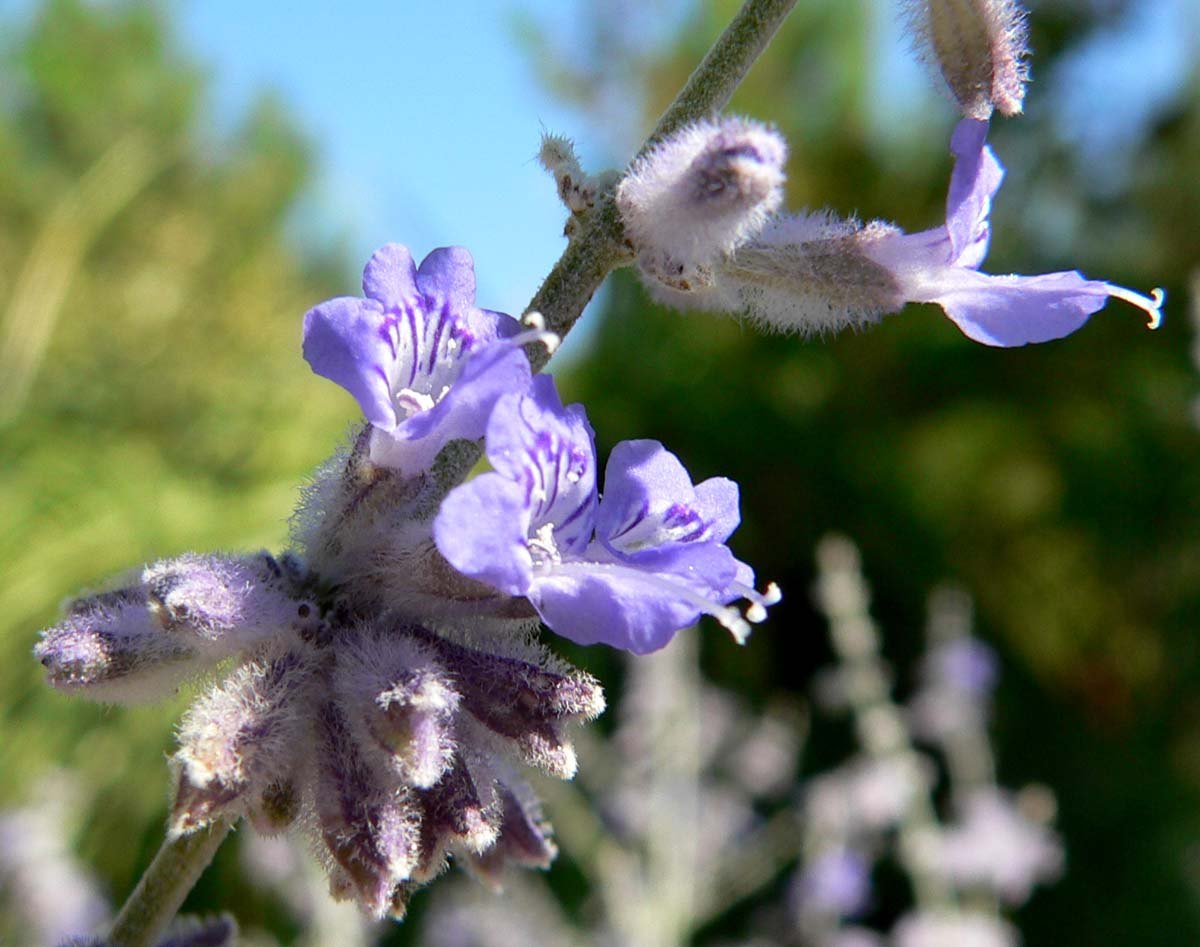
LATIN NAME: Perovskia atriplicifolia
COMMON NAME: Russian Sage
Plant Profile
Russian sage is a herbaceous perennial that behaves like a subshrub, with upright stems that stiffen and persist through winter. It reaches 0.5 to 1.2 m, carries square stems typical of the mint family, and holds grey-green leaves that release a sharp, resinous smell when crushed.
The flowers are the point. Blue to violet blossoms are arranged in branched panicles, and the season runs from midsummer into late October, which is late enough that very little else in a mixed border is still going. The silver stems stay upright through the winter and look better than most plants do dead.
The name changed recently and the trade has been slow to follow. Long known as Perovskia atriplicifolia, it was moved into Salvia in 2017 and is now Salvia yangii. Seed packets and nursery labels still carry the old name, and both refer to the same plant. Closest relatives on the list are Nepeta × faassenii, Mentha requienii and Mentha × piperita.
Science & Biotechnology
The plant has a long record of use in traditional medicine across its native range, where it is employed for a range of complaints, and that history has driven a fair amount of phytochemical work. The aromatic compounds in the foliage are the reason: the same resins that make the leaves smell sharp are what the pharmacological literature is interested in.
The grey-green colour of the leaf is itself an adaptation. A dense covering of fine hairs reflects light and reduces water loss, and the pale surface keeps leaf temperature down in the strong summer sun of the steppe. Combine that with a deep root system and you have a plant that survives on rainfall alone in places that bake for months.
Hardiness is the other selected trait. The plant comes from continental Asia, where winter cold is severe and summer heat is extreme, and it handles both. That range is why it performs from northern Europe to the hot interior of North America without much fuss.
Uses & Benefits
In the garden it fills the late-season gap that most perennials leave. Plant it behind lower herbaceous planting, where the haze of blue reads at a distance, and leave the stems standing until spring: the silver framework is the reason many designers use it in winter borders.
The cultivars differ mainly in height and leaf. ‘Filigran’ reaches 1.2 to 1.3 m on lacy, fern-like foliage, ‘Little Spire’ stops at 0.6 m, and ‘Longin’ matches ‘Blue Spire’ in height but stands more upright. Allan Armitage selected ‘Mystery of Knightshayes’ from a plant at Knightshayes Court, and it flowers later than any of them.
It ranks among the best plants for pollinators at a time of year when bees are short of forage. The flowers are open and shallow, accessible to short-tongued bees as well as honeybees, and the plant attracts butterflies and hummingbirds in North America.
The flowers are edible and can be scattered in salads, or crushed into a drink. The medicinal use belongs to the plant’s home range and should stay there: this is not a herb to dose yourself with on the strength of a seed packet.
Growing from Seed
Sow on the surface in late winter, because the seed needs light. Press it into moist compost, do not cover it, and hold at 18 to 21 °C. Germination is slow and uneven, two to three weeks and often longer, so do not give up on a tray that looks empty after a fortnight.
The seedlings are modest in their first year and it is tempting to feed them along. Do not. Rich compost produces soft stems that flop and flower poorly; the plant wants lean, sharp-draining ground and full sun, and it will give you a better shape on poor soil.
Plant out at 45 to 60 cm apart once the roots have filled their pots. Cut back hard in early spring, to about 15 cm, before new growth starts. Pruning later in spring removes the flowering wood and costs you the season. In a cold garden, leave the old stems on until March for the frost to look at.
Our Take
It was the Perennial Plant Association’s Plant of the Year in 1995 and the cultivar ‘Blue Spire’ holds an Award of Garden Merit from the Royal Horticultural Society, and both awards were deserved. The one complaint is that it spreads by rhizomes beyond where you planted it, which is fine in a gravel garden and a nuisance in a tight border.
Give it room, cut it back hard in spring, and it will still be flowering when the asters are finished. It also comes less true from seed than a cultivar name implies, so buy plants if the exact height matters.
Related Reading
Continue exploring with these related plants: