


Lewisia cotyledon Seeds | Siskiyou Lewisia
LATIN NAME: Lewisia cotyledon
COMMON NAME: Siskiyou Lewisia
Plant Profile
Lewisia cotyledon is the showiest of a small western American genus, and the one that made the transition from alpine house to ordinary garden. English speakers call it Siskiyou lewisia or cliff maids, both names pointing at the same thing: a plant of rock ledges in the mountains of southern Oregon and northern California.
It grows from a thick taproot joined to a caudex, the woody, slowly lengthening stem that keeps the rosette above the debris. From that crown it produces a rosette of thick, spoon-shaped, fleshy leaves up to nine centimetres long, often with a paler margin and a slightly toothed tip.
The specific epithet cotyledon means small cup, a reference to the leaf shape rather than to any botanical structure. The genus honours Meriwether Lewis, who collected the bitterroot, Lewisia rediviva, on the expedition of 1804 to 1806 and whose name has been attached to the group ever since.
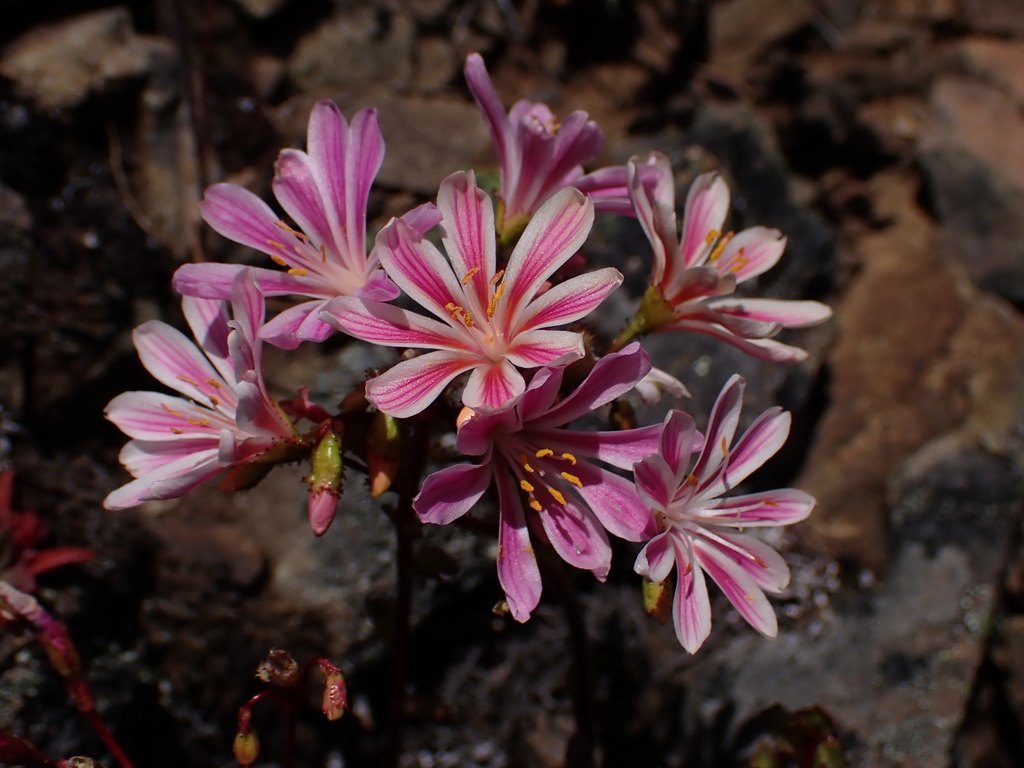
Flowering stems rise ten to thirty centimetres, and a strong stem can carry fifty flowers in a loose, one-sided array. Each flower has seven to thirteen petals about a centimetre and a half long, in pale pink with darker veins, white with orange striping, or solid orange to yellow.
Science & Biotechnology
This is a textbook caudex plant, and the caudex is the whole story of its cultivation. The structure is a short, swollen axis that accumulates water and stored carbohydrate and lifts the growing point clear of soil and snow, so the rosette sits in moving air while the root explores cracks below.
Around each flower sit small pointed bracts tipped with resin glands, and the sepals are unequal and persistent. The petals are not petals in the strict sense but petaloid sepals, a distinction that matters little in the garden and a great deal in a herbarium key.
The species belongs to Montiaceae, a family separated from the old Portulacaceae on molecular evidence. Its relatives include the miner’s lettuces and the spring beauties, all of them plants of thin soils and short seasons, and all of them built to bank water and spend it fast. Nearby in the classification: Sedum selskianum, Sedum rupestre and Sedum lineare.
Uses & Benefits
In the garden it belongs in a trough, a crevice, or the sharp drainage of a raised bed, and it ranks among the few alpines that flowers well enough to justify the trouble. A single plant in a stone trough will produce more colour in June than a metre of ordinary border.
Field records peak sharply in June, with May and July close behind, and almost nothing between November and February. That narrow window is the plant’s own calendar and it does not shift much in cultivation, which makes it a reliable marker of early summer in a rock garden.
The cultivated Sunset group, bred for a wider colour range and better tolerance of wet, holds an Award of Garden Merit along with the species. Those plants are more forgiving than the type but they still refuse to sit in wet compost through winter, and they still need the crown kept dry.
Growing from Seed
Sow fresh seed in autumn and give it cold, either outdoors in a covered frame or in a refrigerator for six weeks. Germination is slow and irregular, often spread over two months, and a proportion of the seed may wait a full year. Surface-sow on gritty compost and cover only lightly.
Prick out at the two-leaf stage into a mix of equal parts leaf mould, grit and loam, and water from below. The seedlings are prone to damping off, so ventilate hard and resist the urge to keep them cosy. Grow them on for a full season before planting out.
Plant on a slope, or set the crown at an angle so water runs off rather than into the rosette, a trick borrowed from alpine growers and worth more than any fungicide. Top-dress with grit, water freely in spring and early summer, and then stop almost entirely once flowering ends.
Our Take
Lewisia cotyledon is a plant that punishes affection. Every account of failure ends the same way: the crown rotted in winter, usually after a wet autumn, usually in soil that would have grown a fine cabbage. Give it the drainage of a scree and it is straightforward.
Buy or sow it for a trough by a door, where you will see the June flush and can pull the dead leaves out. Seed is the cheap route and the slow one; a plant from a specialist nursery will flower the same summer, and if you plant it on its side it may outlive you.
Related Reading
More species in the same orbit as Siskiyou Lewisia: