


Abutilon theophrasti Seeds | Velvetleaf
LATIN NAME: Abutilon theophrasti
COMMON NAME: Velvetleaf
Plant Profile
Velvetleaf is an annual in the mallow family, native to central and eastern Asia, and it ranks among the most damaging weeds of maize and soya in North America. It grows 1 to 2.5 m tall on stout, branched stems covered in soft down, and the whole plant feels like felt, which is where the common name comes from.
The leaves are large, heart-shaped and pointed, alternate up the stem, on long thick stalks. Crushed, they release a smell that is hard to place and easy to remember. The flowers are yellow, about 2.5 cm across with five petals, opening singly or in small clusters where the leaf stalk meets the stem.
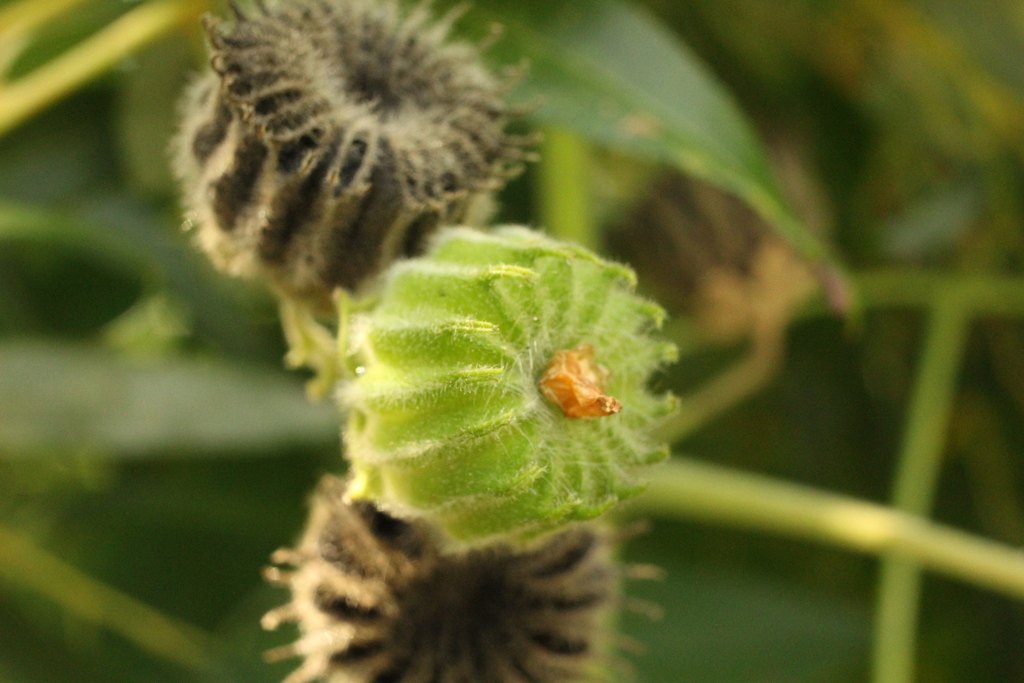
The fruit is a ring of twelve to fifteen woody segments, joined while the seed ripens and opening later by a vertical slit on the outer edge. It looks like a small crown, or a segment of a cog. The specific epithet honours Theophrastus, which is a grand name for a plant most farmers would like to see the last of.
Science & Biotechnology
Seed output is the reason it is so hard to control. A single plant produces between 700 and 44,200 seeds, they mature in seventeen to twenty-two days, and they remain viable in dry storage or in soil for about fifty years. Germination needs 24 to 30 °C, so the plant appears late and slips past early cultivation.
The seed coat is hard enough to survive a cow’s gut and a compost heap, and the seedlings emerge over years rather than weeks. That is the definition of a seedbank weed: you can kill every plant in the field this season and still have fifty seasons of it waiting in the topsoil, germinating whenever the ground is disturbed.
The stems carry a strong bast fibre, and the plant has been grown for it since about 2000 BCE in China. The same fibre made ropes, coarse cloth, nets, paper and caulking for boats, and it is still cultivated there. A plant can be a crop and a pest at once, and velvetleaf is the clearest example in arable farming.
Uses & Benefits
The fibre is the old use and the seed is the quiet one. Seeds are eaten in China and Kashmir, and the leaves were part of Maldivian cooking, finely chopped with fish and grated coconut in a dish called mas huni. The plant is edible, which is worth saying plainly about a weed this widely hated.
In Chinese medicine it is used for dysentery and for eye injuries, including opacity of the cornea. The leaves contain about 0.01 per cent rutin, and softened leaves were applied to ulcers as a soothing dressing. The bark was used to stanch bleeding and to promote the flow of urine.
In the field it is a liability. Uncontrolled, it can cut maize yield by up to 34 per cent, and it costs growers a great deal in herbicide and cultivation. It is listed as an unwanted organism in New Zealand and regulated in parts of Europe, where it arrived as a contaminant and stayed. Malvaceae is well covered here, with Hibiscus manihot, Hibiscus aculeatus and Lavatera trimestris alongside.
Growing from Seed
Nobody sows it on purpose, which is the point. If you want it for fibre or for the look of the thing, sow in late spring, when the soil is above 24 °C, and expect germination in a week or two. The seedlings are vigorous and the plant grows away fast in heat.
It wants full sun and disturbed ground. Any soil will do, from sand to clay loam, at pH 6.1 to 7.8, and it responds to nitrogen with height and more seed. Give it space; a plant in a border will reach two metres and shade everything within a metre of it.
If you grow it, cut the stems before the capsules open, and put them in the green waste rather than the compost. The seed survives composting and it survives the winter in the soil, so a single plant left to ripen will seed the bed for a decade or more.
Our Take
It is a plant to grow once, out of curiosity, in a corner where nothing else has to live. The velvet leaves are genuinely handsome, the yellow flowers are neat and the seed pods are a small marvel of engineering. Then cut it down before it repays you.
There is no garden reason to keep it. As a fibre crop it belongs to history and to Chinese agriculture, and as a weed it ranks among the worst in the temperate world. Grow it in a pot, look at it, and do not let it set seed.
Related Reading
If Velvetleaf appeals to you, these related plants are worth a look: