


Campsis radicans Seeds | Trumpet Vine
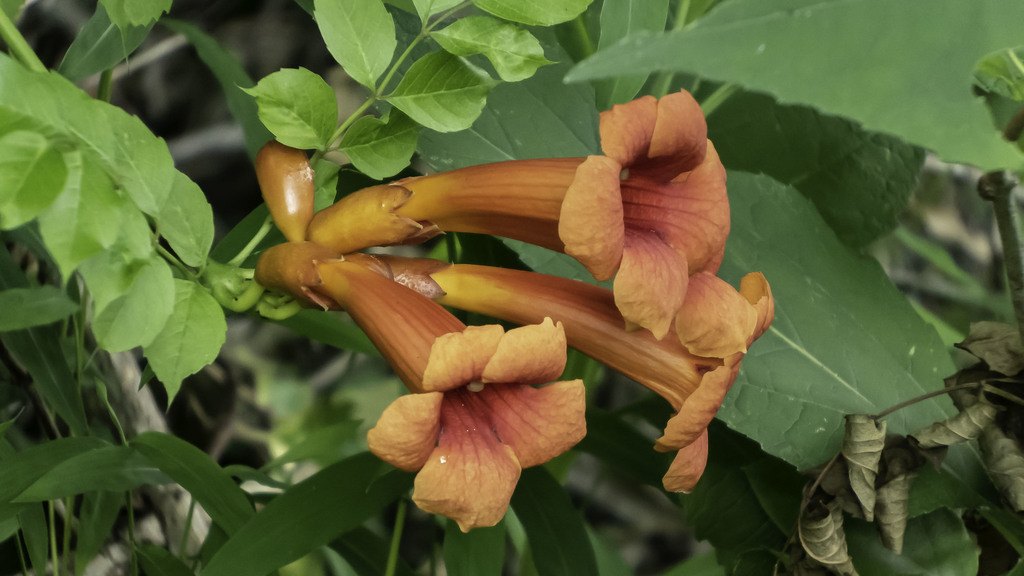
LATIN NAME: Campsis radicans
COMMON NAME: Trumpet Vine
Plant Profile
Campsis radicans is a woody vine of the trumpet vine family, native to eastern North America from Pennsylvania south to Florida and west to Texas, where it grows in woodland, along riverbanks and on fence rows. It climbs by aerial roots that emerge from the stems and grip bark, stone and brick, and it can reach 10 m in a good season.
The leaves are pinnate, with seven to eleven leaflets, and the flowers are trumpet-shaped, 6 to 8 cm long, in orange and red, carried in clusters at the ends of the stems in midsummer. Each flower has five lobes and a throat that opens wide, and the whole thing is shaped for hummingbirds, which pollinate it in its native range.
The fruit is a long, woody capsule 10 to 20 cm long that splits to release hundreds of papery seeds, each with two wings. The seed germinates readily, and the plant also spreads by suckers from the roots, so it can become a nuisance in a small garden.
Science & Biotechnology
Campsis is a small genus of two species, one North American and one East Asian, and it sits in the Bignoniaceae alongside the jacaranda and the catalpa. The family is characterised by opposite leaves, showy flowers and capsular fruit, and it is mostly tropical, with Campsis at the northern edge of its range.
The aerial roots are adventitious roots that emerge from the stem and secrete a weak acid that etches stone and brick, which is how the vine grips a wall. That same acid is why the plant damages mortar over time, and why it should be kept away from old masonry.
The trumpet shape is an adaptation to hummingbird pollination: the tube is long enough to force the bird’s head against the anthers, and the red-orange colour is one that hummingbirds see well. In its native range the plant is also visited by bees, which are too small to reach the nectar and instead collect pollen from the anthers at the mouth of the tube. Related entries here include Radermachera sinica, Tecoma stans and Glandularia canadensis.
Uses & Benefits
It is a plant for a strong structure: a stone wall, a concrete post, a pergola with heavy timber, or a chain-link fence that you want to disappear. It is not a plant for a wooden fence or a gutter, because the aerial roots will find every gap and the vine will pull the structure apart.
In North America it ranks among the best plants for hummingbirds, which visit the flowers for nectar and hover in front of them in the way that hummingbirds do. In Europe, where hummingbirds are absent, the flowers are visited by bees and by bumblebees, which push into the throat for nectar. The cultivar Flava has yellow flowers, and Madame Galen is a hybrid with Campsis grandiflora, with larger, more open flowers in a softer orange. The hybrid is less vigorous and better suited to a small garden than the species.
Growing from Seed
Start them under cover six to eight weeks ahead of the last frost, at 21 to 24 °C, with a light covering of compost. Germination takes 21 to 30 days. The seed needs light and warmth, and fresh seed germinates much better than old.
Prick out into deep pots, since the plant makes a long taproot, and grow on at 18 °C. Plant out after the last frost, in full sun, against a strong structure. Water well in the first year; after that the plant is drought-tolerant and needs no help.
Prune in late winter, cutting the side shoots back to two or three buds and thinning the oldest stems. The plant flowers on the current season’s growth, so hard pruning does not reduce flowering. Be ruthless: a vine that is not pruned will grow into the roof within three years, and it will send suckers into the lawn.
It also grows well in a large container for a few years, where the restricted root run keeps it smaller and easier to manage, though it will need repotting and fresh compost every second spring. Feed it in spring and water it hard in summer, since a restricted root dries fast.
Our Take
Trumpet vine is a plant of enormous vigour and considerable beauty, and it is not suitable for a small garden. Given a strong wall and a hard prune every year, it ranks among the best climbers for a hot summer; given a wooden fence and no attention, it is a demolition project. Grow it where it can run, prune it hard in February, and enjoy the flowers in August. If you have any doubt about the structure, grow the hybrid Madame Galen instead, which is tamer and just as beautiful.
Related Reading
Gardeners who grow Trumpet Vine often pair it with these related subjects: