


Pycnosorus globosus Seeds | Woolly Billy Buttons
LATIN NAME: Pycnosorus globosus
COMMON NAME: Woolly Billy Buttons
Plant Profile
Billy buttons are the golden drumsticks that florists sell by the bunch, and the name on the label is usually Craspedia globosa. The plant was moved to Pycnosorus when the two genera were revised in 1992, on the strength of floral and chromosomal detail that separates the Australian drumsticks into two groups. The trade has been slow to follow, as it always is.
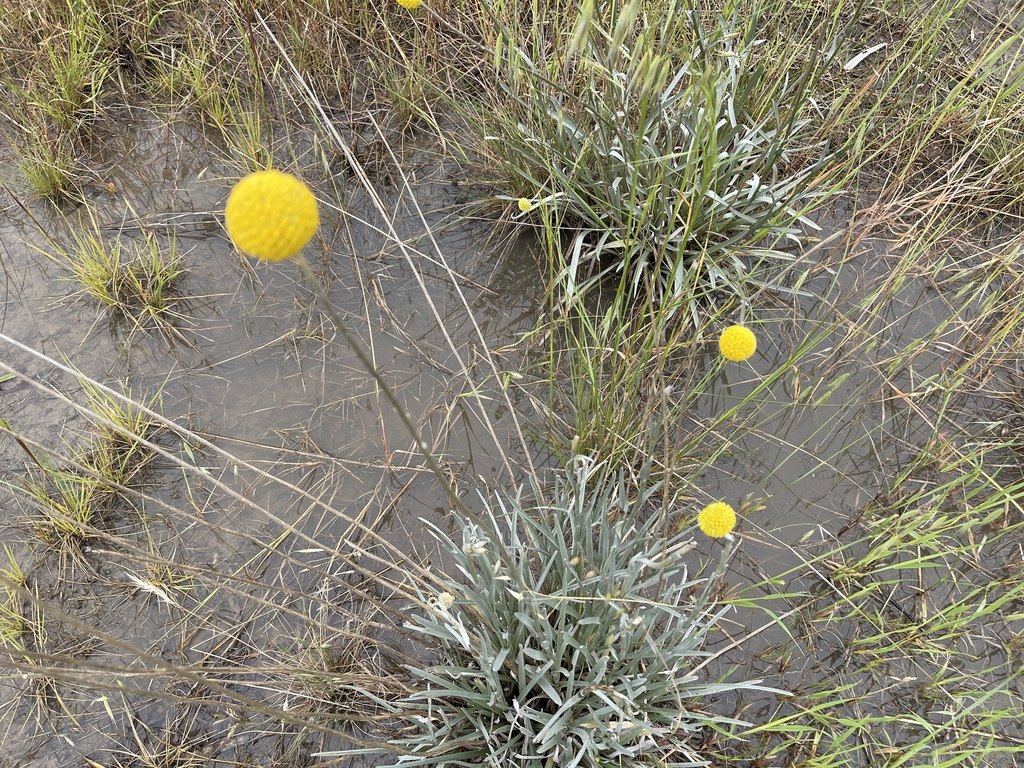
In the ground it is a rosette of narrow, silvery leaves pressed flat to the soil, and from that rosette rise leafless stems to eighty centimetres. Each stem carries one globular head, two to three centimetres wide, made of hundreds of tiny florets packed between papery bracts. The effect is a lollipop of dull gold, and it lasts for weeks.
It grows in open grassland and woodland from southern Queensland through New South Wales into Victoria, on clay and loam that dry out in summer. The rosette sits tight against the ground while the soil is dry and the stems appear after rain. In cultivation that cycle is unpredictable, and plants may flower in their first year or their second.
The common name comes from the billy, the tin can in which Australian workers boiled tea. A head on a straight stem does look like one. The plant entered European horticulture through cut-flower trials rather than through gardens, and it is still grown more for the bucket than for the border. That is unusual for a daisy and it explains the breeding work.
Science & Biotechnology
The head is a capitulum, the standard daisy unit, but here the outer florets are female and thread-like and the inner ones are bisexual, and all of them are hidden behind bracts. Those bracts are the reason the flower dries so well. They are dead at maturity, stiff, air-filled and almost without water, so they keep their shape when hung upside down.
Drying is not a trick of the florist; it is the plant’s own construction. A head cut in bud and dried will open slightly as it loses water and then hold. Heads cut too late shatter. The stems are hollow and stiff, which makes them easy to wire, and they keep their colour for a year in a dry room. Few cut flowers are this forgiving.
Seed is an achene with a small pappus, and it is produced freely where pollinators are present. In the garden, hoverflies and small native bees do the work. The plant is a short-lived perennial, and in hot wet climates it behaves as an annual or simply rots at the crown. Drainage matters more than anything else.
Uses & Benefits
As a cut flower it is sold fresh and dried, and it has become a staple of the Australian export trade and of wedding work in Europe. The heads hold their colour without dye, which is rare in yellow. Bunches are harvested when the heads are firm and the stems still rigid, and they are stripped of leaves before drying.
In the garden it belongs at the front of a dry border or in a gravel bed, where the rosettes can be seen and the stems can rise without support. It combines well with grasses and with blue flowers, since the yellow is soft rather than acid. It is also good in a large pot, provided the compost drains and the crown stays above the surface.
Nothing about the plant is edible, and the silver leaves are bitter. Stock will leave it alone. Its value is ornamental and, in Australia, ecological: the heads are visited by a range of small insects, and the plant volunteers in disturbed ground after rain. In wet climates it is a curiosity rather than a reliable perennial.
Growing from Seed
Sow on the surface of a free-draining mix at eighteen to twenty-two degrees, and do not cover the seed, because it needs light. Germination takes three to four weeks and is erratic; a second flush often appears after the tray has been left to dry and watered again. Keep the seedlings bright and cool to prevent stretching.
Prick out when the first true leaves show and grow on in individual cells, because the taproot resents disturbance. Plant out after the last frost into full sun and soil that drains within an hour of rain. Space them thirty centimetres apart. Water until established, then only in prolonged drought, and never over the crown.
For cut flowers, sow in succession from early spring to midsummer, and harvest stems when the heads are fully round but before the florets open. Cut them in the morning and stand them in shallow water. To dry, bundle and hang head down in a dark, airy room for two weeks. Seed saved from garden plants will not come true.
Our Take
Billy buttons are a lesson in how a plant’s useful life and its botanical identity can drift apart. The name on the seed packet is a synonym, the crop is grown for the bucket rather than the bed, and the revision that renamed it appeared in a journal no florist reads. None of that stops it working.
Sow it if you have sun and sharp drainage, and cut it if you have a dark corner to dry a bunch in. It is not a plant that asks for much, and it gives back a stem that survives a year in a vase. For a dry border in a hot summer, that is a fair bargain.
Related Reading
Continue exploring with these related plants: