


Moluccella laevis Seeds | Bells of Ireland
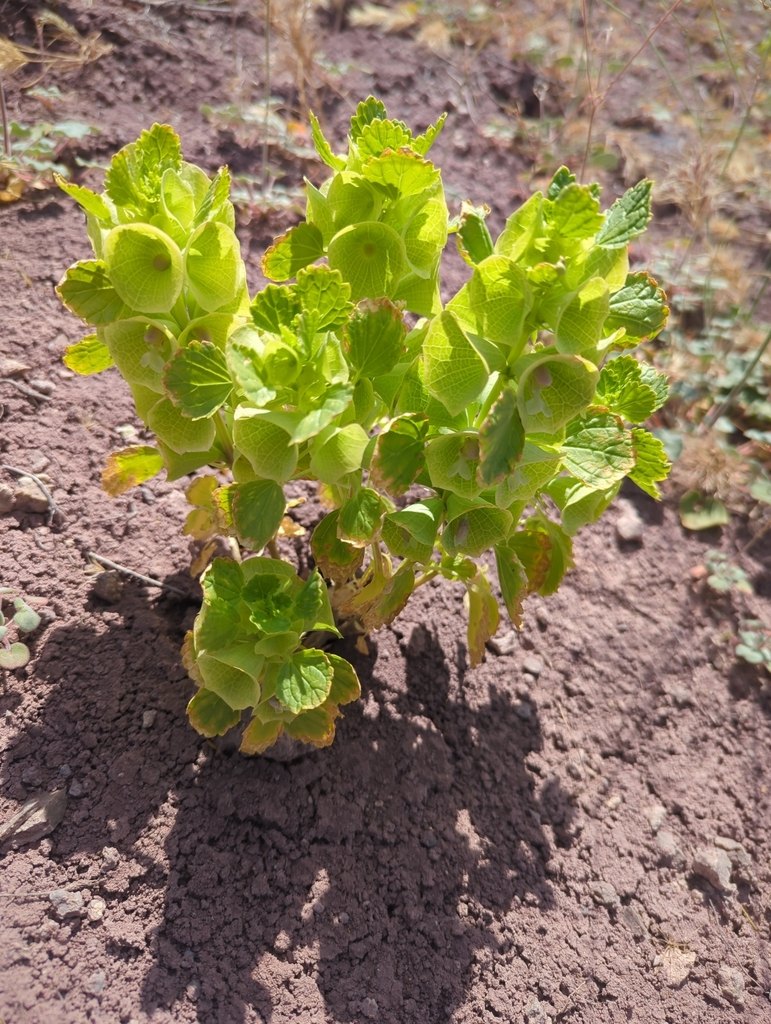
LATIN NAME: Moluccella laevis
COMMON NAME: Bells of Ireland
Plant Profile
Moluccella laevis comes from Turkey, Syria and the Caucasus, where it grows on dry hillsides and in disturbed ground. It is a summer annual 60 to 90 cm tall, with square stems, rounded scalloped leaves and a spike of green flowers that is unlike anything else in the garden.
The flower itself is small and white, but it is hidden inside a large, inflated green calyx with five lobes and a shell-like shape, and it is the calyx that gives the plant its name and its use. The spikes are held upright and are covered in these bells from midsummer until frost, and the whole plant has a formal, architectural look that is hard to place in a border.
The common name is a mystery with no basis in fact: the plant does not grow in Ireland, has no Irish connection, and the name appears in English catalogues in the eighteenth century without explanation. Molucca balm, another name, is equally unfounded. It is a plant that has been misnamed twice and survived both. For more of the Lamiaceae, the list offers Clinopodium chinense, Elsholtzia stauntoni and Salvia pratensis.
Science & Biotechnology
Moluccella is a small genus of about four species in the Lamiaceae, the mint family, and it sits in the tribe Lamieae alongside Lamium and Stachys. Despite its exotic look, it is a close relative of the dead-nettles, and it shows the family’s characteristic square stem and opposite leaves.
The inflated calyx is an adaptation to wind dispersal: when the seed is ripe, the calyx dries and acts as a small balloon, and the whole structure tumbles across the ground, scattering seed as it goes. The same principle appears in the Chinese lantern, Physalis, which is in a different family entirely, a good example of convergent evolution.
The green colour of the calyx is chlorophyll retained in the tissue, not a flower pigment, so it lasts so long after cutting: the tissue is still alive and photosynthesising for days. That is also why the spikes hold their colour when dried, since chlorophyll breakdown is slow in the dark.
It was grown in English gardens by the middle of the eighteenth century and has never been common, because the spikes are heavy, the stems are brittle, and the plants need staking in any wind. The seed trade keeps it alive, and it appears in catalogues every year without ever becoming a fashion.
Uses & Benefits
It is grown almost entirely for cutting, and it ranks among the best green fillers in the trade. The spikes last two weeks in water and hold their colour, and they dry well if hung upside down, which makes them useful for winter arrangements and for dried wreaths.
In the border it is a curiosity rather than a star. Plant it at the back, where its height can be seen, or in a row along a wall, and use it to give vertical accents between softer plants. It is not a plant that mixes easily, because its colour is neither flower nor foliage. The plant is not edible and has no medicinal use. It is a florist’s plant, grown for the vase rather than the bed, and it earns its place by lasting longer than almost any other green filler.
Growing from Seed
Sow indoors eight to ten weeks before the last frost at 18 to 21 °C, on the surface and only just covered, since the seed needs light. Germination takes 14 to 28 days and can be uneven; a packet sown in March may still be germinating in April.
Prick out into 9 cm pots and grow on at 15 °C. The seedlings are slow at first and then grow fast, and they need bright light to stay stocky. Plant out after the last frost, 30 cm apart, in full sun and well-drained soil.
The plants need support in a windy site, since the spikes are heavy and the stems are brittle. Flowering begins about twelve weeks from sowing and continues until frost. Cut the spikes when the bells are fully formed and before they start to dry on the plant, and they will last two weeks in water or a year dried.
Our Take
Bells of Ireland is a florist’s plant rather than a gardener’s plant, and it is worth growing for that reason alone. A bucket of green spikes in August is worth more than a bed of annuals, and it costs one packet of seed.
Grow it in a cutting garden or a row at the back of a border, support it against wind, and cut it hard. Do not expect it to be beautiful in the bed; expect it to be useful in the vase, and it will not disappoint.
Related Reading
Readers interested in Bells of Ireland frequently explore these as well: