


Beckmannia syzigachne Seeds | American Sloughgrass
LATIN NAME: Beckmannia syzigachne
COMMON NAME: American Sloughgrass
Plant Profile
American sloughgrass is a name from the American Midwest, where a slough is a pond that dries in August. Beckmannia syzigachne is a bunchgrass of exactly that habitat: shallow marsh, the muddy margin of a ditch, the strip of ground that is under water in spring and cracked in September, and it grows across Europe, Asia and North America.
It is annual or short-lived perennial, forming a dense tuft of flat, rough-edged leaves rather than running at the root. Culms are erect, between thirty centimetres and a metre, and the whole plant is a fresh mid-green that stays clean through the season, which is more than can be said for most wetland grasses.
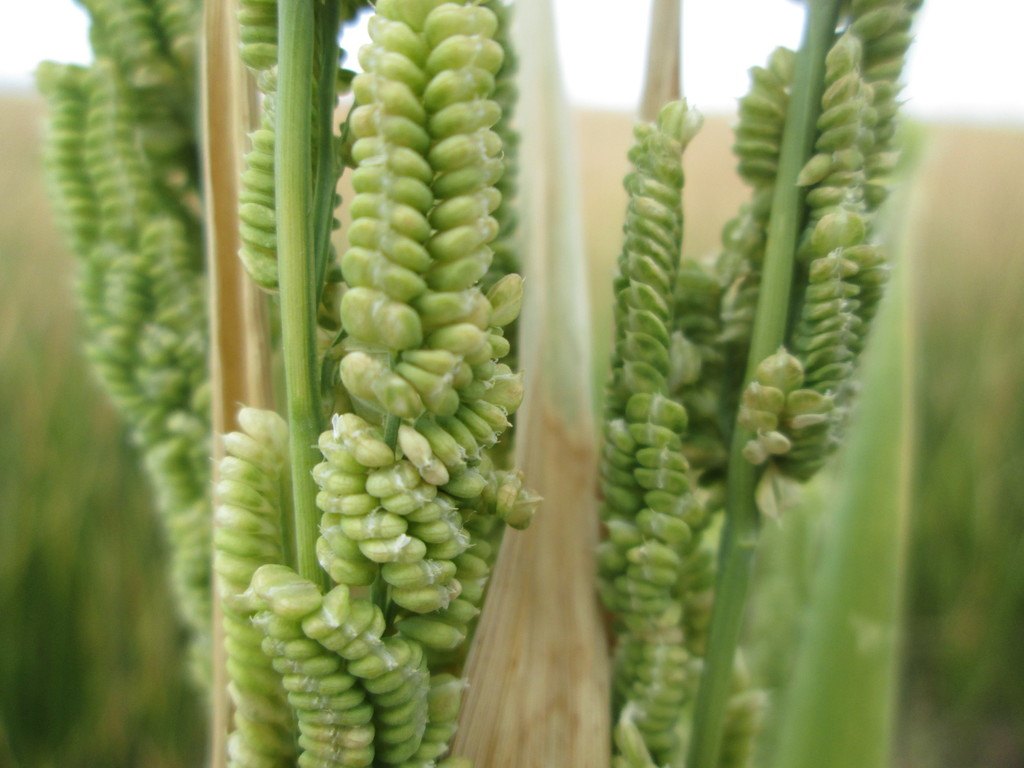
The inflorescence is the diagnostic feature. It is a narrow, interrupted panicle of short branches, and each branch carries flattened, almost circular spikelets arranged on one side of the axis in two neat rows, so that a ripe head looks like a braid of small coins.
The genus holds only two species, this one and Beckmannia eruciformis, and the pair are separated by details of the glumes and the shape of the spikelets. Both are northern hemisphere wetland grasses, and both are of more interest to ecologists and waterfowl managers than to gardeners.
Science & Biotechnology
In 2026 a chromosome-level genome assembly was published, and the numbers are worth recording because they place the species among the larger grass genomes: about 3.19 gigabases, ninety per cent of it anchored to seven chromosomes, with a completeness score of 97.1 per cent and 36,944 protein-coding genes predicted.
The epithet syzigachne comes from the Greek for joined glume, and it refers to the way the glumes of the pair of florets in each spikelet are fused rather than separate. That fusion is not unique in the family, but in this genus it is the character that separates the two species at a glance.
As a wetland grass it is built for anoxic roots. Aerenchyma runs through the stem and into the leaves, allowing oxygen to move from the air to the root zone, and the plant survives weeks of standing water that would kill a dryland grass of the same size within days. Fellow Poaceae members here: Hordeum jubatum, Lolium multiflorum and Elymus trachycaulus.
Uses & Benefits
Its working use is waterfowl and wetland restoration. The seed is eaten by ducks and other marsh birds, the tufts provide cover on open mud, and the plant establishes quickly on bare ground that has been drawn down or disturbed, which is precisely where a restoration project needs something to hold the soil.
It is also grazed, though not enthusiastically. Early growth is palatable and the plant responds to cutting by tillering, but the yield is modest and it disappears under heavy grazing, so it is a component of wet pasture rather than a forage crop in its own right.
The seed is edible and was used as a grain by some northern peoples, so it carries a food rating in the ethnobotanical literature. The quantities are small and the harvesting awkward, and no one has ever proposed it as a crop in the modern sense.
Growing from Seed
Sow in autumn on wet ground, or in spring on ground that will be kept saturated. The seed needs contact with wet soil and light, and it germinates best on a drawn-down mud flat rather than in standing water. Broadcast thinly and press the seed in with a boot or a roller rather than covering it.
Fresh seed germinates without pretreatment; stored seed benefits from four weeks of cold and wet, which is what an autumn sowing provides for free. Seedlings appear over two to five weeks, and they are slow for the first month, sitting as thin blades while the weeds around them race ahead.
Weed hard in the first six weeks, then stop. Once the tufts close, the plant holds its own against everything except reed canary grass, which will swallow a small patch in two seasons. Collect seed when the spikelets turn from green to a straw brown and strip them from the axis by hand.
Our Take
Sloughgrass is not a garden plant, and anyone who buys it expecting an ornamental will be disappointed by a coarse tuft with an unremarkable head. It is a plant for a wet corner, a pond margin, a ditch that floods, or a restoration site, and in those places it does a job nothing else does as cheaply.
The genome paper is a reminder of how much attention a plant can attract without anyone wanting to grow it. Here is a grass with a better assembly than most ornamentals will ever get, and its chief virtue is still that it will grow where the ground is too wet to mow.
Related Reading
Gardeners who grow American Sloughgrass often pair it with these related subjects: