


Helipterum roseum Seeds | Pink and White Everlasting
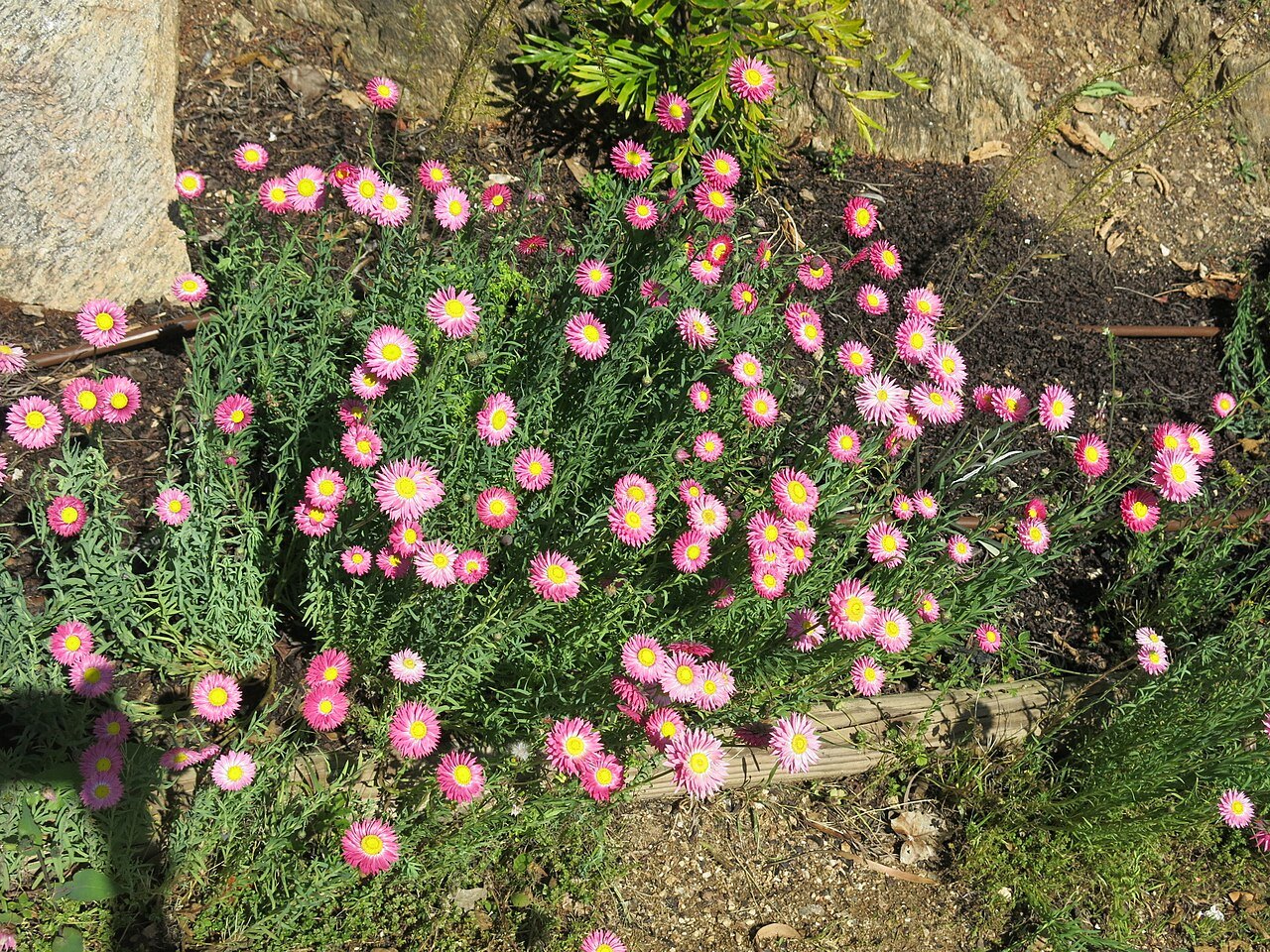
LATIN NAME: Helipterum roseum
COMMON NAME: Pink and White Everlasting
Plant Profile
Pink and white everlasting is a small, tufted annual from southern Australia, grown worldwide under its older trade name Helipterum roseum. Each upright stem, about thirty centimetres tall, carries a single terminal flower from one to six centimetres across, the pink, cream, yellow or white colour supplied not by petals but by papery bracts that never wilt in the ordinary sense.
The foliage is neat and unobtrusive: linear, blue-green, hairless leaves one to two centimetres long, rising mostly from the base of the plant. The buds are wrapped in green outer bracts that peel back as the head opens, revealing the dry, shining inner layers. Flowering runs from June to November in its homeland, the southern spring.
The species was described in 1851 by the botanist Nicolai Turczaninow as Schoenia chlorocephala, and received its current name in 1992 from Paul G. Wilson in the journal Nuytsia. The epithet chlorocephala means green headed, a reference to those bud bracts, and three subspecies are accepted: the typical form, the rosea sold in commerce, and the deep-coloured splendida.
In the wild it grows across Western Australia and South Australia, in eucalypt woodland, wet places, the margins of salt lakes, and on sand, clay and loam. Casual introductions have appeared in Norway, Germany, India, Myanmar, Java and Colombia, each a trace of the international everlasting trade.
Science & Biotechnology
The everlasting strategy is a masterstroke of economy: what looks like a petal is a stiff, paper-dry bract that does not feed the flower or fade with it. The head remains open and coloured through heat, drought and the end of the season, so these plants dominate the dried-flower trade and the Australian spring displays alike.
As an opportunist annual it lives by its seed bank. Germination follows the season’s opening rains, the whole lifecycle compresses into a few months, and the seed waits in the sand for the next reliable year. In poor seasons few plants appear; in good ones the salt-lake margins blaze, a rhythm written into the species’ physiology.
The taxonomic reshuffle that moved it from Helipterum and Schoenia into Rhodanthe reflects broader molecular work on the paper daisies, a group Australia radiated into hundreds of species. Seed listings lag behind the botany by decades, so a gardener ordering Helipterum roseum receives a packet labelled by a name the plant outgrew in 1992. The Asteraceae list also carries Emilia sonchifolia, Coreopsis grandiflora and Melampodium.
Uses & Benefits
In the garden it is a fast, cheap, luminous bedding annual: mass-sown, it produces a drift of pink and white that begins about ten weeks from germination and continues while the weather stays dry. The colours mix without clash, and the low foliage never smothers its neighbours.
For dried arrangements the flower is almost self-operating: cut stems when the heads are newly open, hang them upside down in a dark, airy place, and the colour holds for years. Many growers simply leave the plants standing and cut the dried stems in autumn, which preserves the natural curve of the stem.
For pollinators the open-faced heads offer accessible nectar and pollen to flies, small native bees and beetles during the southern spring, and the same openness works for European hoverflies in gardens abroad. The plant’s contribution is brief but concentrated, a flush of resource in a season when little else is sown.
Growing from Seed
Sow where the plants are to flower, because the seedlings resent transplanting. In mild climates an autumn sowing mimics the natural rhythm; in cold gardens sow in early spring after the worst frosts. Press the seed into the surface of raked, weed-free sand or soil and do not cover it deeply, as light aids germination.
Germination follows moisture and mild temperatures within one to two weeks. Thin the seedlings to ten or fifteen centimetres, resist every temptation to feed, and keep competition down rather than the watering can up. Lean, dryish soil produces the stiffest stems and the brightest bracts.
Seed is easy to keep: let the heads dry fully on the plant, then rub them over a sheet to release the small, bristled achenes. A patch left uncut will scatter its own successors, and in a dry border the species can maintain itself for years, appearing wherever the spring ground opens.
Our Take
The pink and white everlasting is the cheapest colour a garden can buy and one of the most honest: it flowers quickly, dries beautifully, and dies on schedule without complaint. Its Australian birthright gives it a tolerance of poor, salty ground that most annuals cannot match.
Sow it in drifts through gravel, along a dry path or over spring bulbs’ fading foliage, and let a portion stand for drying. Once the rhythm is learned, the species becomes a fixture of the gardening calendar, arriving with the first warm weeks and leaving its colour behind on the shelf.
Related Reading
Continue exploring with these related plants: