


Tithonia Seeds | Tithonia
LATIN NAME: Tithonia
COMMON NAME: Tithonia
Plant Profile
Tithonia is a genus of about ten species of coarse, fast-growing perennials and shrubs in the sunflower family, all of them native to Mexico and Central America. One of them, Tithonia rotundifolia, is a familiar annual in gardens. Another, Tithonia diversifolia, has been carried around the tropics as a green manure and a source of biomass. The genus belongs to the Heliantheae, the same tribe as sunflowers and zinnias.
The name comes from the Iliad rather than from botany. Tithonus was the Trojan prince whom Eos, the dawn, loved and made immortal without making him young. He withered into a cicada, and the genus was named for him, presumably for flowers that open towards the light. It is a romantic gesture in a family not known for them.
The plants are coarse and hairy, with alternate, often three-lobed leaves and stout stems that can reach three metres in a single season. The flower heads are large, with a ring of sterile orange ray florets around a disc of fertile tubular ones. The rays are papery and reflexed in some species. The whole head is built for a large insect to land on.
Tithonia rotundifolia was described by Philip Miller in 1768 as a Tagetes, which tells you how confusing the orange daisies were to the first botanists. It was moved to Tithonia by Sydney Fay Blake in 1917. Miller was curator of the Chelsea Physic Garden, and he named a large share of the plants the eighteenth century grew.
Science & Biotechnology
Blake was an American botanist at the Smithsonian who monographed the genus and who spent his career on the taxonomy of tropical American Asteraceae. His 1917 treatment remains the foundation of the group. He worked almost entirely from herbarium sheets, and he rarely saw his species alive. The genus has not been revised in the same detail since.
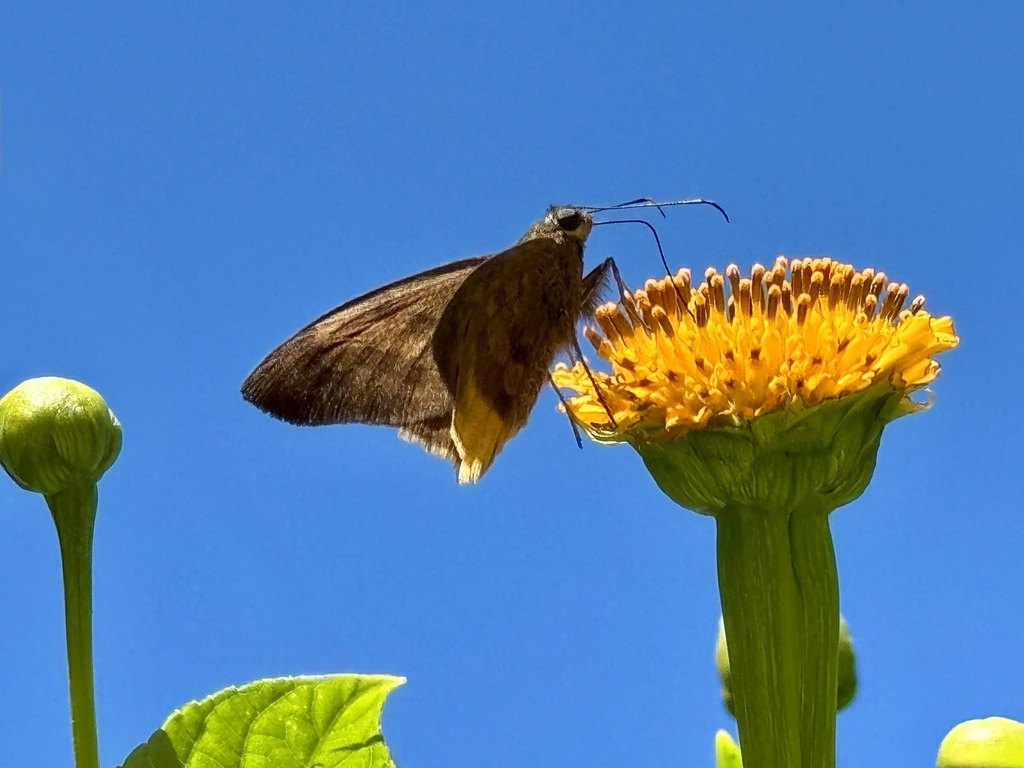
Many populations are self-incompatible, which means two plants are needed for seed, and the flowers are visited by a wide range of bees and butterflies. The orange colour is a carotenoid signal, and it is strongest in full sun. Flowers that open in shade are paler and smaller. The disc florets are fertile and set seed freely.
Growth is fast and the plants are hungry. In warm climates T. diversifolia can reach two metres in a season and flower within four months of sowing. That is why it has been promoted as a fallow-improving crop, and why it has escaped cultivation in several countries. It is now listed as invasive in parts of Africa and Australia.
Uses & Benefits
In the garden the genus is grown for the late season, when the orange heads arrive just as most perennials are finishing. They are good cut flowers, though the stems need searing to stop them wilting. The plants are also heavy feeders of butterflies. A clump in full sun will be busy all afternoon.
Tithonia diversifolia is used in tropical agriculture as a source of biomass and as a green manure, because its leaves accumulate nitrogen and potassium and break down quickly. It is also, in the same countries, a weed of roadsides and abandoned land. The two faces are hard to separate in practice.
The leaves of several species are used in Mexican folk medicine for fevers and skin complaints, and extracts have shown antimalarial and anti-inflammatory activity in the laboratory. None of this has produced a licensed medicine. The gap between a promising extract and a drug is long and expensive. It is worth remembering before the next headline. The other Asteraceae in the catalogue are Tithonia rotundifolia, Tanacetum coccineum and Coreopsis verticillata.
Growing from Seed
Sow indoors in early spring at twenty degrees, or direct where they are to flower once the soil has warmed. Germination is fast and the seedlings grow away quickly. Do not start them too early in a small space, because a plant that runs out of pot before the frost has passed will never recover. Harden them off carefully.
Plant out after the last frost in full sun and ordinary soil, and give them a metre each way, because they are large plants that resent crowding. Water young plants until they are established and then only in drought. A mulch helps in dry summers. They need no feeding in decent ground.
The plants need staking only in exposed sites, but they do need deadheading if you want a long season. They self-sow freely in warm climates, and seedlings come true enough for most purposes. In cold gardens they are best treated as annuals and replaced each year. Seed saved from the best plants is worth the trouble.
Our Take
Here is a genus that gives a great deal for very little: fast growth, big flowers, a long season and no fuss. It is not subtle, and it is not meant to be. A border of tithonia in September is a loud, cheerful thing. Some gardens need exactly that, and others do not.
Grow it where you need colour in autumn and where you have room for something coarse. Give it sun and space, and it will do the rest. The name will make a better story than the plant, but only just. That is a fair bargain for a packet of seed.
Related Reading
More species in the same orbit as Tithonia: