


Thymophylla tenuiloba Seeds | Dahlberg Daisy
LATIN NAME: Thymophylla tenuiloba
COMMON NAME: Dahlberg Daisy
Plant Profile
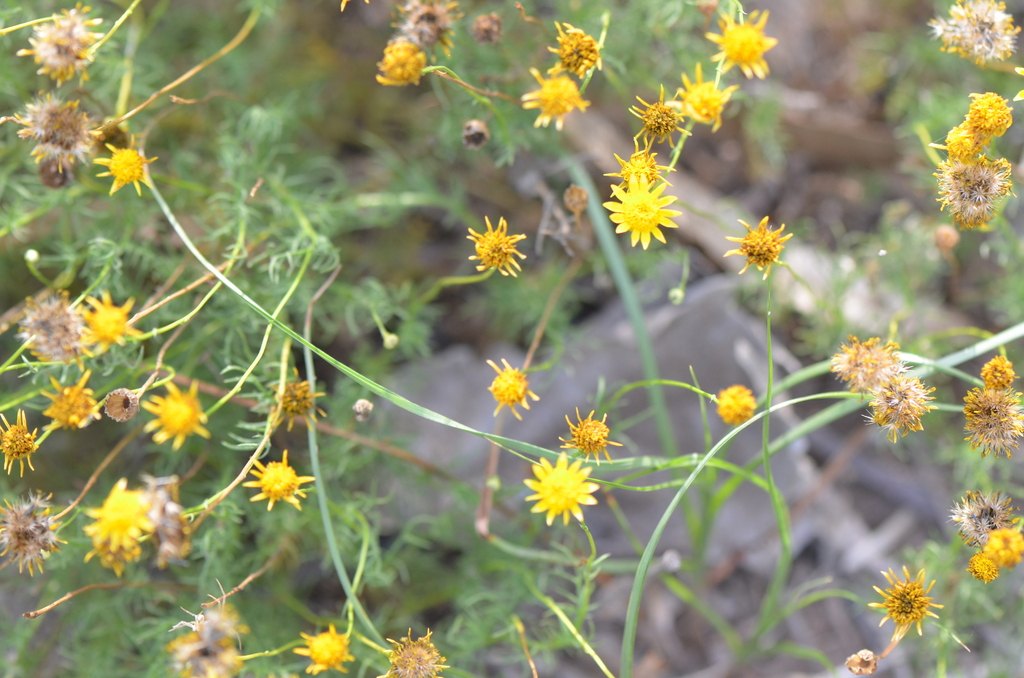
Dahlberg daisy is a plant that looks like a mistake until you see it in flower. The foliage is reduced to thread-fine segments, almost invisible from a metre away, and the plant reads as a green haze until the first gold daisies open and it becomes a small fireworks display.
It is a bushy, multi-branched annual with a trailing habit, usually twenty to thirty centimetres high and wider than it is tall. The flowers are tiny, a centimetre across, and a healthy plant carries dozens at a time over a long season. The habit is prostrate to mounded, and in a container it spills over the rim in a way that few annuals manage.
The name has moved twice: it was Hymenatherum tenuilobum in the De Candolle system, and it is Thymophylla tenuiloba now, with the epithet meaning thinly lobed. The common names are more various: Dahlberg daisy, golden fleece, shooting star, bristleleaf pricklyleaf.
Its native range is south central Texas and northern Mexico, in dry calcareous ground. It has been carried around the world as a summer annual, and it is naturalised in Queensland and recorded as a garden escape in Florida, Hawaii, Mauritius and Israel. Every one of those records is horticultural: it moves in seed mixes and in nursery stock, never on its own.
Science & Biotechnology
The thread-like leaves are the plant’s answer to heat and drought. Narrow segments present little surface to the sun, and the resulting reduction in water loss is what allows the plant to flower through a Texas summer while broad-leaved annuals collapse. The same reduction means it casts almost no shade, so it competes so badly against anything vigorous.
It is a member of the sunflower family, and the small heads are typical composites: a ring of female ray florets around a centre of tubular disc florets, both yellow. The size of the head is what makes the plant useful, since a hundred small flowers read as texture rather than as individual blooms.
The genus name joins two Greek words for thyme and leaf, a reference to the foliage rather than to any scent, because the plant has none worth mentioning. The aromatic compounds that define thyme are absent here, and crushing a leaf gives nothing but a green smell.
Uses & Benefits
Its garden use is the front of a dry border, a gravel bed, a container edge, or a gap between paving where nothing else will grow. The combination of fine foliage and small flowers makes it a soft filler rather than a specimen, and it works best in quantity. At the edge of gravel the fine foliage reads against stone better than any flower could.
Records peak in April, with March and May behind, which reflects a spring flowering in its native Texas that shifts to late summer when the plant is grown further north. In a cool climate it needs a warm start and flowers from July.
It is also a useful cut flower for small arrangements, and a good plant for pollinators with short tongues, since the small open heads are accessible to the smallest bees and flies. That accessibility is worth more in a dry garden than a showier flower that offers nothing. It shares the family with Osteospermum ecklonis, Gazania rigens and Coreopsis lanceolata.
Growing from Seed
Sow indoors six to eight weeks before the last frost, on the surface, because the seed needs light. Press it onto a fine mix, keep it at twenty degrees, and expect germination in ten days to three weeks. The seedlings are thin and easy to damage. Buy a fresh packet each year, because the seed loses viability quickly in warm storage.
Prick out in small clusters rather than singly, since the plant looks better in a group and the roots are fine enough to resent separation. Grow on in full light and keep them on the dry side, which produces a compact plant rather than a leggy one.
Plant out after the last frost in the poorest, sharpest-draining spot you have. Water once, then only in prolonged drought. The plants fade in autumn with the first cold, but they will self-sow in gravel and in the cracks of paving if a few heads are left to ripen.
Our Take
Dahlberg daisy is a plant for the hot, thin, awkward places where nothing else will perform, and it asks for nothing beyond sun and drainage. In a rich border it grows soft and flops; in gravel it makes a carpet.
Buy it for the foliage as much as the flowers, because the green haze is what holds the design together between flushes. Then let it seed into the path, where it will look better than anything you could have planted deliberately.
Related Reading
Readers interested in Dahlberg Daisy frequently explore these as well: