


Mesembryanthemum spectabile Seeds | Ice Plant
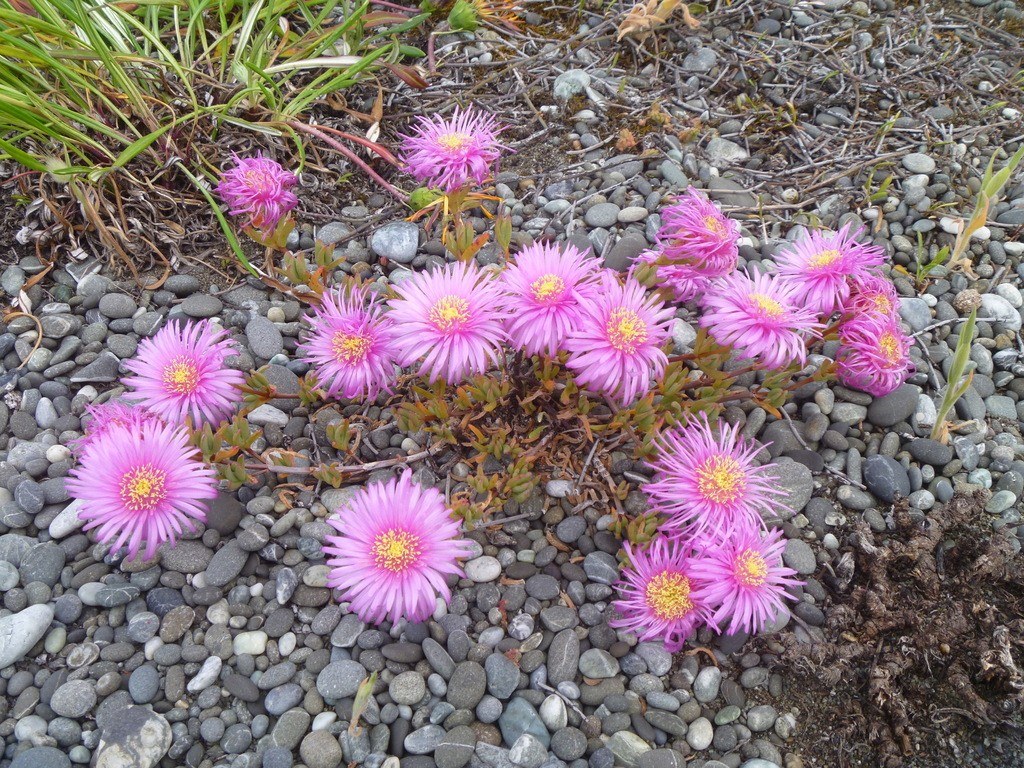
LATIN NAME: Mesembryanthemum spectabile
COMMON NAME: Ice Plant
Plant Profile
The plant sold as Mesembryanthemum spectabile has been Lampranthus spectabilis to botanists since 1930, when N. E. Brown moved it out of the old catch-all genus. The synonym is not an error in the catalogue. It is a fossil of a classification that once held a thousand species, and both names describe the same trailing shrub from the Eastern Cape.
It makes a low mound of grey-green, finger-shaped leaves about six centimetres long, and from it the flowering stems rise and fall outward under their own weight. The flowers are magenta, five centimetres across, and they open at midday. At dusk, or on a wet afternoon, they close again. A plant in full sun covers a square metre in two seasons.
Haworth described it in 1824 from Cape material sent to England, when every Cape succulent was poured into Mesembryanthemum. The epithet means spectacular, and the flowers justify it. Wild plants grow on dry shale slopes and rock ledges inland from Gqeberha, where rain falls in spring and autumn and summers are hot.
The old genus was unworkable and everyone knew it. Schwantes began splitting it in the 1920s, and Lampranthus, with roughly two hundred and fifty species, took the shrubby, large-flowered ones. Mesembryanthemum in the modern sense is a much smaller genus of annual and biennial ice plants with flat leaves. The trade ignored all of this and kept saying mesemb.
Science & Biotechnology
Like most plants in the family, it runs CAM photosynthesis: the stomata open at night, carbon dioxide is fixed into malate and stored in the vacuole, and the acid is released by day behind closed pores. The saving in water is large. The leaves are also swollen with water-storage cells, and their surface is covered in bladder cells that glitter in strong light.
The seed capsule is the neatest piece of engineering on the plant. It has five valves with hygroscopic keels that stay folded in dry weather and spring open within minutes of rain. Seeds are washed out by the splash and land within a metre of the parent. A capsule can open and shut many times a season, releasing a few seeds each time.
The petals are not petals. They are sterilised stamens, flattened and coloured, and the true petals are absent, which is normal in the family. The centre holds a ring of them around the reproductive parts, and the whole display lasts a few days. Solitary bees and small beetles work the flowers at midday, when the pollen is dry and the temperature is highest.
Uses & Benefits
In California, Spain and Australia it is planted on banks and dry slopes where nothing else will hold the soil, and it does the job within a season. The roots are shallow but the canopy is dense, and rain runs off rather than through. It ranks among the few groundcovers that survives a median strip with no irrigation.
In cold climates it is grown as summer bedding or in a pot, and treated as an annual. A plant set out in May flowers by July and can be lifted in October and kept frost-free over winter. It needs a gritty compost and almost no water between November and March. In a cool greenhouse it holds its leaves and flowers again the next summer.
It is not a food plant, and the edible ice plant of the Mediterranean is a different genus entirely, Carpobrotus, whose fig-like fruit is eaten in South Africa. The resemblance stops at the family. Where winters are mild and dry the mesemb can spread and self-sow, and in parts of Australia it has naturalised on disturbed ground.
Growing from Seed
Sow in late winter under glass at eighteen to twenty-one degrees, on the surface of a sandy mix, because the seed needs light. Germination takes two to three weeks and is uneven. Keep the seedlings barely damp and in full light from the start, or they stretch into pale threads that never recover. Ventilation prevents damping off, the main risk here.
Prick out into individual pots as soon as the first true leaves show, and grow them cool and bright. Plant out after the last frost, on a bank or at the front of a border, at about forty centimetres apart. Water them in and then leave them alone. The first summer is the test; after that the plant looks after itself.
Cuttings are easier than seed and they are how named forms are kept true. Take short sideshoots in late summer, let the cut surface dry for a day, and push them into grit. They root in three weeks without heat. Overwinter the pots dry and frost-free, and plant out in spring. Old plants can be cut back hard after flowering.
Our Take
The synonym matters because people still search for it. Mesembryanthemum spectabile is the name on old seed lists, on labels in gardens untouched since the 1970s, and in the Cape literature. A page filed only under Lampranthus would lose those readers. The two names show how taxonomy moves and gardens do not.
Grow it if you have sun, sharp drainage and a winter that does not soak the ground. It is cheap, fast and generous, and it will cover a hot bank that defeats most perennials. Do not expect it to survive a wet cold winter, and do not plant it where you want something else next year. It is a plant for the front edge.
Related Reading
More species in the same orbit as Ice Plant: