


Limonium suworowii Seeds | Russian Statice
LATIN NAME: Limonium suworowii
COMMON NAME: Russian Statice
Plant Profile
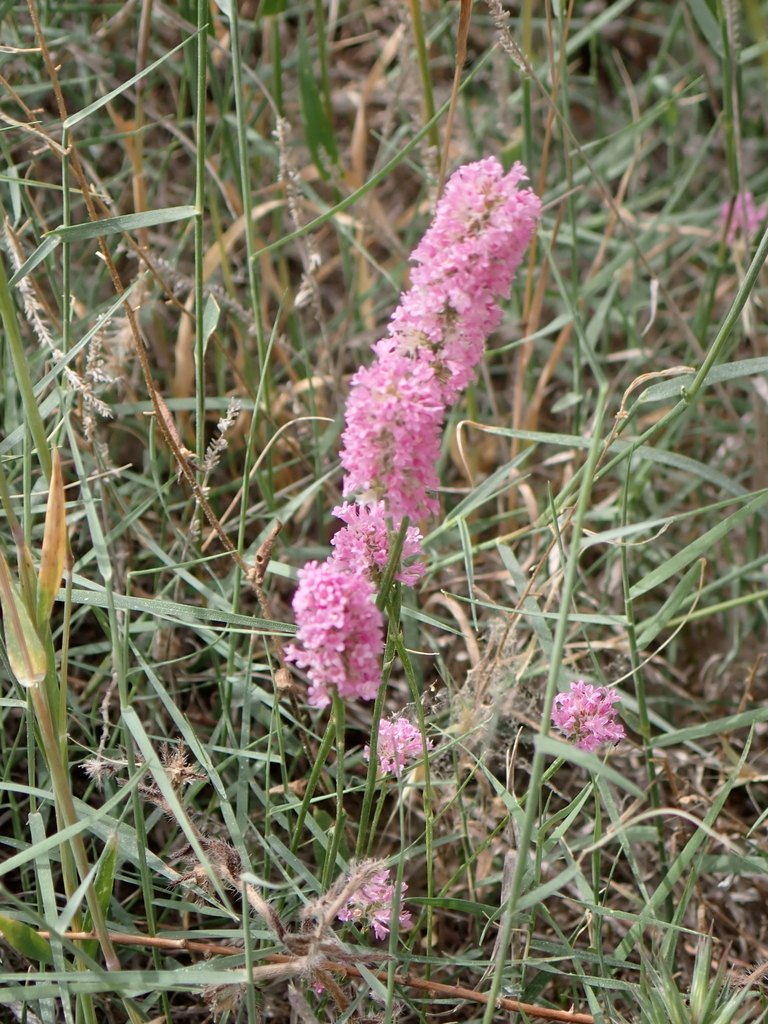
Russian statice looks less like a flower than a pink bottlebrush on a wire. Limonium suworowii is a slender plant of thirty to sixty centimetres from the salt steppes of Central Asia, sending up dense, unbranched spikes crowded with tiny papery florets from pale green, blade-like foliage.
Each spike is a rod of overlapping rows, the little florets packed so tightly that the whole thing reads as one soft plume in rose to lavender. The colour lives in the dry calyx rather than the petals, so cut spikes keep it for years instead of days.
Eduard Regel described it in the 1870s as a Statice and dedicated it to Suvorov. Kuntze swept most Statice species into Limonium in 1891, and recent floras of Central Asia pull it again into a small separate genus, Psylliostachys. Trade still sells it as Limonium suworowii, and the name works.
Its native ground runs from Kazakhstan and Uzbekistan through Turkmenistan to north-east Iran and Afghanistan, on salty or alkaline flats that flood in spring and bake hard in summer. That niche explains its behaviour in cultivation: it wants the flood-then-drought rhythm and has little patience for rich, moist soil. Its nearest neighbours on the list are Limonium tartaricum, Limonium sinuatum and Plumbago.
Science & Biotechnology
The salt-flats habit is real physiology. Plants of these basins push excess salt back out through glands on the leaves, a trait the whole leadwort family shares, and the papery calyx is likewise an adaptation: it stays on the plant after the seed is set and shields the seed through the dry season.
In bloom the spikes serve a mixed crowd of small bees and flies that work the rows bottom to top, and the florets open over several weeks so a single plant is never out of service. Public field records put the flowering peak in April and May in its home range and early summer in northern gardens.
The one-seeded fruits sit cupped in the persistent calyx and shake free only when the spike is fully dry. Gathered at that moment the seed is clean and short-lived in storage, best sown within a year, which suits a plant whose wild strategy is to germinate on the first spring flood.
Uses & Benefits
It is grown almost entirely for the dried-flower trade, where the spikes stand as permanent colour without a drop of dye. Cut once the whole spike is out but before the lower florets shed, hang it upside down in a dark, dry room, and the pink holds for several years. Wrap bundles loosely so air reaches every spike and mould never starts.
Fresh, the stems are wiry and mess-free in the vase, pairing with anything and taking up little space. Florists use them as line material in country-style bunches. Gardeners value a third thing: the plant itself, which flowers its first year from seed and tolerates the poorest corner of a dry bed.
There is no culinary or medicinal use to report and no particular pest. The honest limitation is aesthetic: after rain the spikes flop and tangle, and on rich soil they grow tall and split into stems. Poor ground is not a compromise for this plant but the correct growing condition.
Growing from Seed
Sow indoors six to eight weeks before frost at eighteen to twenty-one degrees, germination in two to three weeks, or direct in spring once the soil warms. Transplant young; older plants root deep and resent the move. Space twenty-five centimetres in full sun. Pinching once at ten centimetres doubles the spike count.
Care is mostly subtraction: no feeding, no coddling, and water only in the worst drought. It stands wind, stands salty spray in coastal gardens, and shrugs off the alkaline soil that stunts other annuals. Overwatering or heavy clay will kill it faster than any pest. In coastal plots it often outlives the perennials beside it.
For seed, let the spikes brown completely on the plant, then strip the florets into a tray; each carries its cup-shaped calyx, which sifts out easily. Store cool and dry and resow the next spring. A dry corner of the garden usually self-sows a thin generation without any help.
Our Take
Our take: this is the most forgiving dried flower we know. It costs a packet, grows on contempt for rich soil, and yields armfuls of permanent colour from a single sowing. Anyone who has bought pink statice by the bunch can cut the habit out at the source.
Its narrowness is also its character: it does one thing, pink spikes for the dry garden and the drying room, and does it every year without fail. Give it sun, poverty and space and it will not disappoint; give it pampering and it will.
Related Reading
More species in the same orbit as Russian Statice: