


Plumbago Seeds | Cape Leadwort
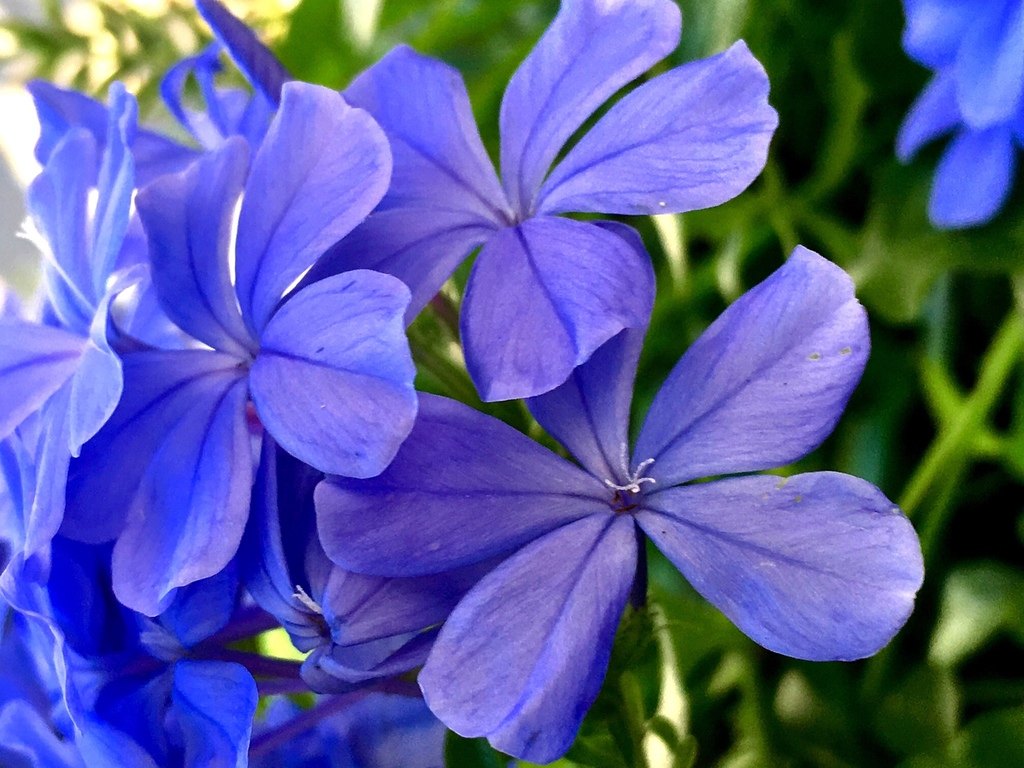
LATIN NAME: Plumbago
COMMON NAME: Cape Leadwort
Plant Profile
Plumbago is a genus of about twenty species of scrambling shrubs and perennials in the Plumbaginaceae, native to warm parts of Africa, Asia and South America. Two are grown widely: Plumbago auriculata, the blue plumbago of South African gardens, and P. zeylanica, the white-flowered species of the Old World tropics. Both have become weeds of disturbed ground far outside their range.
The name has been explained in two ways. One is from the Latin plumbum, lead, for a plant once thought to cure lead poisoning; the other is for the lead-grey colour of the flowers in some species. Both stories are old and neither is documented. The plant has carried the name since the Renaissance.
The genus climbs by long, whippy stems rather than by tendrils, and it will scramble through a shrub or over a wall with equal enthusiasm. The leaves are alternate, oval and soft. The flowers are borne in a terminal spike, each with a long tube and five spreading lobes in a clear pale blue.
Plumbago auriculata was described by Lamarck in 1792 from Cape material, and the epithet refers to the small auricles at the base of the leaf. It has been grown in Europe since the seventeenth century and it ranks among the oldest South African ornamentals in the trade. It was grown at the Cape before that, around the Company gardens.
Science & Biotechnology
The family is small and chemically distinctive, and Plumbago is its type genus. The plants make plumbagin, a yellow naphthoquinone behind most of the medicinal reputation of the group and much of its toxicity. Laboratories are testing it against several kinds of cancer cell. It is also a skin irritant and a purgative.
The sticky stems carry glandular hairs that trap small insects, and the traps are not food. Nothing about the plant is carnivorous; the hairs defend against herbivores and ants. The same glands give it the resinous smell and the tendency to catch dust. A small distinction, and a real one.
The flower has a long tube suited to long-tongued insects, and the stigma is receptive before the anthers of the same flower open, which promotes crossing. Hawkmoths and large bees do the work in its native range. Elsewhere it sets little seed and spreads by suckers instead, which is why it can be a weed in one place and a shy seeder in another. Related plants on the list: Limonium suworowii, Limonium sinuatum and Persicaria capitata.
Uses & Benefits
Plumbago auriculata is grown for late summer and autumn, when the pale blue flowers arrive and hold until frost. It is used on walls, in large containers and as a scrambling groundcover in mild climates, and it will climb a trellis to two metres. The colour is almost unmatched among autumn shrubs. Only the ceratostigmas come close.
Plumbago zeylanica is the species of the pharmacopoeia, its root used in Ayurveda and in Chinese medicine against skin disease and intestinal worms. Plumbagin is a potent irritant and a purgative, and the plant should not be taken without supervision. The margin between a dose and a poison is narrow. The whole history of the genus sits in that sentence.
The genus has no food use. Gardens in warm climates grow it, and cool ones give it a sheltered wall, where it dies back to the root in winter and returns late. In cold gardens it lives in a pot, overwintered frost-free. Either way it wants sun, and something to sprawl through.
Growing from Seed
Sow in spring at twenty degrees, after soaking the seed for a few hours, and expect germination in three to four weeks. The seedlings grow quickly and need pinching to make a bushy plant rather than a single whip. They flower in their second year from an early sowing. The seed is large enough to handle easily, which is a small mercy.
Plant out in full sun and any well-drained soil, against a wall or through a shrub that can take the weight. Water until established and then only in drought. In frosty climates, lift and pot the plants in autumn, or take cuttings as insurance in late summer. Cuttings root in water or in a sandy mix.
Prune hard in early spring, cutting back to a low framework, because the flowers come on new growth. Repeated cutting keeps it as a shrub; left alone, it scrambles. Feed lightly, since rich soil produces leaf at the expense of flower. Most shrubs grown for flowers on new wood behave the same way.
Our Take
Plumbago carries two reputations, and both are deserved. In the garden it is a soft blue haze in September; in the pharmacy it is a drug with a sharp edge. The same molecule is behind both. That is not unusual in this family, but nowhere is it better documented.
Grow the blue one for the flowers, and leave the white one to the physicians. Both climb, and both tell you when they are unhappy. The blue one makes the better garden plant, and it is also the more tolerant.
Related Reading
Readers interested in Cape Leadwort frequently explore these as well: