


Catharanthus roseus Seeds | Madagascar Periwinkle
LATIN NAME: Catharanthus roseus
COMMON NAME: Madagascar Periwinkle
Plant Profile
Madagascar periwinkle grows on the dry western coast of its island, in sandy soil behind the beach and along the edges of scrub that never quite closes. It reached India before 1800, the Philippines by the 1850s and Brazil with the Portuguese trade, so that every tropical country now has it along roadsides and most people assume it belongs everywhere except the one place it does.
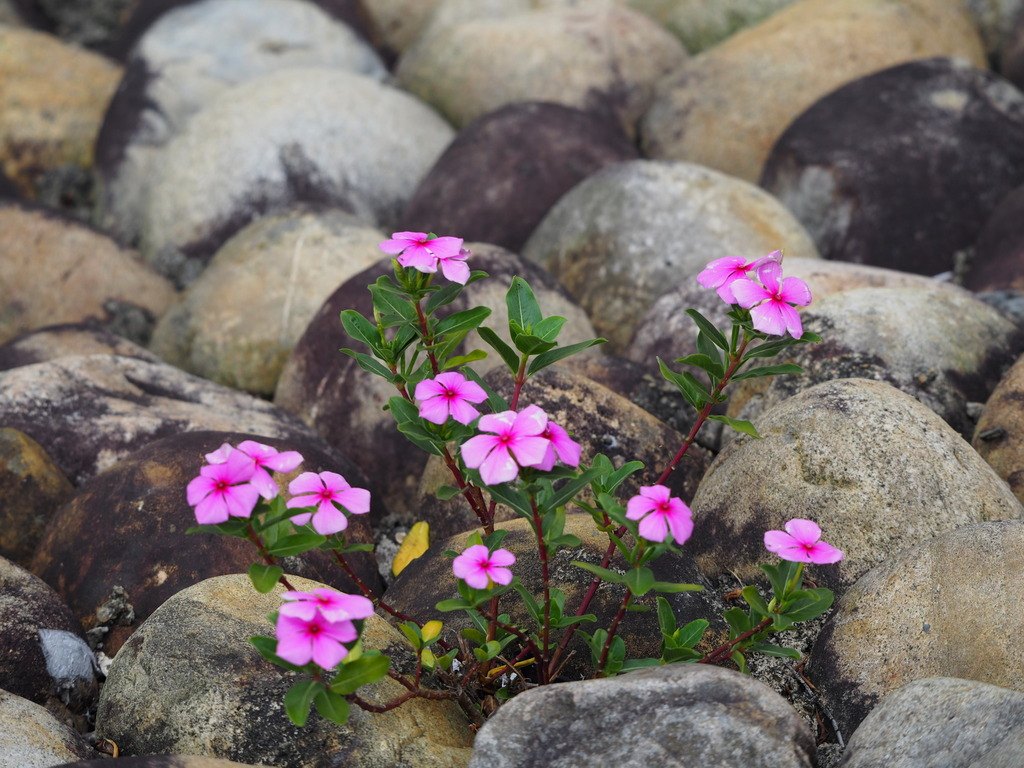
The plant is a subshrub with a woody base and soft green stems, 30 to 100 cm tall, branching from the base. Leaves are opposite, glossy, ovate to oblong, 5 to 9 cm long. Flowers are solitary or paired in the leaf axils, five-petalled, 2.5 to 4.5 cm across, with a narrow tube 2.2 to 3 cm long and a small eye of deeper colour at the centre.
The wild flower is rose-pink with a crimson eye; a white form, f. albus, occurs naturally and is common in cultivation. Fruits are pairs of slender follicles 2 to 4 cm long, splitting to release black seeds about 2 mm long, roughly 700 to the gram. In frost-free climates it becomes a woody shrub; in temperate gardens it is an annual that looks better in August than in June.
Science & Biotechnology
The plant makes more than 130 monoterpene indole alkaloids, but the two that matter are present in vanishing amounts: vinblastine at about 0.0002 per cent of dry leaf weight, vincristine at roughly a tenth of that. Producing a single gram of vincristine takes in the order of 500 kg of dried leaves, so the drug costs thousands of dollars per dose and why supply has repeatedly run short.
Chemistry found a way around the shortage. Both compounds are dimers assembled from two simpler alkaloids, catharanthine and vindoline, which are far more abundant in the plant. Coupling them in the laboratory, first by Pierre Potier’s group in France in the 1970s and later with enzymes, gives a semisynthetic route that uses the plant’s cheap raw material and skips the rare final step.
In 2022 a Stanford team led by Christina Smolke rebuilt the whole pathway, some thirty enzymes, in brewer’s yeast. The yield was tiny, well under what a field of periwinkle produces, but it proved the route can be moved out of the plant.
Uses & Benefits
The plant entered medicine by accident. In the 1950s Robert Noble and Charles Beer at the University of Toronto were testing extracts for a supposed effect on blood sugar in diabetic dogs when the animals developed a sharp fall in white blood cells. The cause was a dimeric indole alkaloid, vinblastine, and its close relative vincristine, both of which bind tubulin and stop cells dividing.
Eli Lilly brought vinblastine to market in 1958 as Velban for Hodgkin lymphoma, and vincristine in 1963 as Oncovin. Combined with other drugs, vincristine helped push the cure rate for childhood acute lymphoblastic leukaemia from under one in ten in the 1960s to around nine in ten today.
In the garden it is a workhorse for heat. It flowers from late spring to frost, tolerates drought, and takes reflected heat that would scorch petunias. The Pacifica and Cooler series are compact, 25 to 35 cm, and come in white, pink, rose, lilac and a red that fades to magenta in strong sun. Cora is notable for resistance to the fungal wilt that kills older strains in humid summers.
The whole plant is toxic. Every part contains the same alkaloids used as drugs, at concentrations that cause neurological and bone-marrow damage in people and pets. It should not be planted where small children pick flowers to eat. Gloves help when cutting back.
Growing from Seed
Sow indoors six to eight weeks before the last frost, at 20 to 24 °C. The seed needs light, so press it onto the surface and water from below rather than covering it. Germination takes 14 to 21 days and is uneven; a tray that looks a failure at day twelve often comes up in the third week.
Seed loses viability quickly. Stored cool and dry it is good for a year or two; in a sealed packet in the freezer, three. Fresh seed from a ripe follicle germinates in a fortnight at 24 °C, and the seedlings grow fast.
Seedlings resent root disturbance. Sow into individual cells or peat blocks and transplant while the first true leaves are still small. Once planted out the plants sit still for two or three weeks and then grow fast; flowering begins ten to twelve weeks from sowing and continues until the first frost. Below 10 °C growth stops, and a cold snap in May sets them back by a month.
Our Take
This is the best bedding plant for a hot, humid summer and a mediocre one for a cool, short one. In the southern United States, the Mediterranean and southern China it flowers for eight months; in a northern garden sown in April it gives six weeks. Start it early under lights if your season is short.
Grow it in full sun, in any soil that drains, and do not feed heavily; rich soil gives leaf and few flowers. Water it for the first month, then leave it alone. The one thing to plan for is the toxicity. It belongs at the front of a border and the back of a balcony, not in a garden where a two-year-old grazes.
Related Reading
More species in the same orbit as Madagascar Periwinkle: