


Penstemon eatonii Seeds | Firecracker Penstemon
LATIN NAME: Penstemon eatonii
COMMON NAME: Firecracker Penstemon, Eaton’s Penstemon
Plant Profile
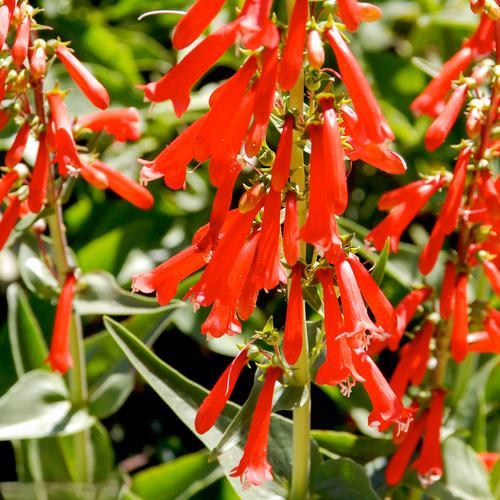
Firecracker penstemon is a clump-forming desert perennial of rocky slopes and canyon walls in the Mojave and Sonoran deserts. It grows between about 900 and 2,700 metres, usually where the ground is gravel, scree or broken rock with almost no litter, and it survives there on winter rain alone. The plant makes a flat rosette of thick, blue-green leaves, then from late April sends up several slender stems to roughly 90 cm, each carrying a one-sided spike of scarlet tubes three centimetres long. The flowers are built for hummingbirds: long, narrow, and holding enough nectar to make a visit worth the flight. After flowering the plant sets a heavy crop of small angular seeds and then dies back within three or four years, leaving seedlings on bare ground. In mild districts the rosette stays green through winter and looks like a small cabbage until the stems rise.
Science & Biotechnology
Penstemon eatonii sits in the plantain family, in a group of desert species with red, bird-pollinated flowers, and it is one of the most drought-tolerant members of a genus of roughly 280 species. Penstemon is unusually broad in its pollination: some species are worked by bees and carry blue or purple flowers on a wide landing lip, while the red ones have a narrow tube and exserted anthers that dust a hummingbird’s forehead. Firecracker penstemon is self-compatible but sets more seed when a bird works the spike, and its flowering is timed to the spring movement of hummingbirds through the desert. The fruit is a two-chambered capsule that splits at the tip when dry, and the seed has no wing or hook, so most of it lands within a metre of the parent. Wild populations are often small and patchy, and the species depends on disturbed, open ground for recruitment. Where its range overlaps other red penstemons it hybridises freely, and some garden seed is of mixed origin.
Uses & Benefits
Firecracker penstemon is planted for early scarlet colour in dry beds, at a season when very little else is out, and for the hummingbirds that arrive with it. It is also a standard component of desert restoration mixes, drilled onto road cuts, mine edges and burned ground where irrigation is impossible. The plants establish fast from seed and hold soil with a deep root system while slower shrubs and grasses come away. In a border it belongs at the front of a dry bed, where its short season can be followed by something with late flowers, and it should not be cosseted: rich soil and summer water shorten its life and invite crown rot. Stems picked as the first buds open last a week in water. Seed is easy to collect, because the capsules on a spike ripen together and a paper bag tied over the stem catches most of it.
Growing from Seed
Sow in autumn, or give the seed eight weeks of cold, moist stratification in the refrigerator; fresh seed will germinate without it but far less evenly. Surface-sow, since light helps, and press the seed into the mix rather than covering it. Use one part loam, one part compost and two parts grit, keep the tray at about 18 degrees, and water from below. Germination runs over three to six weeks and often continues after the first seedlings are lifted. Prick out into deep tubes, because the taproot resents disturbance, and plant in autumn so the roots can work before summer. Pick the sharpest, sunniest site you have, on a slope or a raised bed, and set the crown slightly proud of the soil. Water through the first summer only. After that, leave the hose off; a plant that is watered in July usually dies in its second winter.
Our Take
A scarlet desert penstemon that gives one good spring and then hands the ground to its own seedlings. Drainage matters more than anything else.
Related Reading
More species in the same orbit as Firecracker Penstemon: