


Achillea millefolium Seeds | White Yarrow
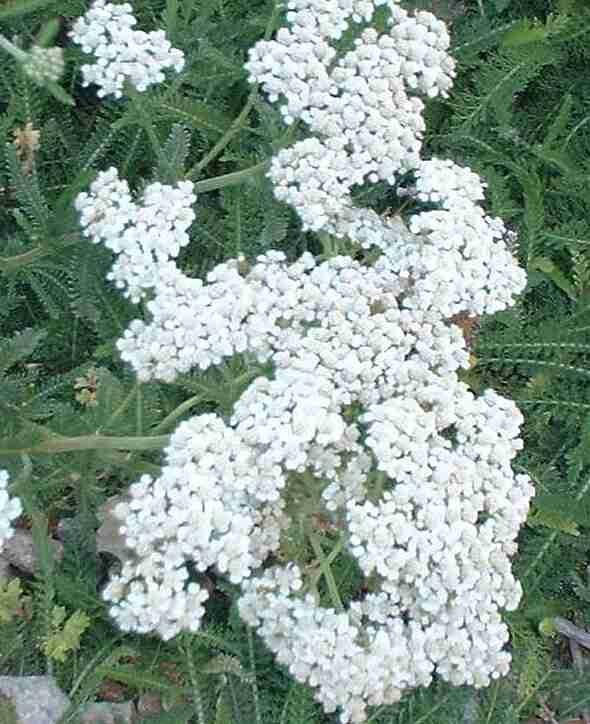
LATIN NAME: Achillea millefolium
COMMON NAME: White Yarrow
Plant Profile
Yarrow is a tough, shallow-rooted perennial of the daisy family, with finely divided, feathery leaves and flat-topped heads of small white flowers held at about 60 cm. The species is variable across its huge range, and the white form sold for gardens is the one with the strongest medicinal reputation and the tidiest habit.
Flowering runs from June to September, and the heads are not single flowers but clusters of dozens of tiny florets, which is why they attract such a wide range of insects: short-tongued flies, small wasps, hoverflies and beetles all find something to eat in a flat head. The seed heads hold their shape into winter and look well frosted.
The plant spreads by rhizome as well as seed, forming a loose mat over a few years. On thin grass and poor soil it stays compact and grey-leaved; in a rich border it grows taller and looser and needs staking. Its wild range covers almost the whole northern hemisphere, from sea level to alpine pasture.
Science & Biotechnology
Yarrow contains a long list of active compounds, including the alkaloid achilleine, sesquiterpene lactones, flavonoids and a volatile oil with camphor and chamazulene. Achilleine is the basis of its old reputation as a styptic, and the plant was carried to battlefields for that purpose long before its chemistry was understood. The oil is blue when distilled, from chamazulene formed during the process.
The plant is also a reservoir for beneficial insects. Aromatic margins of yarrow and umbellifers are used in orchard and vineyard planting to shelter predatory hoverflies and parasitic wasps, and the flat flower heads give them nectar at a reachable depth. That is applied ecology rather than folklore, and it is the best argument for growing yarrow at the edge of a fruit plot.
One caution worth knowing: contact with the foliage can cause photosensitivity and dermatitis in some people, and the plant should not be taken internally in pregnancy.
Uses & Benefits
In the garden, white yarrow is a filler that holds a border together in high summer, and its grey-green foliage contrasts well with broad leaves. It dries well and holds its colour if cut when the heads are fully open and hung in the dark. The plant is also a workhorse for green roofs, dry banks and wildflower mixtures, where its drought tolerance and rapid establishment are more useful than any ornamental quality.
The young leaves are edible in small quantities, bitter and aromatic, and were once used to flavour beer and cheese. The flowers can be used as a garnish. Herbal use centres on the dried flowering tops as a bitter tonic and a traditional wound herb, and it remains one of the most widely sold herbs in Europe.
Growing from Seed
Sow on the surface at 18-21°C; the seed germinates in ten days to two weeks and needs light, so press it in rather than covering it. The seedlings are vigorous and transplant well, but they also cross freely, so isolated plants are needed if a particular colour is wanted.
Set out at 30 cm apart in full sun on any soil that drains. Water only until established. To keep a clump tidy, lift and divide it every third year, discarding the woody centre, and cut the stems to the ground after flowering if self-sowing would be a nuisance. In a meadow the plant can be left to seed and will spread without help.
Our Take
Not a plant for a manicured border, but a hard-working one for dry ground, for insects and for anyone who wants a flower that keeps going through August.
Related Reading
Gardeners who grow White Yarrow often pair it with these related subjects: