


Allium schoenoprasum Seeds | Chives
LATIN NAME: Allium schoenoprasum
COMMON NAME: Chives
Plant Profile
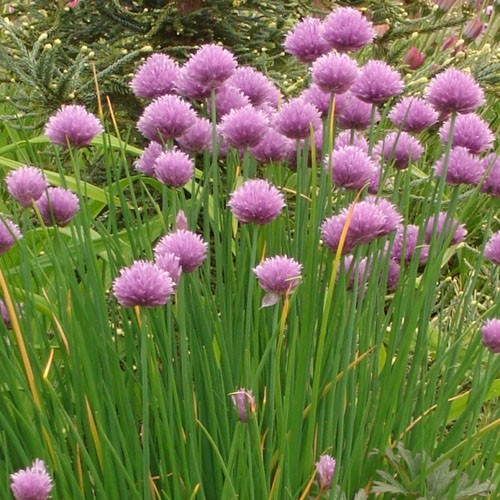
Chives holds a quiet record among its genus: it is the only Allium native to both the Old World and the New, ranging across northern Europe and Asia and well into North America, a distribution that points to a shared Beringian ancestry rather than human introduction. It is a clump-forming perennial with slim, hollow, grass-like leaves and rounded, pom-pom heads of pale lilac, star-shaped florets on leafless stems in early summer, and the whole plant carries the mild onion scent released the moment a leaf is cut.
The hollow leaves are a real morphological clue: unlike the flat blades of garlic or the solid stems of many onions, chives store little and live for the season from a small bulb cluster, which is why the clump thickens year after year without forming a single fat bulb. That clumping habit also makes chives one of the easiest alliums to lift and divide, and the slender leaves photosynthesise efficiently even in cool northern light.
Science & Biotechnology
Biotechnologically, chives are a straightforward subject for micropropagation by shoot-tip and meristem culture, useful for clean stock of virus-free planting material, and the alliinase pathway is a textbook system for studying sulphur metabolism in the genus. Such work explains why supermarket packs of chives can be uniform and disease-free even when field soil carries viruses that would dull a home-divided clump.
Uses & Benefits
The onion smell is not present in the intact leaf. The flavour arises when cells are broken and the enzyme alliinase meets odourless sulphur precursors, mainly S-alk(en)yl cysteine sulphoxides such as isoalliin and methiin, converting them into the volatile sulphides and thiosulphinates that we smell and taste. Chives are comparatively mild because the precursor mix is lower in the pungent species found in garlic and onion, and because the thin leaves hold less total material. The pink-violet flower heads contain anthocyanin pigments and are themselves edible, with a gentle onion note and a pretty look in salads.
Use chives with scissors: snip the leaves straight into potato, egg, and cream dishes, into a soft cheese, or over a spring soup, where the mild bite suits delicate food better than harsher onions. The flowers are decorative and edible, scattered over a plate or infused into a pale pink vinegar. In the garden the bloom heads are a magnet for bees, and a clump at the edge of a vegetable bed pulls pollinators while marking the boundary. Chives also return reliably each year with almost no care, which makes them a first herb for new gardeners and a dependable edging for the potager.
The flower heads are steeped to make chive-blossom vinegar, a pale pink infusion that carries the gentle onion note into dressings, and across Russia and central Europe chives are stirred into sour cream and soft cheese as a near-daily herb. Because the flavour is mild, the leaves are best added at the end of cooking or raw, since long heat dulls the subtle sulphur compounds that make chives distinct from their pungent relatives.
Growing from Seed
Sow the seed thinly on the surface of a moist seed compost and cover with a dusting of 3 to 5 mm of fine material, then keep the medium evenly damp. Transplant or thin seedlings once they carry four to six true leaves, setting clumps about 15 to 20 cm apart so the tufts fill in over a season. Chives take full sun to light shade and any reasonable, well-drained soil; they are unfussy about fertility but respond to a spring feed with a flush of leaf. Keep the clump watered in dry spells and cut the leaves back to a few centimetres after flowering to push fresh, tender regrowth. Lift and divide the thickening clump every three or four years to keep it vigorous and to stop the centre from dying out. Watch for onion fly and for rust on the leaves in damp summers, and remove affected foliage promptly so the spore load does not build on neighbouring clumps.
Our Take
I keep a chive clump by the kitchen door and a second one just for the bees; dividing every few years keeps both happy. For more alliums see Garlic Chives, Onion, and Welsh Onion.
Related Reading
Gardeners who grow Chives often pair it with these related subjects: