


Trigonella foenum-graecum Seeds | Fenugreek Foenum Graecum
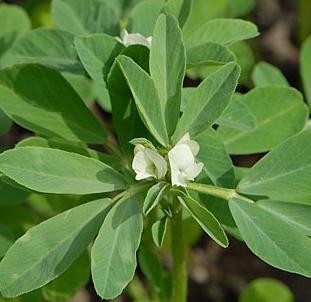
LATIN NAME: Trigonella foenum-graecum
COMMON NAME: Fenugreek
Plant Profile
Crack a fenugreek seed and the first scent is warm, sweet, and oddly like maple syrup or burnt sugar, a smell that surprises first-time cooks. The compound behind it is sotolone, 4,5-dimethyl-3-hydroxy-2(5H)-furanone, present in both the seed and the leaf, and it is the same molecule that gives a faint maple note to aged rum and some cheeses. Fenugreek is therefore two herbs at once: the dried seed that anchors curry blends, and the fresh leaf, methi, cooked as a green across the Indian subcontinent.
Trigonella foenum-graecum is a short annual legume, 20 to 60 cm tall, with the trifoliate leaves typical of its family, three obovate leaflets that smell of the seed when crushed. Pea-like flowers are pale cream to yellow, followed by long, slender pods with a beak that curves upward and holds ten to twenty hard, rectangular seeds in an amber-to-russet tone. The genus name Trigonella refers to the three-cornered corolla; the species name foenum-graecum means “Greek hay,” a nod to its old use as fodder.
The plant was domesticated in the Near East and the Transcaucasus and has been found in archaeological layers of Bronze Age China and Egypt. Today it is grown widely in India, Pakistan, Egypt, Ethiopia, and the Mediterranean, thriving in sunny, well-drained ground that stays warm and dry through a short growing season.
Though a legume, fenugreek is grown for seed and leaf rather than the pod, and its nitrogen-fixing nodules still enrich the soil like any bean. It is easily told from clover by the beaked, strongly angled pod and the maple-scented leaf.
Science & Biotechnology
The seed is a small pharmacy. It contains 4-hydroxyisoleucine, an unusual amino-acid derivative studied for its role in stimulating insulin secretion in cell and animal models, and diosgenin, a steroidal sapogenin that served for decades as the starting material for semi-synthetic progesterone and other steroid hormones. These are the compounds that keep fenugreek in nutrition and pharmaceutical research.
The seed coat is rich in galactomannan, a soluble fiber that swells into a gel in water. Food technologists value it as a thickener and stabilizer, and the same mucilage is why soaked seeds turn slimy, a property used in hair and skin preparations as well as in traditional poultices.
Because diosgenin and the aroma compounds are valuable, researchers raise fenugreek in callus and cell-suspension cultures to push secondary-metabolite yields without a field. Conventional breeders meanwhile select for larger seed, lower bitterness, and uniform pod set, using marker-assisted lines to speed the work.
Fresh methi leaves are boiled, sauteed with potato, or folded into flatbread dough. The small leaves carry the same scent at lower intensity and add a bitter, savory depth.
Uses & Benefits
Toast a teaspoon of seed in a dry pan to soften the bitterness, then grind it into curry powder, berbere, or a pickle masala. The toasted seed pairs with cumin, coriander, and turmeric. A pinch of ground seed also replicates a maple note in baked goods and syrups.
Beyond the kitchen, the seed appears in traditional preparations aimed at blood-sugar balance and milk flow in nursing mothers, with 4-hydroxyisoleucine the most-studied active. Such uses belong to tradition and ongoing research, not to medical claims.
Growing from Seed
Sow into a light, well-drained seedbed or a deep module, covering the seed with about 1 to 2 cm of fine soil so it stays dark but not buried deep. Warm soil and full sun suit it; keep the surface evenly moist until seedlings break through.
After the first true leaves unfold, thin clusters to a single strong plant and space rows or stations 15 to 25 cm apart. Crowding lowers air flow and invites mildew on the dense foliage.
A legume needs little nitrogen; a phosphorus-rich start helps pod set. Cut the tops when pods yellow and the lower ones rattle, then dry the stalks before threshing the seed. In cool gardens, grow it as a short-season annual and pull the plants at first frost.
Our Take
Fenugreek rewards the cook more than the tidy gardener, because the pods are messy and the leaves scent everything they touch. Grow a short row, toast what you harvest, and save the rest for curry.
Related Reading
More species in the same orbit as Fenugreek: