


Verbena hybrida Seeds | Garden Verbena
LATIN NAME: Verbena hybrida
COMMON NAME: Garden Verbena
Plant Profile
The name covers a swarm of hybrids rather than one plant. Low creeping species supplied the trailing habit, taller upright ones the flower heads and colour, and species with finely divided foliage contributed the lacy leaves of some older strains. Because the group is defined by horticultural origin, no native range can be given, and the closest it comes to a wild population is the gene pool of its parents.
Verbena incisa and Verbena peruviana are the two names most often cited as ancestors, with Verbena phlogiflora and Verbena tenuisecta contributing to particular lines. All four are South American, several are prostrate and mat-forming, and between them they carry the white eye and the magenta and scarlet tones breeders have recombined ever since. Older selections were raised as seed strains; the modern trade relies on vegetatively propagated clones.
Trailing forms make long flexible stems that hang over a basket rim or spread across paving, and mounded forms build a compact upright crown for bedding. The trailing group has been pushed toward sterility, so the plants never divert energy into seed and keep flowering until cold stops them, while the mounded group is bred for uniformity and an early dense head of colour.
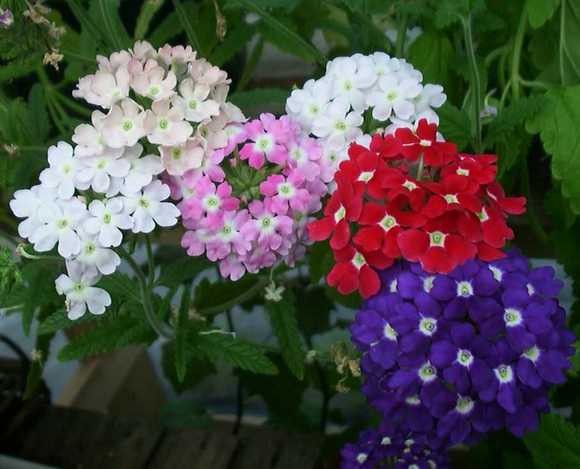
Flowers sit in a dense spike that lengthens as it opens, so an old head becomes a loose cylinder of blooms with the newest at the tip. Each flower is tubular at the base and opens into five lobes, usually with a pale eye at the throat. Stems are square in section and slightly rough with short hairs, and the leaves are opposite and coarsely toothed on the mounded forms.
Inside the tube sit four stamens in two pairs of unequal length, with the shorter pair set lower, and a four-chambered ovary that ripens into four separate one-seeded segments. That division into four dry nutlets is a family trait and a useful one for seed cleaning, since a ripe head separates into individual segments rather than shedding as a capsule. In the sterile trailing clones the ovary rarely fills at all, which is why they flower so persistently.
Science & Biotechnology
The genus is chemically well characterised. Verbena tissues carry iridoid glycosides, with verbenalin and hastatoside the most widely recorded, together with phenylethanoid glycosides such as verbascoside and a range of flavonoids. These compounds have made the genus a favourite subject in screening work on antioxidant and anti-inflammatory activity, and they also give the dried herb its bitter taste. The essential oil of the flowering tops is dominated by monoterpenes rather than by any single component, which is why commercial verbena oil is normally distilled from the lemon-scented relatives instead.
Uses & Benefits
Trailing forms are used in baskets and window boxes, where they should be planted at the rim rather than the centre so the stems can fall freely. Mounded forms work as bedding, as an edging to a sunny path, and as a filler between roses; they also make a good front row in a pollinator strip, since the flat open heads are easy landing platforms for small butterflies and hoverflies. A light trim after the first flush thickens the plant and brings a second wave of flowers.
Growing from Seed
The fungal mildew that coats verbena foliage with white felt is the reason this plant is treated as difficult in humid climates. It develops when days are warm and nights humid, when plants are crowded, and when water sits on the leaves overnight, and it spreads fastest on soft heavily fed growth. The response is a full-sun site with moving air, wide spacing, drip irrigation rather than overhead watering, and a thin mulch to keep soil moisture even. Taking cuttings from clean stock early is more reliable than trying to cure a badly infected batch.
Fill trays with a fine low-nutrient seed compost mixed with an equal volume of vermiculite, press the seed onto the surface and dust it with a thin layer of vermiculite rather than burying it. Water from below and keep the surface just damp. Pot the seedlings on singly once they have their first true leaves, and grow them cool and bright rather than hot and soft, since leggy plants transplant badly. Set plants out about thirty centimetres apart after the last spring frosts, then pinch out the growing tips when the stems reach roughly ten centimetres to force branching. Feed every fortnight with a balanced liquid fertiliser at half strength, and keep the soil evenly moist but never waterlogged; in containers, a gritty compost with slow-release granules suits them better than a rich mix. Hard pruning after flowering, cutting back to about ten centimetres, renews the plant for autumn.
Thrips scar the petals and distort young tips, spider mites thrive in dry glasshouse air, and both are managed by keeping humidity moderate and foliage dry. Garden verbena is a tender perennial, so take tip cuttings from healthy plants in late summer, root them in a gritty mix, and overwinter the young plants frost-free in a bright frame; plants left in the border through a wet winter usually rot at the crown.
Our Take
Treat garden verbena as a sun plant with a drainage problem to solve, and it becomes far easier than its reputation suggests. I use the trailing clones in baskets and let the tall purpletop verbena stand behind them so the bed has height as well as carpet, and in a herb border the old medicinal vervain, Verbena officinalis, gives the genus a wiry character by contrast. Where the ground stays damp I plant blue vervain instead, and I keep lantana for the same wall, since it takes the heat that makes verbena sulk.
Related Reading
Gardeners who grow Garden Verbena often pair it with these related subjects: