


Psychotria mucosa Seeds | Psychotria
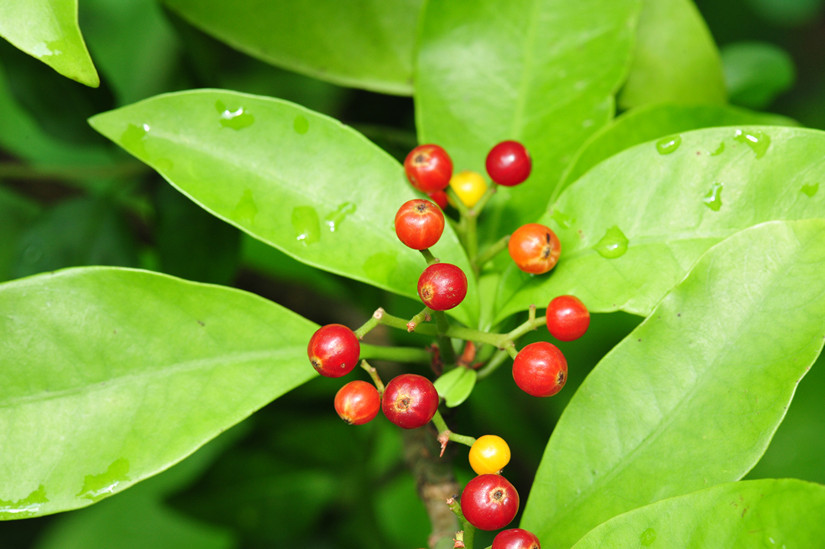
LATIN NAME: Psychotria mucosa
COMMON NAME: Psychotria
Plant Profile
Psychotria muscosa is a Caribbean and Amazonian understorey shrub, and its name is often misspelt in the seed trade as mucosa. It grows in humid forest from Trinidad and the Lesser Antilles through the Guianas and Venezuela to the Amazon basin, in deep shade on acid soils, where it forms a sparse understorey of thin stems and dark leaves. The plant reaches one to two metres, with opposite, slightly fleshy leaves that are glossy above and pale beneath, small white flowers in stalked clusters, and small dark fruits. It is one of the species studied alongside Palicourea colorata in the search for analgesic alkaloids, and its chemistry turned out to be different, with a profile dominated by quinoline compounds rather than the active pyrrolidinoindolines. The epithet muscosa means mossy or cushion-like, and it refers to the low, tufted habit rather than to any moss.
Science & Biotechnology
Psychotria is one of the largest genera of flowering plants, with perhaps 1,400 species, and it has been the subject of a long taxonomic clean-up: many of its species have been moved to Palicourea, Eumachia and other genera, and the process is not finished. The genus belongs to the coffee family and shares its characteristic opposite leaves and interpetiolar stipules, and many species are distylous, with two flower forms that encourage cross-pollination. Psychotria muscosa is a forest understorey shrub whose fruit is eaten by birds, and its seed is dispersed into shaded gaps. Chemically it is rich in alkaloids, and the same study that found analgesic compounds in P. colorata found only inactive quinoline alkaloids in this species, a reminder that a genus can look uniform and be chemically diverse. The species is not a crop and has no recorded food use, and its main interest is taxonomic and chemical.
Uses & Benefits
The plant has a place in local medicine in the Guianas and the Caribbean, where the leaves are used as a poultice and a tea for fevers, and it appears in the ethnobotany of several Amazonian groups. It is not used for pain in the way its relative is, and the difference in chemistry means the two should not be substituted for one another. In gardens it is grown only in tropical collections, as a shade-loving understorey shrub for a humid corner, and it has no ornamental value beyond its foliage. Its seed is sold to collectors and to laboratories rather than to farmers. The plant’s wider importance is as part of the understorey flora that keeps forest soils covered and provides fruit for birds. It is not a species that anyone should gather from the wild for medicine without expert identification.
Growing from Seed
Sow fresh seed, cleaned of pulp, in a shaded pot of leafmould, loam and grit at 22 to 27 degrees, covering it lightly; germination is slow and uneven. Keep the pot humid and out of direct sun, and pot the seedlings on as they develop. Plant out in deep shade in acid, well-drained soil with plenty of organic matter, and mulch with leaf litter. Water regularly but never allow the roots to sit in water. Below ten degrees it suffers, so it wants a frost-free climate or a warm glasshouse. Prune lightly to keep it compact, and feed twice a year with a fertiliser for acid-loving plants. Take cuttings in summer if you want to keep a particular plant, since the species is not long lived in a pot.
Our Take
A shade-loving Amazonian shrub with a name that is regularly misspelt and a chemistry that is not the same as its famous relative.
Related Reading
Readers interested in Psychotria frequently explore these as well: