


Podocarpus macrophyllus Seeds | Buddhist Pine
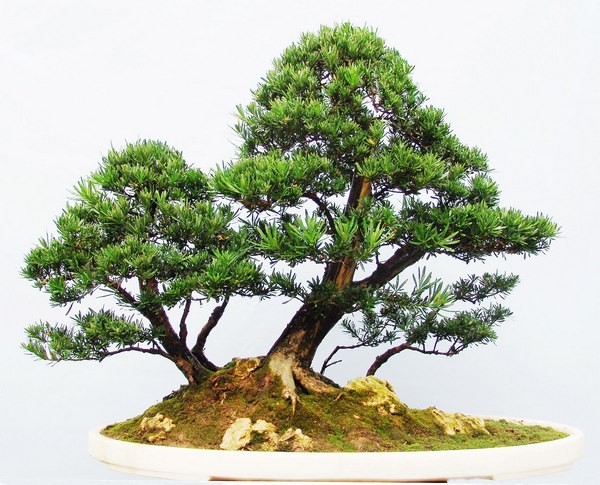
LATIN NAME: Podocarpus macrophyllus
COMMON NAME: Buddhist Pine, Yew Plum Pine, Fern Pine, Kusamaki
Plant Profile
Podocarpus macrophyllus is one of the few conifers that earns a place in the formal garden without a single cone that looks like a cone. Its fruit is a fleshy, blue-violet aril carried on a short stalk, and the true seed sits naked at its base, a throwback to the naked-seed plan that sets the gymnosperms apart from every flowering plant. In Japan and China it has stood for centuries in temple grounds and courtyard gardens, clipped into clouds or left as a dark, upright tree, which is why one of its English names is the Buddhist pine. The leaves are not needles at all but flat, leathery, yew-like blades that stay glossy through the hardest winter.
The species grows as a small evergreen tree or a large shrub, reaching toward twenty metres in the wild but usually kept far smaller in cultivation. The foliage is arranged in two ranks along the branch, each leaf a long narrow blade with a blunt tip and a pale midrib, which gives the whole plant a fern-like, layered look and explains the name fern pine. The bark is thin and grey, and the wood is fine and pale, valued in joinery. Male and female structures sit on separate plants, so only a female tree set near a male will hang the plum-like arils that give the plant its other common name.
Podocarpus is a southern-hemisphere genus, and the close relative Podocarpus nagi shares the edible aril and the garden use. The true yews of the genus Taxus, such as Taxus baccata, echo the look with their red arils but belong to a different family, and their foliage is treated with far more caution. Telling the two apart by the leaf alone is a useful garden skill.
Science & Biotechnology
The genus is chemically distinctive. The heartwood and foliage carry podocarpic acid and related diterpenes that give the plant its resistance to browsing and its characteristic resinous scent when a leaf is crushed. These compounds are of interest to natural-products chemists studying plant defence, and the essential-oil fraction of the foliage has been profiled for sesquiterpenes and monoterpenes. None of this is a reason to chew the leaves; the chemistry is simply why the deer usually leave the hedge alone.
Uses & Benefits
Because named forms such as the narrow-leaved Maki are kept true by cloning, tissue culture from nodal segments is the commercial route to uniform stock. Shoot tips rooted on a cytokinin-rich medium regenerate whole plants that hold the parent’s form, and somatic embryogenesis has been reported for Podocarpus, giving nurseries a clean alternative to slow seed raising. The work matters for bonsai and hedge lines that must look identical row after row.
The Buddhist pine is above all a shape plant: clipped into mounds, trained as a niwaki, or grown as a screen that asks for little once established. In Japan the broad-leaved form, kusamaki, is planted where a finer texture is wanted, while the narrow form, inumaki, makes the classic column. The wood is used for furniture and turnery, and the tree’s tolerance of shearing makes it a staple of the formal evergreen border across warm-temperate cities.
Use it where you want year-round structure without the prickly footprint of a holly or the dropping needles of a pine. A row of matched plants makes a quiet wall, and a single specimen in a pot reads as a small sculpture. Pair the idea with the Cryptomeria japonica for a taller conifer accent, or the deodar cedar where space allows a true giant.
Growing from Seed
What looks like a grape-sized fruit is an epimatium, a fleshy scale that swells around the single seed and turns from green to purple as it ripens. Birds take the sweet aril and drop the hard seed elsewhere, which is the tree’s dispersal trick. The seed itself is a tough, bony nutlet, quite different from the winged seed of a pine, and it is the part a grower sows. Knowing this matters, because the aril rots in the packet while the seed inside stays viable if kept dry and cool.
The bony seed benefits from a cold, moist rest before it is sown, a treatment that breaks its dormancy and lets the embryo move when warmth returns. Sow it in a free-draining, sandy mix and keep the pot cool and shaded through the resting period, then bring it into gentle warmth to encourage the root to show. Patience is the rule: a woody conifer seedling is slow to appear and slower to size up, so do not judge the sowing by a calendar.
Layer the seed in damp sand or a peat-free grit and hold it cool but not frozen, then sow singly so the taproot is not disturbed later. Keep the medium just moist, never wet, because a rotting seedcoat is the usual failure. Once the shoot stands a few centimetres, pot it on by the height of the stem and grow it in bright, indirect light until it is sturdy enough for the open ground or the bonsai tray.
Our Take
I value Podocarpus macrophyllus for the calm it brings to a border that never goes bare. The arils are a gift to the birds, and the clipped form holds a line better than almost any broadleaf I grow. For a conifer collection it sits happily beside the cryptomeria and the cedars already mentioned.
Related Reading
Continue exploring with these related plants: