


Siraitia grosvenorii Seeds | Monk Fruit
LATIN NAME: Siraitia grosvenorii
COMMON NAME: Luo Han Guo
Plant Profile
The shift out of Momordica was not a whim. Botanists moved the monk fruit into Siraitia on the strength of its seed shape, its floral detail, and its biochemical profile, which sit closer to the other Siraitia vines than to the bitter melons of Momordica. The move is a clean example of modern taxonomy catching up with a plant long used before it was named correctly, and it is worth citing because so many old references still point to the discarded name. A buyer comparing seed stocks should expect either spelling on aged material but the same living vine either way.
The plant’s home is the misty karst hills of Guangxi, with Guilin and Yongfu at the centre of its cultivation and its folklore. The warm, humid slopes and the cool nights suit the vine, and the local climate is cited by growers as the reason Guangxi fruit carries the prized sweetness and aroma that copies from drier regions struggle to match. Monk fruit is woven into the regional identity: it is the gift, the tea, and the tonic of the hills, and the name luo han, the arhat or enlightened one, signals the respect the fruit earned in local tradition long before it reached the sweetener shelf.
The oldest use is the simplest: a dried monk fruit cracked into a pot of water and simmered into a sweet, cooling drink taken on hot days or to soothe the throat, and the same fruit flavours soups and broths across the south. Modern use runs to the extract, where mogroside V replaces sugar in drinks and foods for people who avoid it, and the two uses meet in the same molecule. The fruit is a rare case of a traditional tonic and a modern sweetener being exactly the same thing, just prepared at different scales, and the vine that needs a human hand to fruit repays the care with a sweetness no sugar beet can match.
Science & Biotechnology
Luo han guo changed its Latin name and kept its fame. The monk fruit once listed as Momordica grosvenori is now placed in its own genus as Siraitia grosvenorii, a move that left the old seed packets and the old books one step behind the taxonomists. The plant is a perennial climbing vine of the gourd family, with tendrils, heart-shaped leaves, and round green fruit, and the name change reflects its chemistry and its flower structure more than any change in the garden. For the grower the practical point is to read the current label, because the old Momordica name still turns up on seed lists and in recipes written a generation ago.
The reason the dried fruit is prized is a family of cucurbitane triterpene glycosides called mogrosides, with mogroside V as the headline compound and the most abundant of the sweet ones. These molecules are hundreds of times sweeter than sucrose by weight, yet they bring no sugar and no calories, and they hold their sweetness through heat and through drying, which is why monk fruit extract has become a favoured sweetener for those avoiding sugar. The sweetness lives in the flesh and the skin of the round fruit, not in the seed, and the level of mogroside V is what processors measure when they grade a batch for the extract trade.
Most fruits lose their sugar to heat, but luo han guo gains its market value exactly because the mogrosides survive the drying that turns the fresh green globe into the brown, papery fruit of the shop. The traditional product is the whole dried fruit, boiled to make a sweet, cooling tea, and the modern product is the purified extract, but both rely on the same heat-stable glycosides. Because the sweet compounds are not destroyed by the drying heat, a fruit cured centuries ago by the same method would still taste sweet today, and that stability is the chemical quirk that built the crop.
Uses & Benefits
The monk fruit vine sets fruit poorly on its own, because its flowers are built for a narrow set of pollinators and the right insect is scarce in the farmed rows. The famous answer came from Yongfu county, where growers trained crews to walk the trellises and dust the female flowers by hand, carrying pollen from the male blooms on a small brush or on the finger. Hand pollination is slow and personal, but it is why Yongfu became the heart of the monk fruit world, and the image of a person fertilising each flower by hand is as much a part of the crop’s story as the sweetener in the fruit.
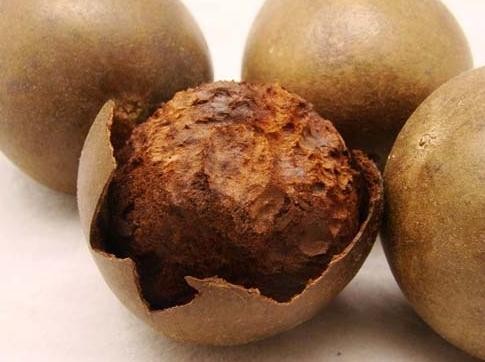
The harvest is the round fruit, picked before it over-ripens and then cured by heat until the skin turns brown and the inside caramelises to a dark, sweet paste. The cured fruit is the traded form, sold whole for tea or milled for extract, and the quality shows in the even colour and the clean, sweet smell with no sour edge. Poor curing leaves a fruit that moulds or tastes green, and the export trade grades hard on this point, so the drying shed, not the vine, is where much of the value is won or lost.
Growing from Seed
In cultivation the vine is trained up a trellis much like a grape, set on a warm, sheltered slope with rich, well-drained soil and a frame the long runners can climb. Plants are spaced so air moves through the leaf canopy, which lowers the fungal pressure that the gourd family invites, and the vine is watered to keep the root zone even without waterlogging the crown. Because the flowers need the human hand to set fruit, the trellis is built at a height a person can walk and reach, and the yearly work is as much pollination as pruning. A vine that reaches the top wire and carries a full leaf canopy is the one that yields the round, heavy fruit.
Our Take
I grow monk fruit for the tea first and the extract second, and the Yongfu hand-pollination story is the part I tell visitors. For the vine itself see the Grosvenor momordica seed page, the Corsvenor momordica seed, the bitter melon seed, and the gac seed for gourd-family cousins.
Related Reading
Continue exploring with these related plants: