


Siraitia grosvenorii Seeds | Grosvenor Momordica
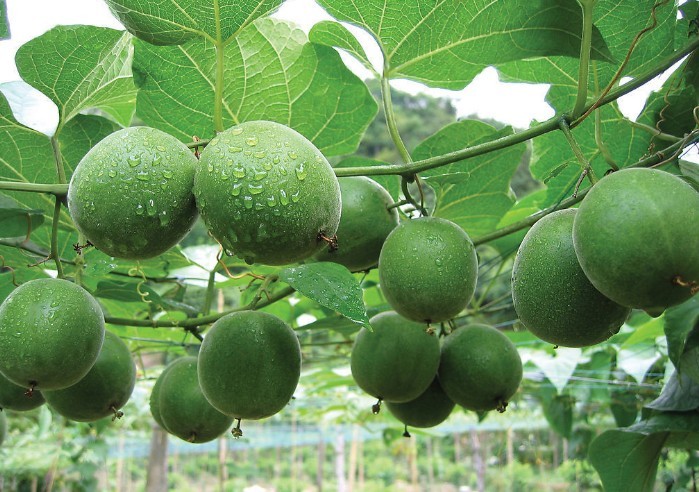
LATIN NAME: Siraitia grosvenorii
COMMON NAME: Luo Han Guo
Plant Profile
The names tell two stories at once. Luo han guo means ‘arhat fruit’, honoring the Buddhist monks — the luohan — long associated with the hills where it grows and with the traditional preparations that simmered the dried fruit for sore throats and coughs. The botanical name honors Gilbert Hovey Grosvenor, president of the National Geographic Society, whose 1930s-sponsored plant exploration helped bring the vine to Western science; Swingle described it, and the plant later moved from Momordica into the genus Siraitia.
Unlike most garden cucurbits, monk fruit separates the sexes onto different plants: some vines bear only male flowers, others only female, so a fruiting planting always needs both. The flowers are small, pale yellowish and bell-shaped, held along a perennial climber that dies back to a tuberous root crown each winter. In its home valleys, natural pollinators handle the job; elsewhere, and under netting, growers hand-pollinate female flowers with male pollen carried on a brush in the morning.
Monk fruit’s rise as a clonally propagated crop began in the tissue-culture lab. The traditional field stock carries a burden of viruses that builds over seasons and saps vine vigor, so Chinese institutes developed meristem-tip culture to clean selections, then multiplied virus-tested plantlets for growers. Tissue culture also sidesteps the seed lot’s gamble on sex ratios, since a tested clone is known female or male before it reaches the trellis. Commercial plantations now anchor themselves on tissue-culture females paired with a known male pollinizer line.
Science & Biotechnology
The mogrosides are cucurbitane-type triterpene glycosides, concentrated in the fruit wall, and they pass through the human gut largely unmetabolized — hence sweetness with no caloric load and little effect on blood glucose. Biosynthetically they climb the familiar cucurbit ladder, from squalene through cucurbitadienol and a series of cytochrome P450 oxidations to the fully decorated, ultra-sweet molecules. That pathway has made Siraitia a biotech celebrity, with research groups screening germplasm for higher glycoside loads and exploring yeast fermentation routes built on the vine’s genes.
Yongfu growers and research breeders have spent decades selecting lines for bigger fruit, higher mogroside content, disease resistance and adaptation to different hill slopes. The published chromosome-scale genome of the species has given those programs molecular markers, and the sex-determining region is now mapped — a practical tool, since being able to sex seedlings genetically turns the seed gamble into arithmetic.
Uses & Benefits
There is a vine in the misty hills around Guilin whose dried fruit is so intensely sweet that a fragment can turn a whole pot of tea into dessert — without sugar, and with essentially no calories. That sweetness comes from a family of compounds called mogrosides, and mogroside V alone tastes several hundred times sweeter than sucrose. For centuries the fruit stayed a local medicine and tea companion of southern China; in the last few decades it became one of the most important natural sweeteners on the international market, hiding in soft drinks and protein bars under the name monk fruit. The plant behind it is a vigorous cucurbit climber, and the mountains near Yongfu still produce the lion’s share of world supply.
The classic product is the whole dried fruit: smooth, tawny-brown shells that keep for years and are cracked into a teapot or simmered into syrups. In Guangxi kitchens the dried fruit sweetens braises and herbal drinks; in Western kitchens, monk fruit extract powder does the same job as a zero-calorie sweetener.
Fresh off the vine the fruit is green and only mildly sweet; the famous flavor appears during curing. Harvested fruit is held warm — traditionally in bamboo baskets over gentle heat, nowadays in low-temperature drying rooms — for a controlled period during which enzymes and slow browning reactions build the mogrosides into their final, concentrated sweetness and turn the shell that familiar brown. Rush the cure and the fruit stays pale and flat; that narrow window, refined over generations in Yongfu, is why authentic luo han guo tastes different from fruit merely dried in the sun.
Growing from Seed
For the home grower the recipe is a perennial trellis crop. Give each vine a sturdy frame — it will run several meters in a season — and deep, humus-rich, moisture-retentive soil with sharp drainage. Start from seed indoors in warmth, barely covered, and transplant once vines carry several true leaves and the weather has settled; expect roughly half of seedlings to be male. Mulch thickly, water steadily through fruiting, cut the dead tops down in winter and let the crown resprout. Hand pollinate mid-morning.
Our Take
Monk fruit is one of the few crops where the botany itself is the hook — a dioecious cucurbit that out-sweets sugar. Its cucurbit cousins make good companion reading: the potent gac fruit, the bittersweet balsam pear, and the wild Momordica subangulata of the same southern hills. Keep both a male and female vine, label which is which the moment it flowers, and save your own seed — but know that only tissue-tested clones will give you a guaranteed fruiting pair.
Related Reading
Readers interested in Luo Han Guo frequently explore these as well: