


Jasminum officinale Seeds | Common Jasmine
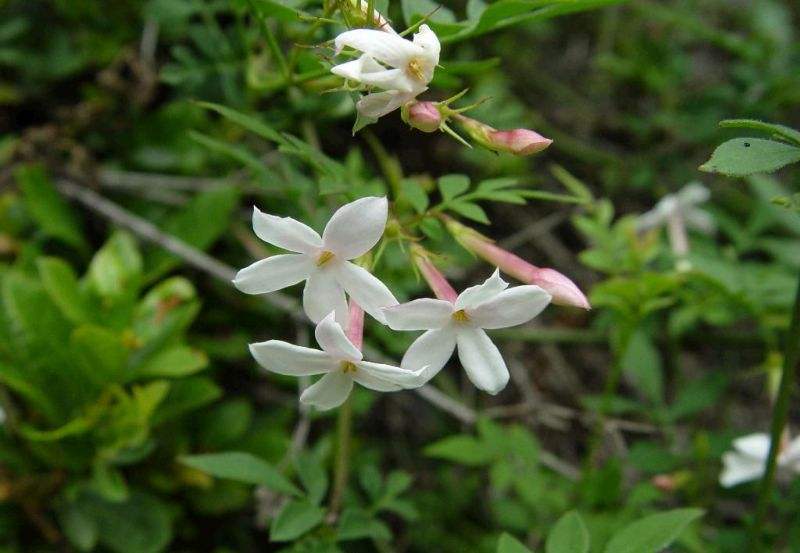
LATIN NAME: Jasminum officinale
COMMON NAME: Common Jasmine
Plant Profile
Common jasmine is a scrambling climber of the olive family from the Caucasus, Iran and the foothills of the Himalaya, grown for flowers that have scented gardens, tea and perfume for two thousand years. It climbs by twining to ten metres, with opposite, pinnate leaves of five to nine leaflets, and from summer into autumn it carries clusters of white, star-shaped flowers that open in the evening and release a heavy, sweet perfume. The flowers are followed by small black berries, though these are rarely seen in cultivation. In the right climate it is vigorous to the point of untidiness, and it needs a frame, a wall or a pergola to climb. It is the national flower of Pakistan and the source of the scent used in jasmine tea.
Science & Biotechnology
The perfume of Jasminum officinale comes from a complex of benzenoid and terpenoid volatiles, chiefly benzyl acetate, linalool and indole, released in a circadian rhythm that peaks at night when the moth pollinators are active. That rhythm continues for a day or two after the flowers are picked, which is why jasmine tea is scented with fresh flowers laid against dry tea leaves overnight. The species is self-incompatible and rarely sets seed in cultivation, where a single clone is usually grown, so propagation is by cuttings. Its diversity in the Caucasus and Iran is higher than in the gardens of Europe, which suggests the cultivated stock passed through a genetic bottleneck. The genus is placed in Oleaceae, close to the true olives, and its flowers are unusual in having only two stamens.
Uses & Benefits
The flowers are used to scent tea, to flavour sweets and syrups, and to make jasmine oil and absolute for perfume. In Chinese and Ayurvedic medicine the flowers are used as a calmative and for skin complaints, and jasmine oil is used in aromatherapy. In the garden the climber is grown on a warm wall, a pergola or a conservatory frame, where its scent can be enjoyed in the evening. It is also a good cut flower, though the blooms drop quickly. The plant is not edible in quantity and the berries are mildly toxic. In cool climates it needs a sheltered, sunny position and may die back in hard winters, regrowing from the base the following spring.
Growing from Seed
Sow fresh seed in spring at twenty degrees, one centimetre deep in a loam and grit mix; germination is slow and often poor, since much of the seed is not viable. The reliable method is softwood cuttings in early summer, rooted in a closed frame with bottom heat. Grow the young plant on in a rich, free-draining compost in a sunny, sheltered place. Plant out against a warm wall with a trellis, or keep it in a large pot and move it under cover for winter. Water well in summer and feed monthly. Prune after flowering, cutting out old wood and tying in new shoots, since the plant flowers on the current season’s growth.
Our Take
The jasmine behind tea and perfume, and a climber that wants a warm wall. Cuttings take far more reliably than seed.
Related Reading
More species in the same orbit as Common Jasmine: