


Laburnum anagyroides Seeds | Golden Chain Tree Hardy Tropical
LATIN NAME: Laburnum anagyroides
COMMON NAME: Golden Chain Tree
Plant Profile
Laburnum anagyroides is a small deciduous tree, typically five to seven metres tall in gardens, with a rounded crown and smooth, green-grey bark that stays silky for many years before cracking. The leaves are trifoliate, each leaflet an oval with a fine silky underside, and they can be mistaken for those of young locusts until the flowers settle the question.
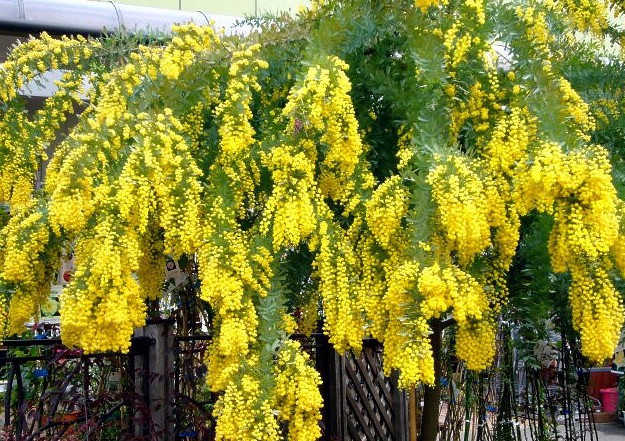
In late spring the tree hangs out its famous chains: pendulous racemes ten to thirty centimetres long, packed with golden, pea-shaped flowers of the papilionaceous type. Long-tongued bumblebees force the keel open to reach nectar and, in doing so, trip the stamens onto their bodies, so pollination is a mechanical event between bee and blossom. The fruit is a flattened pod with a few dark, kidney-shaped seeds. The species is a diploid with 2n = 48, and it hybridises readily with its Alpine relative L. alpinum wherever the two meet, producing the intermediate plants that nurseries later fixed as named crosses.
In its native mountains it grows among beech and pine on limestone hills, often as a small tree of clearings and forest edges, where its light-demanding seedlings establish in gaps. Plants raised from seed differ subtly in flowering time and chain length, which is exactly why clonal selections came to dominate nursery production.
As an ornamental, the golden chain tree is planted as a single specimen on a lawn, as a short avenue, or trained over a walk to form a tunnel of gold in May. It prefers full sun and deep, well-drained soil, including chalk, and it dislikes waterlogged ground. The hybrid Laburnum × watereri ‘Vossii’, a cross with L. alpinum, carries longer racemes and is the most widely sold cultivar in nurseries today.
Science & Biotechnology
Cytisine acts as a partial agonist at nicotinic acetylcholine receptors, occupying the binding site that nicotine would use and blunting its reward. Eastern European medicine manufactured the drug Tabex from laburnum-derived cytisine decades ago, and the molecule inspired the design of newer synthetic cessation agents. Research continues into refined cytisine derivatives, and the tree remains a legitimate source plant for pharmaceutical chemistry rather than a folk curiosity.
The alkaloid load is not uniform: it concentrates in the seeds, runs high in young pods, and shifts with season and plant part, which is why pharmacognosy teams assay batches before extraction. Chemists also study how the molecule’s compact scaffold engages different receptor subtypes, work that keeps laburnum on the shelves of natural-product laboratories.
The same alkaloid is the reason this species never belongs near paddocks or sandpits. Symptoms of poisoning begin with nausea and can progress to convulsions, and there is no safe ‘dose’ of seeds. Chemists extract the alkaloid from seed batches under controlled conditions; gardeners should collect pods only for disposal. Related quinolizidine alkaloids occur in broom and gorse, hinting at the shared chemistry of this branch of the pea family.
Uses & Benefits
Woodworkers prize laburnum timber for its dense, chocolate-brown heartwood, used for veneer, inlay, turnery and small musical instruments, where it has long served as a local substitute for ebony. Horticultural history records an even stranger artefact: the graft chimera +Laburnocytisus ‘Adamii’, created near Paris in 1828 by Jean-Louis Adam, which carries tissues of laburnum and purple broom side by side and flowers in both colours at once, often on the same branch.
Growing from Seed
Give the seeds a cold stratification period in moist sand in a fridge, then sow them about one to two centimetres deep in modules filled with loamy compost with added grit. Keep them cool and just moist; warmth without chilling tends to leave the seeds dormant. Pot on individually once true leaves expand.
Set young trees out when they reach roughly forty centimetres, spacing them six metres apart for avenues or giving a lone specimen at least that much room. Choose sun and soil that never sits wet. Prune only after flowering, and lightly — laburnum resents hard cuts into old wood. Train a single clear trunk early if you want the standard form, and remove basal shoots each summer before they thicken. Aphids and the laburnum leaf miner can disfigure foliage in some seasons, and silver leaf disease can enter through pruning wounds, so use clean tools and avoid winter cutting.
Beekeepers note that the nectar can carry trace alkaloids, so the tree is best enjoyed for its ornamental chains rather than planted beside hives in quantity; the bumblebees that work the flowers suffer no ill effect. Sheltered positions in cold valleys protect the young blossom from late frost, one of the few weaknesses of an otherwise hardy mountain plant.
Our Take
Plant this tree where it can be seen from a window, and educate the household about the seeds on the day you plant it. If you love the look but want a climbing form, the purple racemes of Chinese wisteria offer a twining alternative on strong structures. The taller, longer-chained Alpine laburnum is its closest garden relative, and for another hardy spring tree with pendulous white blooms see Prunus padus. Collect pods promptly after they dry if children visit your garden.
Related Reading
More species in the same orbit as Golden Chain Tree: