


Cinnamomum camphora Seeds | Camphor Tree
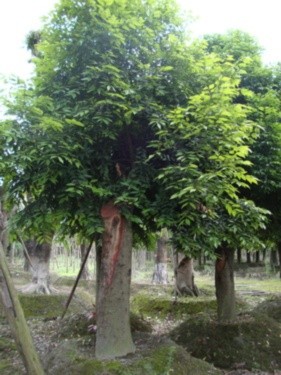
LATIN NAME: Cinnamomum camphora
COMMON NAME: Camphor Tree
Plant Profile
Flowers are tiny, yellowish-white, and gathered in loose axillary panicles that hardly look like flowers at all until you notice the six equal perianth segments typical of the genus. The autumn fruit is a glossy black drupe the size of a pea, seated in the enlarged, cup-like base of the flower stalk. The species has been planted far beyond Asia, becoming a familiar shade tree in the southern United States, the Mediterranean and India, and a serious invader in parts of Florida and Australia.
Separating it from close relatives is a useful exercise. Cinnamomum japonicum and C. chekiangense share the three-veined leaf but differ in leaf texture and the depth of the vein pits, while true cinnamon leaves smell of clove-and-spice rather than camphor; botanists also weigh flower pubescence and fruit shape. The word camphor itself travelled from the Arabic kafur through Latin into every European language, and the species’ synonymy records three centuries of argument about whether it deserved a genus of its own.
Pot on before the young taproot turns at the container base, and move plants to their final position when they stand thirty centimetres or taller, spacing future avenue trees at least eight metres apart. Give full sun, deep soil and room for surface roots away from paving. Prune to a single clear trunk early, feeding moderately through the growing season. Scale insects and leaf-spotting anthracnose are the usual troubles, and both ease with good airflow through the crown.
Science & Biotechnology
Not every camphor tree smells the same. Populations split into chemotypes: Taiwanese distillers long prized the linalool-rich ‘Ho’ leaf oil used in fine perfumery, while other strains are dominated by camphor or by cineole. This variation has made the species a textbook case in essential-oil chemistry and a continuing subject of chemotaxonomic study, and modern work extends to screening its oils for antimicrobial and insect-repellent properties against stored-product pests.
Uses & Benefits
Steam distillation of wood and leaves yields camphor oil, from which the crystalline ketone camphor sublimes out on cooling. Natural camphor from this tree is the dextrorotatory (+)-camphor, chemically distinct in optical rotation from the synthetic product, and the crude oil separates into the well-known white, brown and blue fractions of the fragrance trade. Brown camphor oil carries safrole, a regulated compound, which is one reason the industry now leans on leaf rather than wood distillation.
Camphor has been rubbed, inhaled and burned in East Asian medicine for well over a thousand years; in modern pharmacies it survives as a rubefacient in liniments and balms, while natural camphor once supplied mothballs and celluloid before synthetics took over. In Japan and Taiwan, vast old camphors stand beside shrines and village squares, some with trunks no two people can encircle, and felling them remains socially unthinkable.
As a landscape tree it offers dense, quick shade and tolerance of urban air, though its aggressive surface roots and the sheer size of mature specimens have made several regions think twice about planting it. Where it is invasive, seedlings spring up beneath bird perches and replace native forest understorey. Responsible growers in warm climates should check local weed lists before sowing.
Growing from Seed
Cinnamomum camphora is an evergreen tree that can pass thirty metres in its homeland, with a broad crown and bark that breaks into longitudinal ridges on old trunks. Each spring the new foliage flushes red or bronze before hardening to deep green, a show that makes street plantings glow for weeks. The leaves are alternate, oval with a pointed tip, and along the underside of the main veins lie small domatia — pit-like shelters whose association with mites is a classic laurel feature.
Seed loses vitality once it dries, so sow soon after collecting the ripe black fruits, cleaned of their pulp. Fill deep trays or tubes with loamy compost plus a third of coarse sand, and cover the seed about two centimetres deep. Keep the medium warm and consistently moist; shoots appear over the following weeks as the medium stays warm, and the first true leaves soon show the three-veined pattern.
Our Take
Think of this as a tree for the next generation and site it accordingly — few things in the garden outlive a camphor. To explore its relatives, the true cinnamon Cinnamomum verum, the cassia of commerce in Cinnamomum aromaticum, and the evergreen Cinnamomum japonicum all share the family’s fragrant leaves. Crush a leaf of each as you go; the nose teaches taxonomy faster than any key.
Related Reading
Readers interested in Camphor Tree frequently explore these as well: