


Dysoxylum gotadhora Seeds | Gotadhora
LATIN NAME: Dysoxylum gotadhora
COMMON NAME: Gotadhora
Plant Profile
Dysoxylum gotadhora is a tree that most gardeners will never see and most botanists will recognise at once, since it belongs to the mahogany family and carries the family’s signature: pinnate leaves, a distinctive fruit, and wood worth cutting. It is also, by the standards of its genus, one of the more widespread and more frequently collected species.
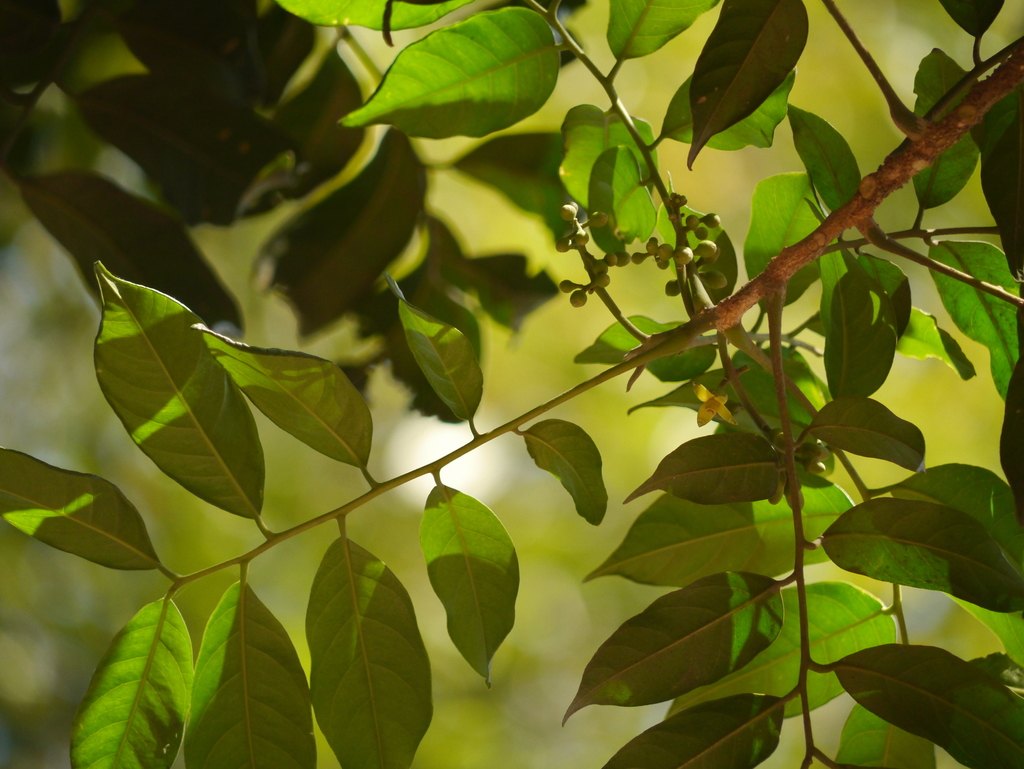
It reaches twenty metres in good forest, with a reddish heartwood and imparipinnate compound leaves whose leaflets have acuminate tips, asymmetric bases and entire margins. The white flowers are carried in axillary panicles, and the fruit is a four-seeded obovoid capsule that turns red as it ripens.
Inside the capsule the seeds are dark purple, each sitting in a white aril. That combination, a bright capsule with a contrasting aril, is a bird-dispersal design, and it places the tree in the same functional guild as the better-known Meliaceae of the Asian tropics.
The range runs from southwest India and Sri Lanka through Nepal, Bhutan and northeast India to southern Yunnan, Hainan, Thailand, Laos and Vietnam. Records also exist for the Andaman Islands and Bangladesh, so the tree is more widespread than its sparse literature suggests.
Science & Biotechnology
The genus name is bluntly descriptive: dys for bad, oxys for sharp or sour, hyle for wood. Bad-smelling wood, which is fair comment on the freshly cut timber of several species in the group. The specific epithet comes from a vernacular name used in the Indian subcontinent.
Meliaceae is the family of neem and mahogany, and it is chemically defined by limonoids, the bitter tetranortriterpenoids that give the family its insecticidal and anti-inflammatory reputation. The genus itself is large and taxonomically difficult, and the Indian and Sri Lankan material has travelled under at least three names. Dysoxylum species have yielded their own series of these compounds.
A 2015 study in the Journal of Natural Products isolated anti-inflammatory terpenoids from the leaves and twigs of this species, work of the kind that turns a locally used timber tree into a pharmacological lead. The chemistry is real; the clinical medicine is not yet.
Uses & Benefits
Its timber is used locally for construction and furniture, though the tree is not a commercial species in the way that its relatives are. The wood is hard, takes a finish, and is valued where it grows rather than exported, so it appears in forestry lists and not in timber catalogues.
The seeds and bark have a place in local medicine across its range, and the 2015 chemical work gives that use a plausible mechanism without validating it. This is a familiar pattern in the family: a strong in vitro signal, a long traditional record, and very little clinical follow-up.
As a garden plant it is an exotic for tropical and subtropical collections, grown for the foliage and the red capsules rather than for flowers. Public records are very few, and most of them come from botanic gardens and forest reserves rather than from streets. Seed reaches growers through collectors rather than through the ordinary trade, which is how the species travels outside the tropics at all. The other Meliaceae here is Citrus macrophylla, with Zanthoxylum tibetanum alongside.
Growing from Seed
Meliaceae seed is usually short-lived and often recalcitrant, so sow it fresh, within days of cleaning the aril off. Sow in a moist, open mix at twenty-five to thirty degrees, in a propagator or a shaded frame, and expect germination in three to six weeks with a wide spread. Cleaning the aril off matters, because the pulp left around the seed invites mould in the first week.
The seedlings are fast and soon need deep pots, because the taproot goes down before the shoot goes up. Grow them in bright filtered light with high humidity, and pot on before the roots circle. Cold is the limiting factor everywhere outside the tropics.
Plant out in frost-free ground with shelter from wind, in soil that drains but does not dry out completely. The tree wants space: twenty metres of eventual height means it is not a plant for a small garden, and its best use in cultivation is as a specimen in a collection or a park.
Our Take
This is not a plant for the ordinary border, and it would be dishonest to pretend otherwise. It is here because the seed list of any serious collector eventually reaches the Meliaceae, and because a tree that produced a 2015 anti-inflammatory paper is more interesting than one that did not.
Grow it if you have the climate, the space and the patience, and treat the pharmacology as context rather than as a reason. The red capsule and the purple seed are the reward, and they are worth waiting a decade for if you have a decade to spare.
Related Reading
Continue exploring with these related plants: