


Heracleum hemsleyanum Seeds | Hemsley’s Cow Parsnip
LATIN NAME: Heracleum hemsleyanum
COMMON NAME: Hemsley’s Cow Parsnip
Plant Profile
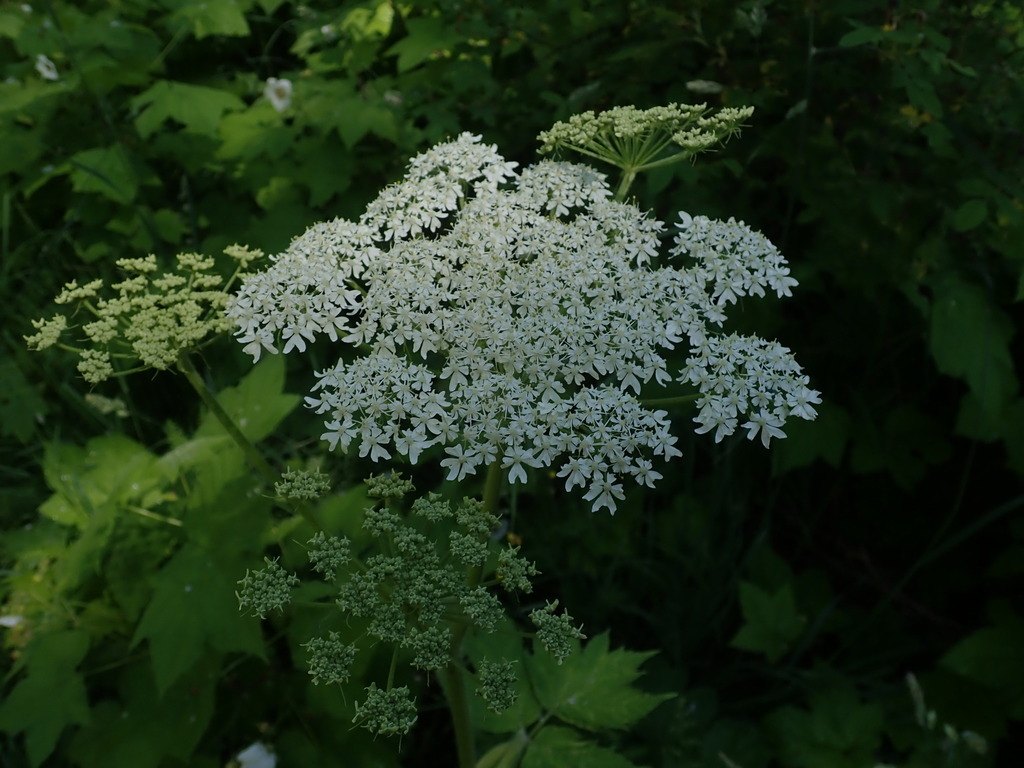
Heracleum hemsleyanum is one of the tall umbellifers of central Chinese mountain country, an architectural plant of thickets and stream edges with the genus’s unmistakable build: hollow grooved stems, big ternate leaves, and flat compound umbels of small white florets held above everything around them.
Ludwig Diels described it in 1900 from Chinese material, and the epithet carries the name of a Kew botanist of that generation, one of the many plants named in tribute as European herbaria worked through the flood of Chinese collections arriving at the turn of the century.
The stems rise one to two metres, branching above, each branch ending in an umbel ten to fifteen centimetres across. Leaves are divided into three broad leaflets, themselves lobed and toothed, thirty centimetres long on the lower stem and diminishing upward until the uppermost are reduced to inflated sheaths clasping the stem.
Flowering runs through June and July, and the fruits that follow are the family’s characteristic schizocarps: flat, winged, ribbed, splitting into two halves, each with oil tubes running along the valleys between the ribs. The plant’s range is compact, from Hubei and Henan through Sichuan into northern Vietnam.
Science & Biotechnology
The genus name comes straight out of Dioscorides, who gave the name herakleion to a great coarse umbellifer in the belief that the hero had discovered its virtues. The English cow parsnip records a different observation, that the foliage looks like a parsnip’s and grows where cattle graze.
Heracleum sap contains linear furanocoumarins, and those compounds are the reason the genus has a safety file. On skin, in sunlight, they intercalate into DNA and produce the blistering burn called phytophotodermatitis, the reaction that made giant hogweed a public hazard in Europe and North America. This species is milder, and still handled with gloves.
The umbels run a strict sequence. Flowers are protandrous, the male phase opening first and shedding pollen before the female phase of the same flower begins, and the umbel orders flower in succession, the outer and earlier heads acting as pollen donors for the later ones. Outcrossing is the default, and the flat landing platforms serve beetles, flies and small wasps without preference.
Uses & Benefits
In the mountains of Sichuan and Hubei the dried root has long been gathered and sold in local markets among the duhuo group of drugs, the wind-damp remedies used for aching joints and damp cold pain. It is a regional substitute rather than the pharmacopoeia article, sliced and decocted by practitioners who know the local flora.
For a wild garden or a damp meadow the plant has real presence: bold foliage from April, white umbels in early summer, and architectural dried stems that stand into winter. It suits the back of a moist border or a rough patch beside water, where its scale reads as structure rather than coarseness.
The ecological accounting is generous. Umbels at their peak carry dozens of insect species at once, from tiny parasitoid wasps to pollen beetles and hoverflies, and the seedheads that follow feed finches and small mammals through the winter. Nothing about the plant needs feeding, watering or staking once established. It sits among Heracleum sphondylium, Bupleurum rotundifolium and Libanotis seseloides, all Apiaceae.
Growing from Seed
The seed needs cold and moisture to break dormancy. Sow in autumn where the plants are to grow, or mix seed with damp sand and hold it in the refrigerator for six weeks before a spring sowing. Cover lightly, five millimetres at most, and keep the ground moist until seedlings appear.
A taproot forms immediately, so the plant hates being moved. Sow in situ or start in a deep pot and set out young, and expect a rosette of leaves through the first season with flowering in the second or third year, after which many plants die, having spent everything on the seed crop.
Handle the work with gloves and long sleeves, and do it on a cloudy evening, because sap on skin plus sunshine is the one genuine hazard of the genus. Cut the umbels before the seed shatters if you want to keep the colony in bounds, or leave them and let the plant place itself along the damp ground it prefers.
Our Take
The plant is a fine argument for growing umbellifers at scale. Nothing in the border gives more insect traffic per square metre in early summer, and almost nothing in the whole border needs less from the gardener once the taproot is down.
Sow it in autumn where it is to stay, or chill the seed in damp sand for six weeks before sowing in spring. Wear gloves when you cut the stems, keep the sap off your skin in sunlight, and let the white umbels do the rest of the work for you.
Related Reading
Readers interested in Hemsley’s Cow Parsnip frequently explore these as well: