


Orlaya grandiflora Seeds | White Lace Flower
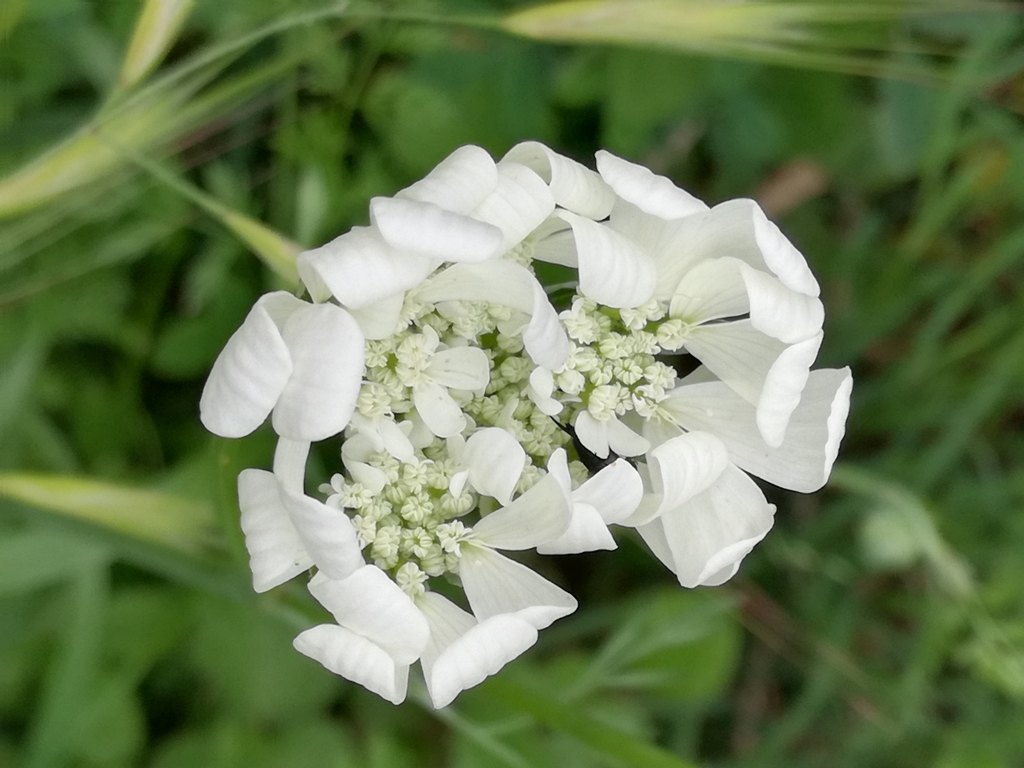
LATIN NAME: Orlaya grandiflora
COMMON NAME: White Lace Flower
Plant Profile
White laceflower is the best of the annual umbellifers, and the name describes the effect rather than the structure. Orlaya grandiflora is a multi-branched annual reaching ninety centimetres, with finely divided ferny leaves and flattish heads of pure white flowers carried over a long period in summer.
The lace is made of unequal parts. The outer florets of each head are much larger than the inner ones, their petals deeply and unevenly divided, and the contrast between a ring of broad white petals and a centre of tiny flowers is what the eye reads as fabric. Planted in swathes, the effect is stronger than any single plant suggests.
It is native to Mediterranean Europe, from the Balkans through Italy and Greece to France and Iberia, with outlying populations in North Africa, and it has spread northward into central Europe as a casual of field margins and vineyards. The records thin out toward the northern edge of the range.
The species holds the Royal Horticultural Society’s Award of Garden Merit, and the citation prefers a sunny, well-drained position, which is the correct advice and also the whole of the cultivation story. Everything else about growing it follows from giving it what its habitat already provides.
Science & Biotechnology
The enlarged outer florets are the botanical point. In most of the family the marginal flowers differ little from the central ones; in Orlaya the outer ring is sterile or imperfect and expanded into broad, bilabiate petals, turning the whole inflorescence into a landing platform visible from a distance to generalist pollinators. The inner flowers keep the family’s five stamens and two styles and do the seed-setting work alone.
The flower records peak in May and June, with a scatter through the summer, which is the Mediterranean annual pattern of a spring flush and a slower tail. In northern gardens the flush comes six weeks later, and the tail runs into September if the summer is not too dry.
The genus is small, and its species have been shuffled between Orlaya, Caucalis and Turgenia by authors working on fruit characters. The fruit of Orlaya is bristly and ridged, and it is the structure that separates the genera more reliably than the flowers do. Closest relatives on the list are Cuminum cyminum, Carum carvi and Ammi visnaga.
Uses & Benefits
The cut-flower trade found it in the last two decades and uses it as a lacy filler for wedding work, where its white heads fill the same role as Ammi majus but with a finer, more deliberate look. Stems last a week in water and the heads hold their shape when dried.
In the garden it fills the same gap as the annual ammis and the cow parsley lookalikes: a transparent white layer between stronger colours, particularly useful in a border of pinks and purples where a solid white flower would be too heavy. It associates well with grasses and with anything that flowers through June.
It is not edible, and although the family contains both food plants and deadly poisons, this species is neither. The foliage is not notably toxic, the plant is not recorded as a weed anywhere in its introduced range, and the only sensible caution is the general one about not eating anything from the carrot family without knowing exactly what it is.
Growing from Seed
Sow in autumn for the strongest plants, or in early spring where winters are hard, directly where the plants are to grow. The seed germinates in two to three weeks in cool soil, and autumn-sown plants make a deep root before winter that carries them through the following summer without irrigation.
Thin to twenty-five or thirty centimetres and resist feeding. In rich ground the plant makes a metre of soft foliage and few flowers, and the stems need support; on lean soil it is self-supporting and flowers longer. Water only in prolonged drought.
Cut for the vase when the outer florets are fully open and the centre still flat, and strip the foliage, which wilts fast. For drying, cut later, when the heads have begun to turn cream, and hang them in a dark airy place for a fortnight.
Our Take
Laceflower is the annual that makes the rest of a summer border look planned. It has no colour, almost no scent and no presence as an individual plant, and in a drift it is the most sophisticated thing in the garden, which is a contradiction worth learning from.
Sow it in autumn if your climate allows; the difference between an autumn and a spring sowing is the difference between a plant and a crop. And grow more of it than seems sensible, because the effect that justifies it only exists in quantity.
Related Reading
Gardeners who grow White Lace Flower often pair it with these related subjects: