


Eragrostis pilosa Seeds | Indian Lovegrass
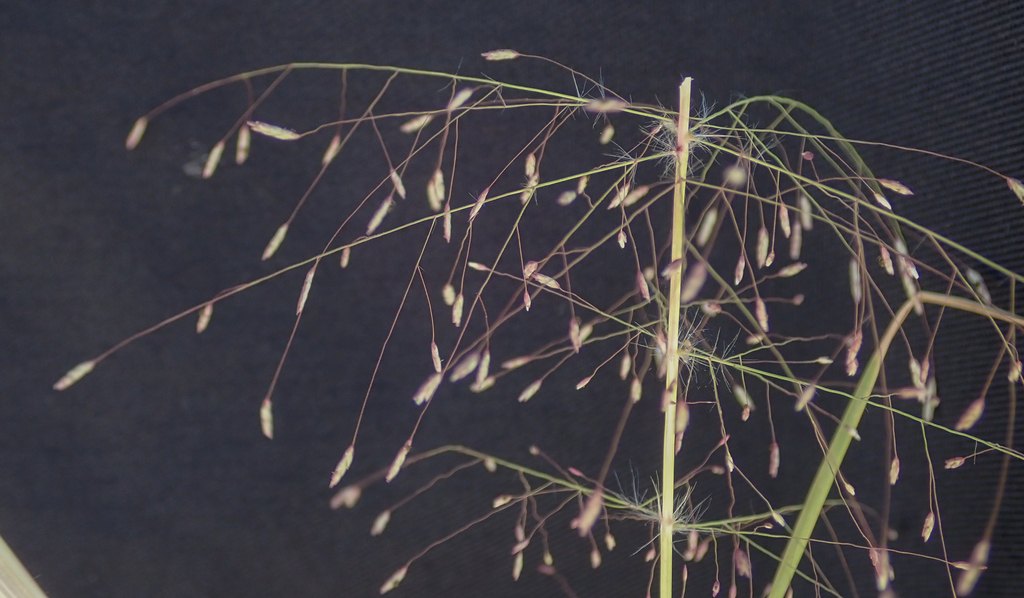
LATIN NAME: Eragrostis pilosa
COMMON NAME: Indian Lovegrass
Plant Profile
Indian lovegrass, Jersey love-grass, hairy love grass, soft lovegrass: the names suggest a garden plant and the plant is a weed. It is native to Eurasia and Africa, possibly to North America as well, and it has been carried so widely that its original range is now a matter of argument rather than record. It grows in roadsides, crop fields, waste ground and swamps.
It is an annual to 70 cm, with narrow leaves up to 20 cm long. The ligule, the small structure at the junction of leaf and stem, is a fringe of hairs rather than a membrane, which is one of the characters that separates Eragrostis from the fescues and bents. The stem and foliage usually carry scattered glandular pits, and the abundance of those pits is what separates the varieties.
The inflorescence is an open panicle, its branches up to 10 cm long and the lowest of them whorled around the stem. The spikelets are narrow, greyish to purple-green, up to a centimetre long, and each holds ten to seventeen florets. A single panicle therefore carries a hundred or more seeds, and a plant carries many panicles. Poaceae is well covered here, with Eragrostis ferruginea, Poa pratensis and Phleum pratense alongside.
Science & Biotechnology
This is the main wild ancestor of teff, the grain that feeds Ethiopia and Eritrea, and the relationship is close enough that the two are sometimes indistinguishable by eye. Genetic evidence supports the link. Both are allotetraploids, carrying the genomes of more than one ancestor, and fertile hybrids between them have been bred deliberately.
The one consistent difference is shattering. E. pilosa disintegrates its seedhead at maturity, which is exactly what a wild grass should do and exactly what a crop must not. Teff heads stay intact, so the grain can be harvested in one pass. That single change in a gene or two of the abscission layer is the whole domestication story, and it happened once, in the Ethiopian highlands.
The species is also a host for Striga hermonthica, purple witchweed, a root parasite that devastates sorghum and maize across the Sahel. A weedy relative of a crop that also supports the parasite is a useful thing to study, because it shows where the infection can start before the crop is even planted.
Uses & Benefits
Its forage value is modest and real. It grows fast on poor ground, it is palatable while young, and it will produce a cut of hay on land that would otherwise grow nothing. It is not a pasture grass and no one pretends otherwise, but in a dry year it fills a gap.
The grain is edible by humans, and in Ethiopia it has been harvested in times of desperation, which is the most honest description of its food value. Teff is the crop; this is the wild plant that looks like it, shatters before you can gather it, and yields a fraction as much.
As a plant of disturbed ground it has a professional competence that is hard not to admire. The seed moves in water and wind, in soil and hay, on machinery and trains, and it persists in a long-lived soil seed bank for years after the last plant set seed. A railway embankment is a motorway for this species.
Growing from Seed
Nobody sows it deliberately, which is the first thing to say. If you want it, scatter seed on bare ground in spring and keep it damp for a fortnight. It germinates fast and grows faster, and it will flower in eight weeks from a May sowing, so it can complete a generation between two hoeings.
The seed is tiny and light. Sow it on the surface and water with a fine spray, because a heavy can will wash it into a corner. Light improves germination, and a temperature around 20 °C is enough. There is no dormancy to break beyond the natural after-ripening of a few weeks.
If you are growing it for study, isolate it. This species crosses with teff and with its own varieties freely, and a glasshouse population becomes a swarm within three generations. Bag the panicles before anthesis if the identity of the seed matters, and collect the spikelets as they turn from green to grey.
Our Take
There is no garden case for it. It is a weed of pavement cracks and lucerne fields, and it earns its place in this catalogue as the wild relative of a crop rather than as an ornamental. That is worth something: a plant that fed a country is growing in the gutter outside the shop.
What it teaches is how narrow the gap is between a crop and a weed. One trait, the seedhead that holds together for a fortnight longer, separates a staple from a nuisance. Everything else about the two plants is nearly the same, down to the chromosome count.
Related Reading
More species in the same orbit as Indian Lovegrass: