


Tarenaya hassleriana Seeds | Spider Flower
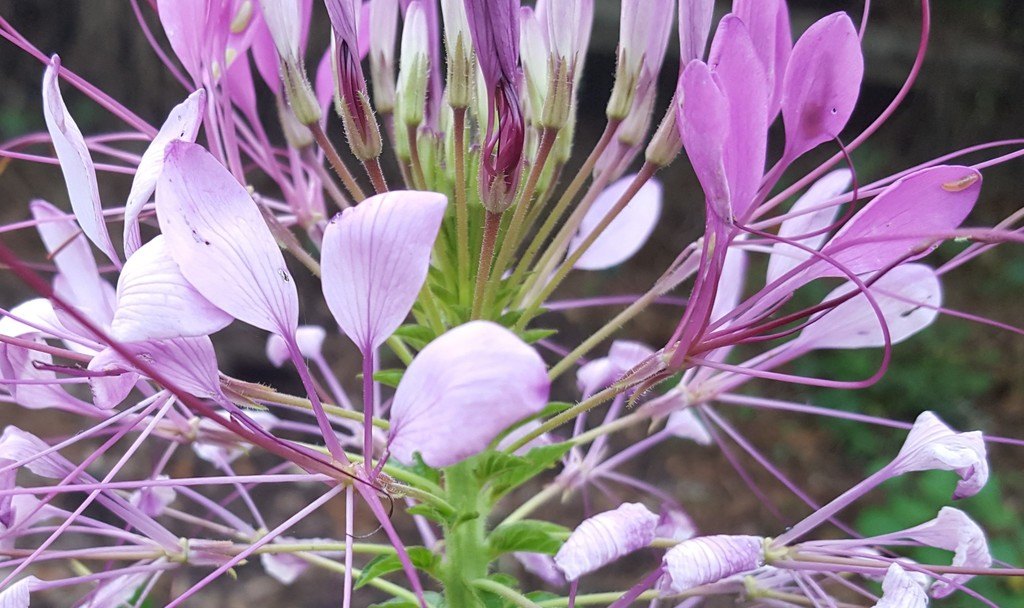
LATIN NAME: Tarenaya hassleriana
COMMON NAME: Spider Flower
Plant Profile
Spider flower is an annual growing to 150 cm, usually between 90 and 180, with spirally arranged palmately compound leaves of five or seven leaflets, each leaflet up to 12 cm long and 4 cm broad on petioles to 15 cm. The crown spreads 30 to 60 cm, and the whole plant carries glandular hairs you notice before you see them.
The flowers are purple, pink or white, each with four petals and six long stamens that give the plant its names: spider flower, pink queen, grandfather’s whiskers. The fruit is a slender capsule up to 15 cm long and 3 mm broad holding several seeds, and flowering runs from late spring to early fall. The scented blooms are sometimes compared to citronella.
The name has been through the mill. Long grown as Cleome hassleriana, it now appears as Cleome houtteana in current treatments and as Tarenaya hassleriana in the seed trade, all three pointing at the same plant in the family Cleomaceae. Catalogues lag botany, and buyers should expect the old name to persist for years.
It is native to southern South America, in Argentina, Paraguay, Uruguay and southeast Brazil, and has been introduced to South Asia, including the Haor area of Bangladesh and India. Specimen records now show it established or casual in Germany, South Africa, Eswatini, the northern Caucasus, Georgia, the Ryukyu Islands and Vietnam. Its nearest neighbours on the list are Cleome gynandra, Lobularia maritima and Lunaria annua.
Science & Biotechnology
The six projecting stamens are the engineering story. They hold the pollen presentation well clear of the petals, so a visiting bee or butterfly meets anthers and stigma in sequence, and the long capsules that follow split along their length to release the seed in rows. The plant flowers its way up the stem, so buds, blooms and ripening pods share one spike.
Its most famous feature is accidental: the glandular hairs produce a foetid, skunky odour, and combined with the palmate leaves and open growth habit, the plant is sometimes mistaken for cannabis by neighbours and occasionally by authorities. It has also been misidentified, more innocently, as its relatives Cleome arborea, C. pungens and C. spinosa.
The genus has been reshuffled repeatedly on molecular evidence, which explains the three names in circulation. Whatever the label says, the plant in the packet behaves the same: a fast, upright, half-hardy annual that flowers without pause once the weather is warm and sets seed generously wherever the capsules are allowed to ripen.
Uses & Benefits
It is commonly cultivated in temperate regions as a half-hardy annual, and its role is the back of the border: height, airiness and a flower spike that keeps opening for months without deadheading. Few annuals give so much vertical presence from a single spring sowing.
Numerous cultivars have been selected for flower colour and other attributes. The Queen series supplies Violet Queen, Rose Queen and White Queen, and the white-flowered Helen Campbell holds the Royal Horticultural Society’s Award of Garden Merit, confirmed in 2017. Mixed strain packets remain the cheapest route to all three colours at once.
The cannabis resemblance deserves a practical note rather than a joke: position it where visitors can read the label, because the leaf shape and the smell are genuinely convincing at a distance. The smell itself divides opinion; some gardeners mind it, others never notice, and it is strongest on warm evenings when the plant is touched.
Growing from Seed
Sow under cover four to six weeks before the last frost, or direct once the soil has warmed properly, since it is half-hardy and sulk in cold ground. The seeds are small; cover them lightly and keep them evenly moist. Germination is uneven by nature, so do not discard the tray too early.
Grow the seedlings cool and bright and move them out after the weather settles. Full sun and ordinary garden soil suit it; rich ground buys height and floppiness, and exposed sites may need a stake or two for the tallest strains. Space them 30 to 45 cm apart and let the crown width do its own arithmetic.
Through the season it needs little: water in drought, nothing else. If you want seed, leave the lower capsules to ripen and brown before they split, cutting whole spikes into a paper bag; if you want display, deadhead and the spike simply keeps climbing and opening to the first cold nights.
Our Take
Spider flower is the annual that fills the August gap nobody plans for, at a height nothing else cheap will reach, and it does it on neglect and heat. The skunky reputation is real and, in a warm border at dusk, part of the experience.
Sow the mixed colours once and let one capsule ripen; in any reasonably warm garden it will handle its own succession from there, seeding into the same warm soil each year. Pull the unwanted seedlings early, because later they argue back like any weed with a taproot.
Related Reading
Readers interested in Spider Flower frequently explore these as well: