


Ipomoea quamoclit Seeds | Cypress Vine
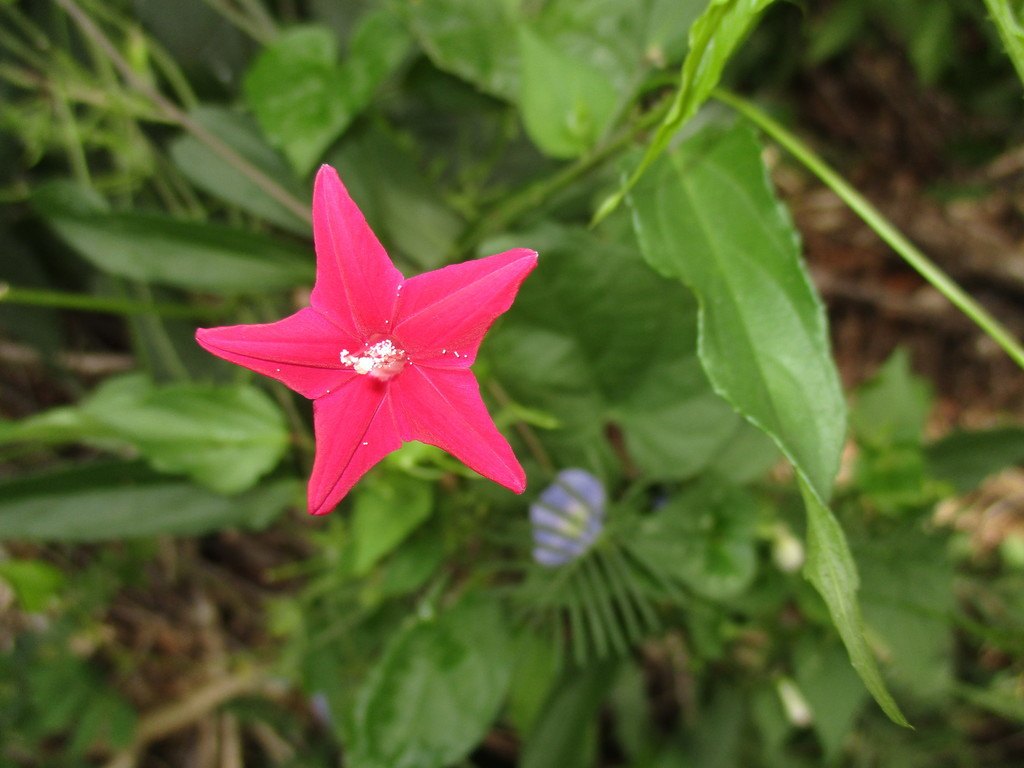
LATIN NAME: Ipomoea quamoclit
COMMON NAME: Cypress Vine
Plant Profile
Cypress vine is a twining annual in the bindweed family, and it is the finest-textured of the morning glories. The stems run 1 to 3 m in a season and carry leaves 2.5 to 10 cm long, cut almost to the midrib into nine to nineteen narrow lobes on each side. From a distance the foliage reads as fern or cypress, which is where the common name comes from and why people misjudge the plant at first sight.
The flowers are trumpets 25 to 51 mm long and about 25 mm across, opening into five sharp points. Scarlet is the usual colour, with pink and white forms in cultivation. They open in the morning and close by the afternoon, and a plant in full growth carries a flower at almost every node, so the effect is a scattering of small stars rather than a mass of bloom.
Linnaeus named it in 1753 and gave its origin as simply Habitat in India, while citing earlier authors who had already placed it in Central America. He had the plant in front of him and the geography wrong. The species epithet may be Greek or may be Nahuatl; nobody has settled it, and the argument has run for two centuries.
Science & Biotechnology
The leaf is the most deeply divided in the genus, and the narrow lobes reduce the boundary layer of still air around the leaf. That is a liability in dry heat and an asset in humid heat, so the plant wants a warm, wet summer. In a cool season it sits, yellows and produces a few flowers in September, which is not what the packet promised.
The flower is built for hummingbirds. The tube is long and narrow, the mouth is wide enough for a bill but not for a bee, and the anthers sit where a hovering bird’s forehead will brush them. In North America the plant is sold as hummingbird vine for exactly this reason, and where the birds occur it works without any encouragement.
Seed set is heavy. Each capsule holds four seeds, they ripen quickly and they drop around the parent, so a plant in a warm garden becomes a patch in two seasons and a nuisance in five. In the tropics it has naturalised widely, and in parts of the Old World it is listed as an invasive weed of disturbed ground and roadsides. Related entries here include Ipomoea purpurea, Ipomoea nil and Convolvulus tricolor.
Uses & Benefits
It is grown on trellis, netting and wire, and it ranks among the few annual vines light enough to scramble through a shrub without crushing it. The texture is the point: against a dark hedge or a rendered wall, the fine foliage and small scarlet stars look like embroidery rather than like bedding, and the effect holds until the first frost.
In India it has a long medicinal reputation, and it is grown near houses for that reason as much as for the flower. Every part is purgative, and the seeds more so. That is a warning rather than a recommendation; the plant is toxic in quantity, and children should not be left to pick the capsules and taste them.
The names are worth a paragraph on their own. In Tamil it is mayil manikkam, peacock ruby; in Malayalam akasamulla, sky jasmine; in Marathi Ganesh Vel. In Jamaica it is Indian creeper, which is a fair comment on how thoroughly the plant had travelled before anyone wrote down where it started.
Growing from Seed
Sow indoors four weeks before the last frost, or direct once the ground is warm. Soak the seed overnight, then sow 6 mm deep. Germination takes seven to fourteen days at 21 to 24 °C and the seedlings are thin and weak for a fortnight, so handle them by the leaf and never by the stem when you prick them out.
Give them a support at planting. The stems find one by circling until they touch it, and a plant left to sprawl on the ground makes a tangled mat that flowers poorly and looks like a mistake. Netting, wire or a tripod of canes all work; the vine does the rest without any tying in.
Full sun and steady water. The plants are thirsty while they establish and tolerant afterwards, but a dry spell in July stops growth and the flowers shrink. Feed lightly; too much nitrogen gives leaf and delays the first flower by a fortnight. The first blooms open about ten weeks from sowing.
Our Take
It is the vine to grow when you want something delicate and fast, and are prepared to pull seedlings out of the gravel next spring. The flower is small, the season is long and the hummingbirds, where there are hummingbirds, will find it within a day of the first one opening.
The one caution is the seeding. Deadhead if you garden near bushland or in a warm climate where it has already escaped. If you want the self-sown effect, keep it to a corner where the seedlings can be hoed, and do not let it climb into a hedge you cannot reach with a rake.
Related Reading
Gardeners who grow Cypress Vine often pair it with these related subjects: