


Coleus scutellarioides Seeds | Painted Nettle
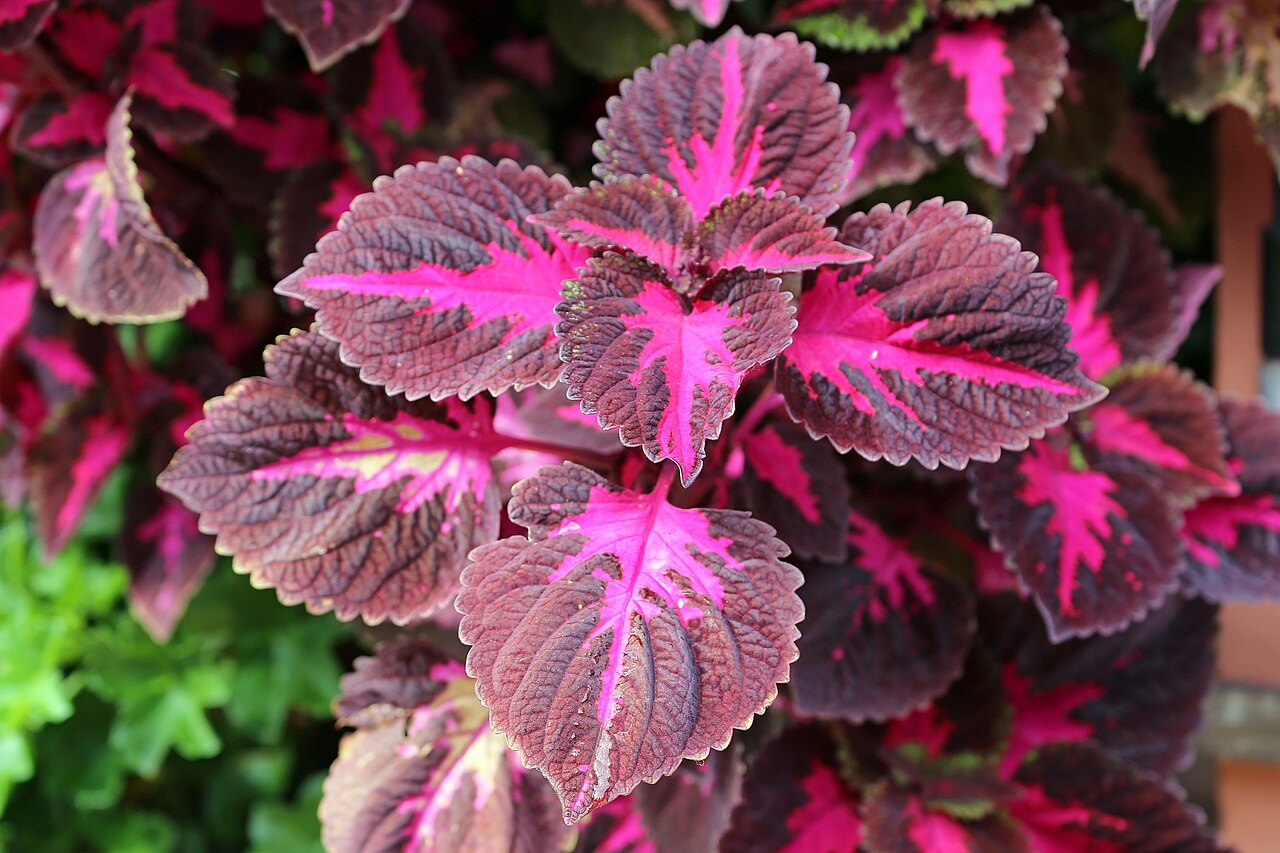
LATIN NAME: Coleus scutellarioides
COMMON NAME: Painted Nettle
Plant Profile
Coleus is a woodland-edge plant of southeast Asia, Java, the Philippines and northern Australia, where it grows on forest margins and disturbed ground in constant humidity and filtered light. It was described from Java in 1825, and the plants in the trade have been renamed so often that the labels never caught up: Coleus blumei, then Solenostemon scutellarioides, then Plectranthus scutellarioides, and since 2019 back to Coleus after DNA work by Alan Paton and colleagues at Kew showed the genus was not monophyletic as it stood.
It is a soft-stemmed evergreen perennial with square stems, 60 to 75 cm tall and as wide in a season. Leaves are opposite, ovate, coarsely toothed, 6 to 15 cm long, thin enough to wilt within minutes of being cut. That thinness is the point: the leaf is a translucent screen, and the pigments behind it show through instead of sitting on an opaque surface. Flowers are small blue-violet spires on a terminal raceme in late summer, and most growers pinch them off because flowering slows leaf production.
The colour is not one thing. In a single leaf you may find a lime centre, a crimson blotch, a burgundy edge and a cream margin, and the pattern shifts with light, temperature and age. Seedlings from open-pollinated plants are a lottery; named cultivars are kept by cuttings because they do not come true.
Science & Biotechnology
The colours come from anthocyanins in the epidermal cells, laid over chlorophyll and carotenoids in the tissue below. Red and purple forms carry pelargonidin and cyanidin derivatives; the lime and yellow forms have little anthocyanin at all and depend on chlorophyll density and on betalain-free flavone copigments that keep the colour stable at vacuole pH.
Coleus is also a polyploid complex, with chromosome counts recorded from 2n = 24 up to 84. That plasticity is why the genus has been so easy to breed and so hard to classify. Modern F1 seed strains such as Wizard and Rainbow are the result of crossing selected inbred lines; they come true from seed, which the older cultivars never did.
One practical consequence of the chemistry: the leaves brown quickly when bruised because polyphenol oxidase released from broken cells oxidises the phenolics. A cut stem in water goes black at the cut within a day not from bacteria but from this enzyme. It is the same reaction that browns a sliced apple, and no amount of clean water stops it.
Uses & Benefits
Coleus was a Victorian bedding craze. From the 1860s the nursery firm of F. Sander and Company in St Albans distributednew forms by the crate, and carpet bedding schemes in public parks were built around the leaf colours. The fashion collapsed around 1900, as these things do, and the plant survived in cottage gardens and in the windowsills of people who liked it. It came back in the 1990s, largely through the American nursery trade, and it has not left since.
Its real use is solving the hardest problem in planting design: what gives colour in shade. Flowering plants in shade grow leggy and pale; coleus holds saturated leaf colour in half light, where a hosta turns blue-green and a begonia sulks. It works in containers on a north-facing step, under trees, in summer bedding where the bed is shaded after two in the afternoon, and indoors by a bright window.
It is not a cut flower. Leaves wilt within an hour of cutting and the stems brown at the water line, so it belongs in the garden rather than the vase. Strip the lower leaves and condition it in deep water if you must try.
Growing from Seed
Sow on the surface at 21 to 24 °C, ten to twelve weeks before you want plants for the garden. The seed is tiny and needs light, so do not cover it; water from below and keep the tray covered until the first green shows. Germination takes 10 to 14 days.
Prick out into 7 cm pots as soon as the seedlings can be handled, and pinch out the growing tip when they have three pairs of leaves. That first pinch is what turns a single stem into a bushy plant; without it you get a leggy stick that falls over in July. Pinch again two or three weeks later if the plant is still upright.
Named cultivars must be grown from cuttings, since seed will not reproduce them. Cuttings root in water or in damp compost in ten days at 20 °C, and a plant brought indoors in autumn will supply cuttings all winter. Keep the stock plant at 15 °C or more and away from draughts; below 10 °C it drops its leaves and rarely recovers.
Our Take
Few plants give so much colour for so little work, and none in shade. The catch is that sun tolerance varies enormously between cultivars and the label rarely tells you which you have. The old rule, coleus for shade, is wrong for the modern sun series, which hold colour in full sun but fade to a washed pastel if they are shaded.
Try a plant in the position you have in mind and watch it for a week. If the colour deepens, it is happy; if it pales and the leaves cup upwards, it wants less light. The stems are brittle, so keep it clear of footballs. Give it that much and it outperforms almost anything else in leaf.
Related Reading
Gardeners who grow Painted Nettle often pair it with these related subjects: