


Cedrus atlantica Seeds | Atlas Cedar
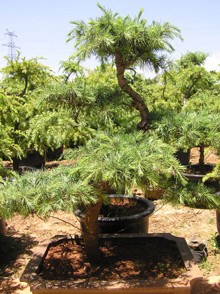
LATIN NAME: Cedrus atlantica
COMMON NAME: Atlas Cedar, Bonsai Form
Plant Profile
Atlas cedar is a large evergreen conifer, 20-40 m in the ground, with a stout trunk, tiered branches and short needles held in dense whorls on the shoots. The blue forms are the ones grown in gardens, with foliage that ranges from grey-green to a strong silver-blue.
The tree is slow when young and then accelerates, and it can live for centuries. In a garden it is used as a specimen, as a windbreak and increasingly as a bonsai, where its flexible branches and its tolerance of hard pruning make it a rewarding subject.
Cedrus atlantica comes from the Atlas mountains of Morocco and Algeria, where it grows at altitude on dry limestone. That origin explains its drought tolerance and its need for sharp drainage, which are the two conditions that decide whether it thrives or sulks.
Science & Biotechnology
The blue colour of the garden forms is a wax layer on the needle surface rather than a pigment, and it reflects ultraviolet light. That is why the colour is strongest in full sun and on new growth, and why it fades in shade.
Cedarwood oil from the Atlas cedar is rich in himachalene and in atlantone, and it is the source of much of the cedarwood oil used in perfumery, where it is a fixative. The wood itself is aromatic and resistant to rot, which is why it has been used for furniture and for coffins for millennia.
The genus has three widely separated species, in the Atlas, the Himalayas and the eastern Mediterranean, and their relationships have been studied as an example of relict distribution. The Atlas cedar is the most drought tolerant of the three, and the most commonly planted in western Europe.
Uses & Benefits
Atlas cedar is a landscape tree for a large garden, a park or a windbreak, and the blue forms are used as specimens where a strong vertical is wanted. As a bonsai it is trained into informal upright and cascade styles, and the blue foliage is an asset at small scale.
The wood is used for joinery, for chests and for construction in its native range, and the oil is a perfumery ingredient. In the garden the tree provides shelter and cover for birds, and its needles suppress weeds beneath it. Commercially the seed is sold to bonsai growers and to forestry projects.
Growing from Seed
Sow in spring at 15-20°C, 1 cm deep, after four weeks of cold stratification. Germination is uneven, three to six weeks, and the seedlings are slow for the first two years.
Plant out in full sun in well-drained soil, ideally on a slope, and water through the first two summers. Do not plant in a hollow or in heavy clay. For bonsai, grow the tree in a deep pot for the first three years to build a trunk, then begin wiring and root pruning. Cedars resent root disturbance, so repot only every three to four years.
Our Take
A conifer for a big garden or a patient bonsai grower, and the best blue foliage in the catalogue. Give it drainage first and water second.
Related Reading
If Atlas Cedar appeals to you, these related plants are worth a look: