


Strelitzia reginae Seeds | Bird of Paradise
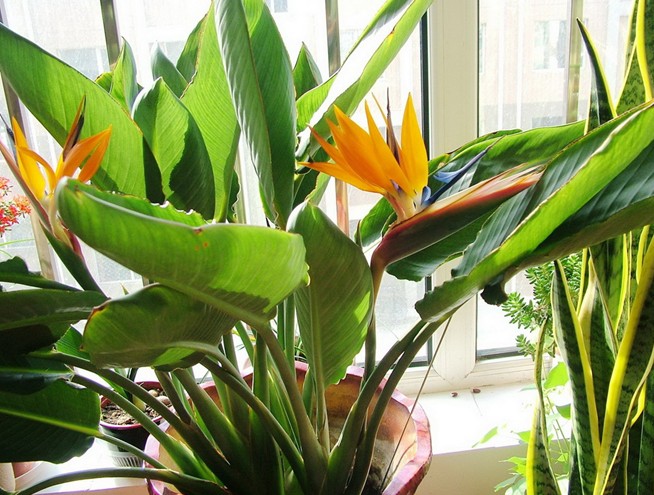
LATIN NAME: Strelitzia reginae
COMMON NAME: Bird of Paradise, Crane Flower
Plant Profile
The plant itself is an evergreen clump of paddle-shaped leaves, grey-green and leathery, held on long stiff stalks that arise from a stout, slowly spreading crown — botanically a cluster of leaf bases rather than a true trunk. Clumps typically reach one and a half to two metres. The fruit is a woody capsule holding black seeds, each wearing a tuft of bright orange aril fibres, an echo of the flower’s palette. The genus belongs to the banana order of monocots, which explains the leaf architecture. In cultivation the bloom sequence runs from late winter into summer, each bract opening over several days, and growers who want seed rather than show transfer pollen by hand between genetically different plants, pressing a thumbnail into the blue keel of one bloom and smearing the sticky load onto the stigma of another.
Since its introduction to European glasshouses, the crane flower has symbolised tropical luxury in temperate places; it is, fittingly, the official flower of the city of Los Angeles. In gardens of mild climates it works as a structural border plant, its grey paddles reading well against bold companions such as cannas, gingers and bananas. In colder regions it is a classic pot plant for a bright, frost-free conservatory, kept rather dry in winter.
As a cut flower it is almost self-arranging: a single stem in a wide-mouthed vase, or grouped with eucalyptus and leucadendron for a Cape-inspired bunch. Florists prise open successive sepals by hand to speed the display. Dried seed capsules with their orange fibres are used in craft work, and the leaves serve florists as a bold foliage line.
Science & Biotechnology
Bird of paradise is a pillar of the international cut-flower business, grown under plastic and glass in South Africa, Israel, Hawaii and Central America, with stems shipped in bud for long vase display. Field growers propagate elite clones by division, but laboratory micropropagation from shoot-tip cultures now supplies uniform planting stock, circumventing the slow multiplication of a clump that may take years to be worth splitting.
Uses & Benefits
The bloom emerges from a boat-shaped green bract, tinged pink or purple, that points horizontally like a hull. From it rise three vivid orange sepals; the paired blue petals beneath form the perch and shelter nectar and anthers. In its home range the malachite sunbird is the classic pollinator, hovering or perching with its forehead thrust into the flower, and plants grown far from any sunbird usually set little seed unless hand-pollinated with a thumbnail dipped into the keel.
Research groups also study its flowering physiology: temperature, light intensity and clump crowding all govern how many stems a plantation produces, and growers manipulate them to spread harvests across the year. Postharvest teams examine how cooling, packing angle and stem-cutting practice affect the vase life of shipped blooms, because a bent stem or a bruised sepal condemns a stem in a market that judges by sight. The flowers are harvested at the first sepal split and last a week or more in water. Seedlings, by contrast, are used mainly for breeding, since seed-raised plants are variable in colour and height and take several years before their first bloom.
Growing from Seed
Pick the orange aril tuft off each seed and soak the seeds in warm water overnight before sowing. Use deep pots, because the seedlings build thick, brittle roots that resent disturbance, and sow about two centimetres deep in a mix of equal parts loam, compost and coarse sand. Gentle bottom heat and steady moisture suit them best; keep the containers evenly watered but never sodden.
Move plants on without breaking the root ball, stepping pot size up gradually, and set out into the open ground only where frost is rare, in full sun with shelter from wind that would shred the paddles. Feed generously during the growing season and hold back water in cool months. Split mature clumps in spring, keeping several leaf bases with each division, and expect divided plants to flower far sooner than seedlings.
Our Take
Patience is the whole game with this species — the architecture is worth waiting for. For striking comparisons, try the rush-leafed Strelitzia juncea, whose leafless cylindrical blades make it look like an entirely different genus, or the tree-form Strelitzia nicolai for big conservatories. For another monocot with sculptural presence in water or pot, see Nelumbo nucifera. Give young plants the deepest pot you can at each move and their roots will reward you.
Related Reading
If Bird of Paradise appeals to you, these related plants are worth a look: