


Michelia figo Seeds | Sweet Fragrant Banana Shrub
LATIN NAME: Michelia figo
COMMON NAME: Banana Shrub, Banana Magnolia
Plant Profile
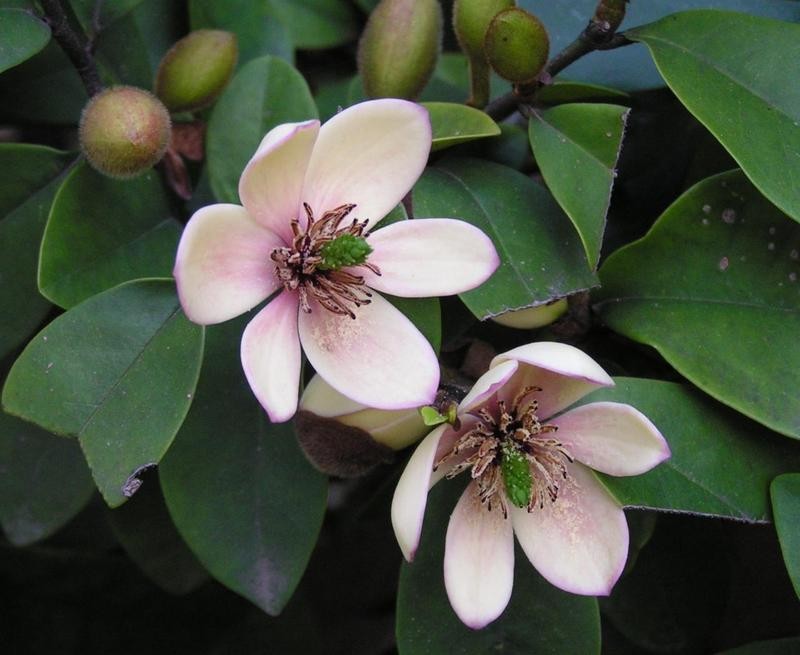
The plant is a dense, rounded evergreen reaching three to four metres, with opposite, oval, leathery leaves that shine as if waxed. The flowers are creamy yellow at the base and edged with a deep maroon to purple band, held half-hidden among the leaves rather than displayed on the branch tips. The purple edge is the quick field mark that separates it from the plainer cream magnolias planted nearby, and the concealed flower is why the scent arrives before the eye finds the bloom.
After flowering the shrub forms an aggregate of small follicles, and when these split the seeds show a bright red aril that birds take. The red-coated seed and the alternate-to-opposite leathery leaf place the plant in Magnoliaceae, and modern floras often write it as Magnolia figo, though the older name Michelia figo still heads most seed lists and garden labels.
The banana scent is the biotech hook. Analysts separate the flower headspace and find isoamyl acetate with smaller amounts of isobutyl acetate and related esters, the mix that explains the fruit-like note. The same volatiles make the flower a candidate for a natural fragrance raw material, captured by gentle solvent or enfleurage rather than by steam, since the quantity per bloom is small.
Because cuttings can be slow and uneven, labs multiply selected fragrant clones by nodal culture, rooting the shoots on a controlled medium so a good-smelling parent is copied exactly. This matters for a shrub valued purely for scent: a seedling row will vary, and only clonal holds keep the banana note strong from plant to plant.
Science & Biotechnology
Michelia figo is the one evergreen shrub people stop and sniff, because its small flowers release the exact sweet, custardy scent of a ripe banana. The smell comes from volatile esters, led by isoamyl acetate, the same compound that gives banana fruit its character, released in tiny amounts from flowers barely three centimetres across. In a warm garden the plant can flower on and off from spring into summer, and a single shrub will perfume a patio more strongly than many showier bloomers.
Uses & Benefits
The shrub’s dense habit makes it a classic low screen or foundation plant where a fragrant evergreen is wanted without the height of a tree. Clipped lightly it holds a neat shape for years, and the waxy leaves shrug off urban dust better than many broadleaf evergreens.
A few cut sprays in a small vase will scent a room, which is the simplest use of the bloom. The petals are not a food crop, so the plant is grown for the nose, not the plate, and that keeps its place firmly in the ornamental and fragrance garden rather than the kitchen row.
Growing from Seed
The easiest path to a true plant is a semi-hardwood cutting taken from a healthy branch and rooted in a humid, shaded frame; keep the leaf on but trim it back so the cutting does not wilt before roots form. Seed is an option for a batch of variable seedlings, sown fresh on a warm, moist medium and lightly covered.
Give the shrub sun to light shade and a deep, well-drained soil that stays moist through summer; it dislikes hard freezing, so in colder zones keep young plants against a warm wall or under cover for the first cool season. Trim after flowering to keep the outline tight, and avoid shearing into old wood, which the plant returns from slowly.
Although figo is usually planted in the ground, it also makes a fine tub subject where the soil is heavy or the winter is cold, because a pot can be wheeled under cover when frost threatens. Use a loam-based mix with extra grit for drainage, and stand the pot on feet so the root zone never sits in a saucer of water. The plant flowers better when it is slightly root-bound, so resist the urge to pot on every year; a gentle trim after flowering keeps the canopy in scale with the container. In a warm courtyard the scent will reach the door, which is the whole point of growing a banana shrub in the first place, and a single specimen in a glazed pot often out-performs three planted thinly for perfume on a still evening.
The only real trouble in a pot is drying. The leathery leaves hide thirst until the branch tips droop, so check the mix with a finger rather than by the look of the foliage, and water deeply when the top few centimetres feel dry. Feed lightly through the warm months with a balanced liquid and stop by late summer so the wood ripens before cool weather. If scale or mealybug appear on the underside of the leaves, wipe them off with a damp cloth and improve the air flow rather than reaching for a heavy spray, since the plant is clean-growing once it has room to breathe. A rooted layer from a low branch also gives a free clone of a fragrant parent.
Our Take
I grow figo for the scent first and the shape second, and I always take cuttings from the most fragrant plant rather than trust a seed row. Near it the Michelia figo seed page, the big southern magnolia, and the golden Michelia champaca make a fragrant Magnoliaceae corner.
Related Reading
Readers interested in Banana Shrub frequently explore these as well: