


Pittosporum tobira Seeds | Japanese Pittosporum
LATIN NAME: Pittosporum tobira
COMMON NAME: Japanese Pittosporum
Plant Profile
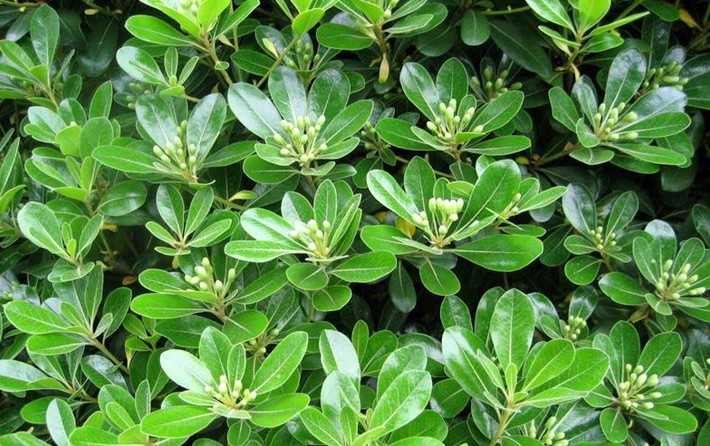
Pittosporum tobira is the workhorse hedge of mild coasts because almost nothing else stays so neat with so little complaint. Its leaves are thick, oval, and leathery with rolled-under margins, a build that lets it sit in salt spray and drying wind where thinner shrubs brown at the edges. In late spring it opens clusters of creamy-white flowers that smell of orange blossom to some noses and of honey to others, and the whole shrub earns its place before the fruit is noticed.
The flower is followed by a rounded woody capsule that splits to show seeds coated in a bright orange, sticky resin called viscin. The stickiness is the genus name made literal: Pittosporum means pitch-seed, and the viscin is what lets birds carry the seed on a feather or foot to a new garden. The opposite, whorled leathery leaf and the sticky orange seed together separate tobira from the many look-alike rounded evergreens of the warm border.
Gardeners know the cultivar Variegatum, a form with cream-edged leaves that brightens a dark hedge, and because it is a sport it must be kept by cuttings rather than by seed. That is the usual story in this genus: the plain green wild type comes true from seed, but every named leaf colour is a clone.
Science & Biotechnology
The leaves and seed carry triterpene saponins, the soapy compounds that foam in water and interest chemists looking at mild surfactants and plant defence. The flower headspace holds a mix of monoterpene alcohols and small lactones that explain the scent, studied as a low-volume fragrance raw material rather than as a bulk oil crop.
Nurseries multiply uniform hedging stock by shoot culture so a long run of tobira lines up leaf for leaf, and tissue work also cleans plants of the leaf-spot fungi that build up in old cuttings. The result is a hedge that starts clean and stays dense through the season.
Uses & Benefits
The plant’s first use is structure: a clipped tobira makes a formal low wall, a rounded mound, or a topiary ball, and it tolerates the close shearing that would open a thinner shrub to dieback. On a seafront it is planted as a wind screen where few broadleaf evergreens survive.
The waxy stems last well in water, so florists strip them in for greenery that holds its shine through a wedding week. The fruit is too sticky and too scarce to be a crop, but the foliage alone pays for the plant in a cutting garden.
Growing from Seed
The reliable way to a true hedge is a semi-hardwood cutting rooted in a humid, shaded frame, kept just moist until new roots hold. Seed will grow, but it is slower and variable, so most growers take cuttings from a plant whose form they like. Sow any seed fresh on a warm, free-draining medium and cover it lightly, then thin the seedlings once they stand a few centimetres tall.
Give tobira sun to part shade and any well-drained soil; it accepts pruning at almost any time, but a trim after flowering keeps it from getting leggy and encourages the dense habit. Protect young plants from hard frost in the first cool season, and once established it asks for little beyond the occasional cut.
The reason most gardeners take cuttings is that seed-grown tobira can throw the occasional narrow or open plant, while a cutting from a dense, rounded specimen repeats that shape exactly. Take a semi-hardwood shoot in summer, strip the lower leaves, and dip the base in a rooting powder before setting it in a mix of sharp sand and peat-free compost. A closed frame or a plastic tent keeps humidity high while the cut surface calluses, and the cutting should be kept out of direct sun so it does not wilt before roots form. Once new growth appears at the tip, the roots are usually ready, and the young plant can move to a small pot. Tobira also layers naturally where low branches meet the soil, and a branch pinned down for a season will often root where it touches, giving a free clone of a plant you already like.
The same frame is where nurseries clean up leaf-spot trouble, since old cutting beds build up fungal spores that pass from plant to plant. Starting fresh each season with sterile mix and clean tools avoids the slow decline that marks a tired hedge, and it is cheaper than treating a long run of sick tobira later. A light trim of the rooted cutting sets the branching that becomes the neat hedge, and the sticky orange seed from a parent plant is a useful reminder that every Pittosporum is a pitch-seed at heart, worth keeping clean from the start.
Our Take
I reach for tobira where I need a neat evergreen that the sea wind will not ruin. The Pittosporum glabratum and Pittosporum dallii are close genus relatives worth a try, and the broadleaf southern magnolia shares the same tidy-evergreen role at tree size.
Related Reading
Readers interested in Japanese Pittosporum frequently explore these as well: