


Vernicia fordii Seeds | Tung Tree
LATIN NAME: Vernicia fordii
COMMON NAME: Tung Tree
Plant Profile
Press a tung seed and you hold one of nature’s strangest chemistries: an oil that, unlike olive or sesame, does not stay oily. Spread it thin and it cures with the air itself into a hard, waterproof, faintly amber film, which is why Chinese boatbuilders sealed hulls and oiled paper umbrellas with it for centuries. The promise of that oil pulled tung seed across the Pacific: American plant explorers introduced the tree in 1905, and by mid-century the hills of southern Mississippi were striped with tung groves, until Hurricane Camille swept through in 1969 and broke the industry in a single storm.
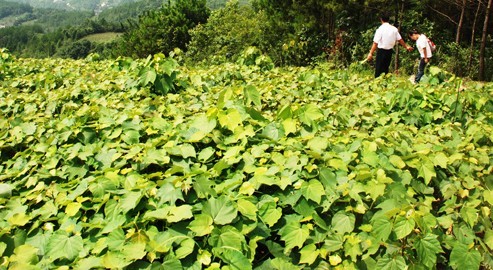
The tree is deciduous and fast, to eight or ten metres, with a short trunk and widespreading branches. Its huge leaves, broadly heart-shaped and up to thirty centimetres across, carry a telling detail: two small reddish glands at the top of the leaf stalk, a mark of the spurge family. Flowers open in spring before the leaves expand, in loose clusters of white petals blushed crimson at the throat; male and female flowers are separate but share the same tree. The fruit is a round, green-then-brown capsule about the size of a apricot, with a shell thick enough to need a hammer, hiding three to five oily seeds.
Tung is the hardiest of the oil-tree Vernicia clan; its sister species Vernicia montana stays tropical and is confused with it constantly in old literature. True tung needs a real winter chill to break dormancy, which is exactly why Gulf Coast planters could grow it. In the wild margin of its Chinese range it fills abandoned slopes and road cuts, and rural families traditionally owned groves passed down through generations, a tree treated more like an orchard asset than a forest resident.
Outside the workshop the oil’s waterproofing career continues in boat seams, ink formulations and traditionally made rain capes, and cosmetic chemists borrow it for hard-setting natural varnishes on wood utensils.
Science & Biotechnology
The seed oil runs to roughly eighty percent eleostearic acid, a conjugated fatty acid whose triple array of double bonds lets the molecule link with its neighbours under oxygen. That conjugation is the whole secret: ordinary drying oils dry slowly and softly, while tung oil polymerises quickly into a dense, water-tight network. Chemists call it a film-forming drying oil, and it remains a reference standard in coatings science. Current research lines include selecting Chinese and American accessions for oil content and cold tolerance, tissue-culture propagation of elite mother trees, and enzymatic modification of eleostearic acid for specialty resins.
Every part of the story has a sharp edge. The seeds are genuinely poisonous to people and livestock, causing severe gastric illness, so no orchard byproduct goes to the kitchen. The press cake left after oil extraction still carries its toxins, and growers have long used it instead as fertiliser and as a folk insecticide against crop pests — a use modern biopesticide work keeps revisiting.
Uses & Benefits
Woodworkers prize pure tung oil because it penetrates, hardens, and never darkens into a plastic shell. The craft rule is patience: thin wiped coats, each left to cure fully, sanded back between applications. Polymerised tung oil — heat-treated in the factory, never in the home — cuts the waiting and suits floors and furniture. Violin and guitar makers blend it into varnishes for a finish that moves with the wood, and fine-art paint makers rely on it where linseed would yellow.
Growing from Seed
Tung seed has a hard coat and a lazy pace, so soak it in warm water overnight before sowing and expect nothing hurried. Sow in deep containers — the young tree makes a taproot — in a loose mix of loam, leaf mould and coarse sand, at a depth of three to four centimetres, and keep it evenly moist and warm. Transplant when the seedlings stand twenty to thirty centimetres tall with several true leaves, setting them out in full sun, six to seven metres apart, in deep well-drained soil. Young trees are frost-tender their first winter; wrap or mulch them. Train a single clear trunk early, water deeply in dry spells, and expect the first worthwhile crops only once the crown fills out.
In orchard country groves are planted on hillsides so cold air drains away, and weeds are kept down around the stem for the first years while the canopy closes. Feed with balanced fertiliser in spring, prune only to remove crossing limbs, and resist the urge to harvest heavily from young trees — the shells will tell you when the crop is ready by splitting along the seams.
Our Take
A tung tree is a long courtship with a slow reward, so plant it where its autumn leaf-fall and spring flower show will be enjoyed while the oil accumulates. If you want to compare the clan, our Vernicia montana page covers the tropical sister species with its larger fruit, and Malania oleifera is another remarkable Chinese oil-seed tree for the discriminating grower. For a gentler, edible-oil alternative with the same evergreen patience, see Chinese tallow tree — three trees, three very different kitchens of the land.
Related Reading
Continue exploring with these related plants: