


Magnolia grandiflora Seeds | Southern Magnolia
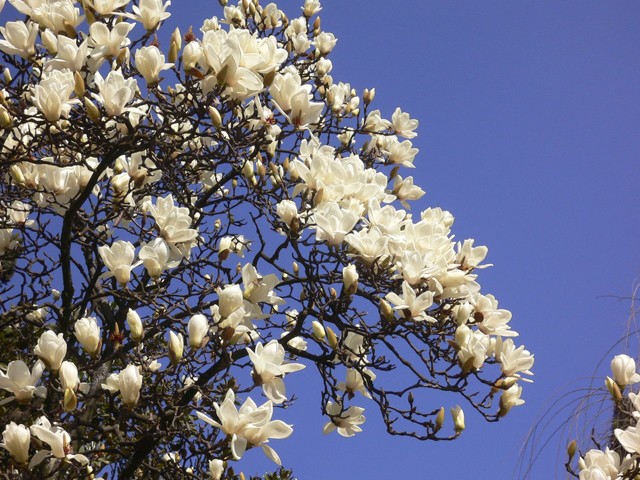
LATIN NAME: Magnolia grandiflora
COMMON NAME: Southern Magnolia
Plant Profile
A single open bloom of Magnolia grandiflora can span the palm of a hand and smell like a subtropical garden on a still evening, yet the tree that bears it keeps those leaves all winter. Few temperate trees combine such large, waxy, powerfully fragrant flowers with a stubbornly evergreen crown, and that pairing is why the southern magnolia became the state tree of both Mississippi and Louisiana and a fixture of the Deep South.
The flowers are followed by an aggregate of follicles that looks like a small green cone. As it ripens the cone opens to reveal scarlet seeds, each dangling on a slender thread, which birds readily take. This fleshy red display is a useful field mark separating grandiflora from its deciduous magnolia relatives.
Planted as a specimen or a tall screen, the southern magnolia gives dense shade and year-round structure. Older cultivars such as ‘Bracken’s Brown Beauty’ and ‘Edith Bogue’ extended its garden range well north of the native line, while ‘Little Gem’ brought it down to courtyard scale.
A single branch of open flowers scents a room, and the foliage is valued in floral work. Growers seeking other fragrant options can look to the creamy Magnolia champaca or the tulip-like Magnolia denudata.
In frost-free regions the southern magnolia is planted as a lawn specimen and as a screen, and its tolerance of heat and humidity makes it a dependable choice where many evergreen trees struggle. Choose a cultivar matched to your winter low, and give it room, because a mature tree can spread nearly as wide as it is tall.
In cooler climates grow the tree against a warm wall and choose a cold-tolerant cultivar. Established trees shrug off brief cold, but young growth burns easily, so a sheltered start pays off for years and a winter wrap helps in the first two seasons.
Science & Biotechnology
The bark and leaves accumulate neolignan compounds, notably honokiol and magnolol, the same bioactive pair studied in Magnolia officinalis. These molecules are the basis of the genus’s long traditional use as a calming and anti-inflammatory herb, and they make grandiflora a regular subject in phytochemical screening.
The foliage yields a small amount of essential oil on steam distillation, dominated by terpene alcohols and sesquiterpenes that carry the green, balsamic scent of the crushed leaf. Such leaf-oil work is mostly of analytical interest, but it underpins the species’ place in the broader magnolia aroma trades.
Because seedling populations vary, the horticulture industry multiplies chosen forms by somatic embryogenesis and by micropropagation on standard media, work that also supports selection for cold tolerance and narrower garden habits.
Uses & Benefits
Magnolia flowers are built on a primitive blueprint: the many tepals, stamens, and pistils are arranged in a spiral on a cone-like receptacle rather than in neat whorls, a structure little changed since before bees evolved. Beetles, not bees, are the original pollinators of such flowers, which is why the bloom is so robust and fragrant rather than finely tuned to a single insect.
Dried magnolia bark has a long place in traditional medicine across East Asia, used as a bitter aromatic. Modern interest centres on the neolignans named above rather than on any home preparation, and the bark should be admired on the tree rather than brewed at home.
Growing from Seed
The upper leaf surface is a deep glossy green, but turn one over and you find the underside densely covered in rusty-brown felt, a tomentum that reduces water loss and reflects heat. The leaves are large, leathery, and evergreen, persisting for two to three years before dropping a few at a time, so the tree never stands bare.
Magnolias sit among the most ancient lineages of flowering plants, with fossil pollen testifying to a far wider distribution before the ice ages. Grandiflora is a survivor of that warmer world, which explains both its frost sensitivity at the northern edge of its range and its affinity for hot, humid summers.
Collect the red seeds, remove the fleshy aril, and sow the seed in a moist, well-drained medium; a cold resting period improves even growth. Seedlings are recognised by the first pair of broad true leaves, at which point they can be potted on and given their first light feed.
Use a deep, fertile loam with good drainage and a site in full sun to light shade. Water young trees steadily through their first dry season and protect them from hard frost until the wood hardens. Feed in spring and keep competition from grass away from the root zone, mulching to hold soil moisture.
Our Take
For a spring-flowering contrast try the ivory Magnolia denudata, the compact Magnolia liliiflora, or the medicinal Magnolia officinalis, and for pure scent nothing beats Magnolia champaca in warm gardens.
Related Reading
Continue exploring with these related plants: