


Hippocampus | Seahorse
LATIN NAME: Hippocampus
COMMON NAME: Seahorse
Species Profile
A seahorse is a fish, and the shape is the least of its oddities. The body is encased in bony plates, the tail is prehensile and curls around seagrass, and there are no scales. It swims upright by rippling a dorsal fin, which is too small to outrun anything, so it relies on camouflage and on staying still. The snout is a tube, and the animal feeds by snapping small crustaceans through it.
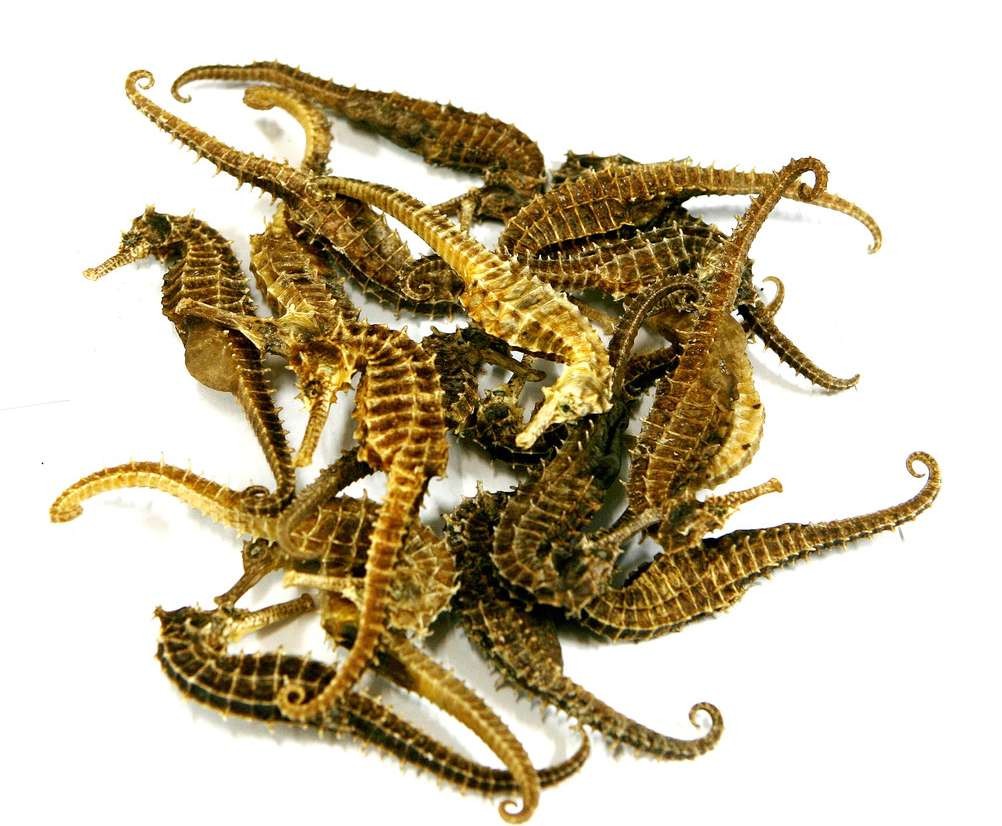
The dried product sold as hai ma is a whole animal, pale brown and curled, threaded on a string or packed flat. About forty species are traded, and the larger ones fetch more, so the small species are often sold in bulk. The trade is global, with the main markets in China and Hong Kong, China, and the main sources in South-East Asia, India and East Africa.
Science & Biotechnology
The seahorse is the clearest case of male pregnancy in the animal kingdom. The female deposits eggs into a brood pouch on the male’s abdomen, he fertilises them there, and the pouch supplies oxygen and nutrients and controls the salinity of the fluid around the embryos. He gives birth after two to four weeks, and a single male can produce several broods in a season.
Most species form pair bonds, and some stay together through several breeding cycles. The pair greets each morning with a colour-changing dance, and the bond matters because the female needs to be able to find the same male when her eggs are ready. The genus is also unusual in having no stomach: food passes through a short gut, which is why seahorses must eat almost continuously.
Uses & Benefits
In Chinese medicine the dried animal is used as a tonic for the kidney and for impotence, usually in a powder or in a wine, and it appears in formulas for asthma and for chronic cough. The claims are traditional, not clinical, and there is no controlled study showing the effect that the market charges for.
Outside medicine the animal is sold dried as a curiosity, and live specimens are traded for aquariums. That aquarium trade is small compared with the dried trade but it is significant for a few colourful species, and it is the part of the market where captive-bred stock is most available.
Source & Harvest
Every species of Hippocampus has been on CITES Appendix II since 2002, which means exports need a permit and a finding that the trade is not damaging the wild population. In practice enforcement is uneven. Most trade passes through a few entrepôts, and the animals are dried and packed before they are identified, which makes species-level checks almost impossible.
Collection is by hand, by divers and by trawlers working seagrass and mangrove edges, and bycatch is a large part of the supply. A pair of seahorses produces many young, but survival in the wild is very low, and the animals need structured habitat that is itself being lost to coastal development. Buyers who want legal material should ask for a permit number and a species name, and should treat a mixed bag of unidentified animals as a warning.
Captive breeding is done, but mostly for the aquarium trade. The young need live food for the first weeks, usually brine shrimp nauplii and then enriched adults, and they must be fed several times a day. Water flow has to be gentle, and the tank needs holds and hitching posts, since the animals stress when they cannot anchor.
The commercial barrier is cost. A captive-bred seahorse sells for more than a dried wild one, and the drying trade has no reason to pay that premium. Breeding for release, which is what would help wild populations, has been tried in several countries with limited success, because the animals settle in habitat that is often degraded. For a hobbyist, buy tank-bred stock of a species that is legal in your jurisdiction, and do not release anything into the sea.
Our Take
A fish whose biology is stranger than its marketing, and a trade that is regulated on paper. The material is not a proven medicine.
Related Reading
If Seahorse interests you, these related tonics are worth a look: