


Saussurea laniceps Seeds | Woolly Snow Lotus
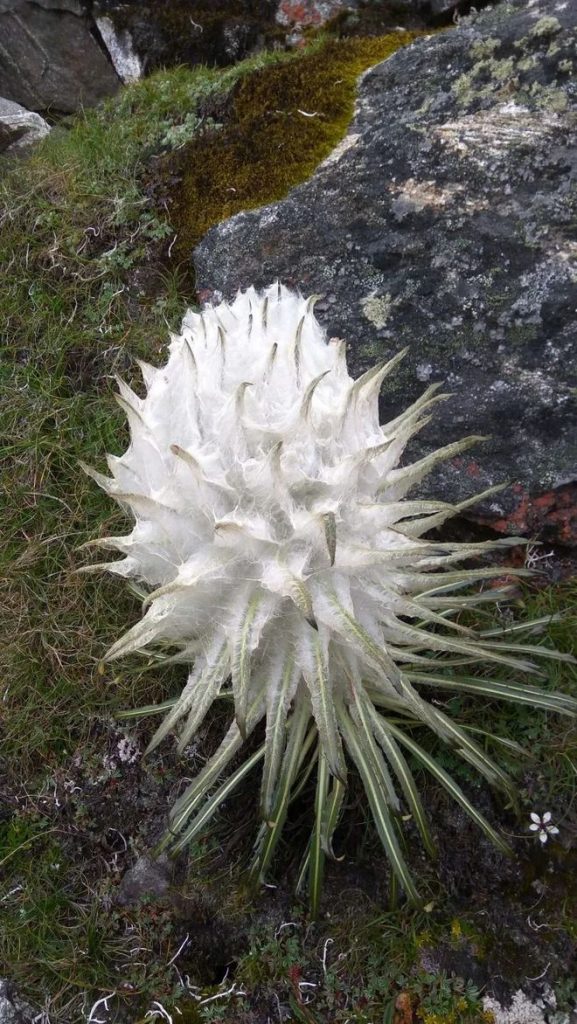
LATIN NAME: Saussurea laniceps
COMMON NAME: Woolly Snow Lotus
Plant Profile
Woolly snow lotus is a small alpine perennial of the high Himalaya, growing eight to thirty centimetres tall from a thick taproot among scree and boulders at four to five thousand metres. Its leaves are covered in a dense mat of white, woolly hairs that give the whole plant the look of a felted animal, and the flowering stem carries a tight head of purple florets surrounded by a ruff of woolly bracts. It flowers once, after several years of slow growth, sets seed and dies. The wool insulates the plant against frost and ultraviolet light and may also reduce water loss in the thin, dry air. It is collected for Tibetan and Chinese medicine, where it is used for joint pain and for altitude complaints, and it is one of several species sold as snow lotus.
Science & Biotechnology
Saussurea laniceps is a monocarpic perennial, and its life history has made it a textbook example of how harvesting can drive evolution. A study in the Hengduan Mountains compared herbarium specimens collected over a century with living plants and found that the average height of flowering individuals had fallen by more than a foot, because collectors remove the largest plants before they can set seed. That is an unusually clear case of human-induced selection on a wild species, and it has been used in arguments for harvest regulation. The woolly indumentum is made of dead, air-filled cells that reflect light and trap a layer of still air, and its density varies with altitude. Chemical work has identified sesquiterpene lactones and flavonoids with anti-inflammatory activity, though the clinical evidence is thin and the trade is largely unregulated.
Uses & Benefits
The whole plant is dried and sold as snow lotus for decoctions and for powders, used in Tibetan medicine for arthritis, for menstrual pain and for the symptoms of altitude sickness. The trade is substantial and has spread to Chinese cities, where the plant is sold in herbal markets and online. In the garden it is grown by alpine specialists in troughs and scree beds, where its woolly rosettes and short purple flowers are admired at close range. It needs sharp drainage, full sun, cold winters and no competition, and it is very difficult to keep through a wet summer. It is not a plant for a border, and wild-collected material should never be bought.
Growing from Seed
Sow in late winter on a gritty mix of coarse sand, limestone chips and sieved loam, barely covering the seed. Give the pot a cold period at four degrees for six to eight weeks, then bring it to twelve to fifteen degrees; germination is slow and often poor. The seedling makes a rosette in its first year and a taproot that resents disturbance, so sow in a deep pot and plant out without breaking the root. Grow in a raised trough or scree bed with full sun, sharp drainage and a top dressing of gravel. Water sparingly, keep the crown dry in winter, and expect flowering in the fourth or fifth year, after which the plant dies.
Our Take
A woolly high-altitude monocarpic that is slow to flower and hard to carry through a wet winter. Buy only cultivated seed, never wild roots.
Related Reading
If Woolly Snow Lotus appeals to you, these related plants are worth a look: