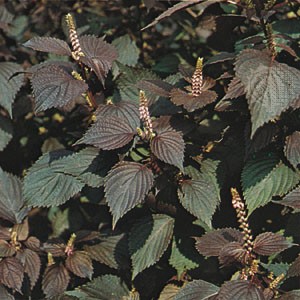
Purple Perilla Perilla frutescens
.jpg)
LATIN NAME: PERILLA FRUTESCENS
COMMON NAME: Purple Perilla, Shiso, Zi Su
The purple perilla is one of the most striking of the kitchen herbs, and its deep-purple, ruffled leaves have made it a treasured plant of the gardens and the kitchens of the East. It grows as an upright, bushy, aromatic annual of the mint family, reaching up to a metre or more, with upright, square, branching stems bearing opposite, broad, oval, pointed, deeply veined, ruffled, deep-purple leaves, which are fragrant when brushed, and, in the late summer, the small, two-lipped, white flowers in the upright, one-sided spikes, followed by the small, round, brown seeds. It is a species of the flowering herb, native to the warm regions of Asia, while it is grown for its striking, purple foliage and its long history of use in the kitchen and the traditional ways of the region, and it is known as the purple perilla.
Scientific Research & Plant Biotechnology
The purple perilla has a real and distinguished place in research. It has been studied in the chemistry of the essential oils and the food science, since the purple leaves of the perilla are a beloved food and a flavouring of the kitchens of the East, and the researchers have examined the leaves, their oil and their constituents, while the value of the perilla has drawn attention in the international food and botanical press, and the study of the perilla and its chemistry has been of continuing interest across the world, and the plant is best appreciated as a subject of study and a fine herb of the kitchen rather than a casual remedy. The plant has also been studied in botany and ecology, since it is a native of the warm regions of Asia, and its relationships, its distribution and its role in the wild have been examined, while the ecology of the warm-region herbs has been of continuing interest, and the broad, ruffled, deep-purple leaves of the perilla have been of the greatest interest to the botanists. The species has also been studied in the horticulture, since the purple perilla is one of the most striking of the foliage plants of the garden, and the researchers have examined its many forms and its cultivation, while its deep-purple, ruffled foliage has made it a treasured plant of the beds and the containers. For a plant of such striking value, the purple perilla has a rich and distinguished record of research.
Ecological & Economic Value & Wide Applications
To grow the Purple Perilla from seed, ecologically, the purple perilla is a generous plant of the garden. Its small, two-lipped, white flowers feed the bees and the insects of the late summer, and its small, round, brown seeds feed the birds, while its bushy, purple, leafy growth gives a fine cover to the small creatures, and its deep-purple, ruffled foliage is one of the glories of the border. Its economic value is real: the purple perilla is prized for its striking, purple foliage and its long history of use in the kitchen and the traditional ways of the East, and its value has drawn attention in the international food and botanical press, while its leaves have been used in the cooking and the making of the traditional things of the region, and the plant is a beloved friend of the garden and the kitchen. To raise the purple perilla, press the fine seeds into the surface of pots of damp, free-draining compost, keep them lightly watered, and grow the little herbs on in the sun.
press the fine seeds into the surface of pots of damp, free-draining compost, keep the young perilla lightly watered, and grow the little herbs on in the sun.
LATIN NAME: Perilla frutescens
COMMON NAME: Perilla, Shiso, Zisu, Korean Perilla
Perilla is a handsome and aromatic herb of Asia, and its colourful leaves have flavoured the cooking of the East for centuries. It grows as a bushy annual of the mint family, reaching up to a metre, with square stems and broad, oval, toothed leaves that come in deep green, rich purple or a striking two-tone form, and in summer it carries spikes of small, white or purple flowers, followed by clusters of small, round seeds. The leaves have a fresh, aromatic, slightly anise-like flavour, and they are used fresh in salads and sushi, as a garnish and as a flavouring, while the seeds are pressed for a fine oil.
Perilla belongs to the mint family, Lamiaceae, and it is native to Southeast Asia and the Indian highlands. It is traditionally grown in Korea, southern China, Vietnam and Japan, where it is known as shiso, and it is now grown around the world as a culinary herb. There are green and red forms, and the red-leaved varieties are used to colour and flavour pickles and preserved foods, while the green forms are the classic garnish for sushi, so the plant has found its way into nearly every corner of East Asian cooking.
Scientific Research & Plant Biotechnology
Perilla has a genuine and growing place in both food and scientific research. It is an important culinary herb of East Asia, and researchers have studied the chemistry of its aromatic leaves, identifying the volatile compounds that give perilla its distinctive flavour, and studying the anthocyanins that give the purple varieties their rich colour. The seeds have also been studied, since they yield a fine oil that is rich in beneficial fatty acids, and researchers have examined the oil, its composition and its uses. The plant has also been studied for its traditional uses, since perilla has a long history in the traditional medicine of Asia, and its potential biological activity continues to interest researchers. For an herb of such culinary and nutritional value, perilla has a rich and growing record of research.
Ecological & Economic Value & Wide Applications
Ecologically, perilla is a generous herb of the Asian garden. Its small flowers feed bees and other pollinators, and its broad, colourful leaves add beauty and life to the summer garden, while it is a beloved plant of the kitchen.
Its economic value is real and varied. It is an important culinary herb of East Asia, used fresh in salads and sushi and as a flavouring, its seeds are pressed for a fine cooking oil, and the plant has a long history of use in traditional medicine. For a grower, perilla is an easy and valuable crop, and for a gardener it brings handsome, aromatic foliage in deep green and rich purple. The seed is small and easy — sow it in a pot of moist compost in spring, keep it in a warm, bright spot and water it gently, and itll sprout within a couple of weeks, growing on quickly into a handsome, aromatic plant for the kitchen.
The chirimen (wrinkled) type of shiso, called "Aka Chirimen Shiso". The color is red (purple) and the leaves are wrinkled. Shiso is very vigorous and it is easy to grow. Best for beginners. Aka chirimen shiso is often used to color umeboshi. Shiso has heat torelance and is very vigorous, and is very flavorful. Shiso is a typical herb in japanese dishes.