


Bombax ceiba Seeds | Gossampinus Malabarica
LATIN NAME: Bombax ceiba
COMMON NAME: Cotton Tree
Plant Profile
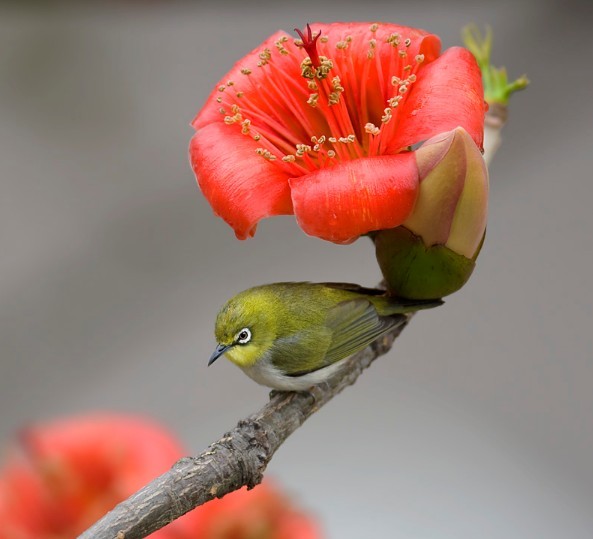
For a stretch of late winter the street trees of Guangzhou catch fire. The red silk cotton tree flowers on leafless branches, great five-petalled crimson cups crowning a skeleton of thorny limbs, and the city it overlooks has adopted it as its official flower and its emblem of courage. In Chinese popular usage it is the hero tree, and every spring the petal-fall carpets pavements in scarlet. A tree that blooms harder before it ever leafs out is hard to forget.
Young trees are unmistakable: the trunk and branches are studded with conical prickles, a medieval armour that smooths away with age, leaving grey, buttressed bark on the veteran. The foliage is palmate, spreading hand-like leaves of five to seven leaflets that drop entirely for the winter, so the flower show happens on bare wood where nothing hides it.
After the flowers come the ellipsoid capsules, woody and dark, which split to release a cottony floss around the seeds. This silk is real cellulose, glossy and water-repellent, but it is smooth and too short to spin into yarn; its historic use is stuffing, and across India and Nepal the semal floss fills quilts, pillows and seat cushions. It belongs to the same family of materials as true kapok, Ceiba pentandra, whose floss once filled the world’s life jackets, and the two trees are frequently confused in the floss trade.
The crimson cups hold deep wells of nectar and open in the dry season when little else feeds, so a flowering bombax operates as a refuelling station. Fruit bats work the blooms after dark, sunbirds and mynas by day, and rose-ringed parakeets are notorious both for drinking nectar and for biting flowers off entirely, an orchard-grower’s grievance and a photographer’s gift in the same crown. The scale of the banquet is one reason the tree seeds so freely around old plantings.
Science & Biotechnology
Molecular systematics moved the baobab-and-kapok family into a broadly defined mallow family, and the silk cotton trees went with it, kin now to hibiscus and cotton. For growers nothing changes except the label, but the family chemistry does explain a shared trait: mucilaginous tissues, with the young flower buds and even the floss used in regional cooking and folk preparations across South Asia. Dried bombax flowers appear in Indian and Nepali market stalls as a traditional article of trade.
Uses & Benefits
Older nursery catalogues, including the legacy listings this article replaces, still sell the species as Gossampinus malabarica. Modern treatment folds that name into Bombax ceiba, but the word survives in the trade and in the botany of the region, a reminder of how many names one great tree can accumulate across two continents. Seed buyers should treat the names as one and the same species.
The raw floss is harvested by hand, a job traditionally given to children in the Nepali hills, who pick the split capsules before the wind carries the cargo away. Modern buyers of the stuffing trade still grade semal floss by cleanliness and colour, and a tree over a village square can supply a household’s quilts for a winter. Anyone growing the species for its own sake gets the floss free as packing material for fragile seed pods of other species, a use growers pass along quietly.
Growing from Seed
Collect capsules as they begin to split on the tree, dry them on a tray until they gape, then tease the floss apart in a breeze to free the round, dark seeds embedded in it. No treatment is needed; the floss even helps broadcast-sown seed settle evenly.
Sow in a warm, free-draining loam-sand mix about a centimetre deep and keep it just moist. Seedlings race, producing a swollen base and the first thorns within their first season, a built-in warning against casual handling. Thin to one strong plant per cell, pot on early to accommodate the root run, and transplant at about knee height into full sun and deep soil. The seedling has no frost tolerance to speak of in its first season, so in marginal climates keep young stock in containers through the first winter and set them out only after the cold has broken.
Space the trees widely, since the crown is broad and the buttresses demand ground. Water to establishment only; the species resents wet feet and will handle long dry spells once rooted. Prune lower branches as it climbs and leave the young prickles to do their own security work. Watch for caterpillars on fresh flushes and for stem canker after wound damage.
Our Take
Plant it where the petal-fall can be enjoyed rather than swept, over a lawn edge or a courtyard mouth, and stand well back: mature trees are enormous. In the same flame-flowered register, the flame tree Brachychiton acerifolius and the floss-bearing silk floss tree make stirring companions, and floss traders may compare them with the kapok page above. Sow a whole capsule’s floss into one tray and you will learn the meaning of abundance.
Related Reading
If Cotton Tree appeals to you, these related plants are worth a look: