


Abelmoschus esculentus Seeds | Okra
LATIN NAME: Abelmoschus esculentus
COMMON NAME: Okra
Plant Profile
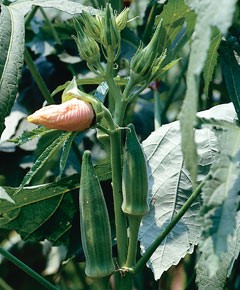
Clemson Spineless is the okra most American gardeners meet first, and its claim to fame is exactly what the name promises: the ribbed green pods carry few of the bristles that make older types unpleasant to pick. Released from Clemson in the 1930s, it became the benchmark green okra because it bears heavily and stays tender when picked young.
Like all okra it is a tall mallow with palmately lobed leaves and large yellow flowers bearing a dark red centre, the bloom opening for a single morning before closing. The flower is a near copy of a small hibiscus, as the family relation predicts from the seed up.
The plant is a true warm-season annual that wants a long, hot run to perform, and it shows its displeasure at cool nights by slowing growth and setting fewer flowers. Given full sun and a fertile, well-drained bed it becomes a sturdy, productive bush that can shoulder a surprisingly heavy load of pods, which is exactly what the home grower wants from a vegetable this size.
Harvest by pod size rather than a calendar, taking them young and often so the plant keeps setting flowers and pods. A plant picked hard stays in production far longer than one left to mature its first fruits and turn its energy to seed.
Science & Biotechnology
The plant is studied on several food-science fronts at once, from the thickening slime to the oil in the seed, which is why it sits in both the vegetable and the oil-crop literature.
Cut pods release the characteristic mucilage, a pectin-like polysaccharide that thickens liquids; this is the trait behind okra’s role in gumbos and is being studied as a natural food stabiliser in place of modified starches.
Uses & Benefits
The ‘Clemson Spineless’ pod is long, ridged and nearly hairless, which makes harvesting by hand quick and avoids the skin irritation of bristly types. The smooth wall also slices cleanly for the kitchen without fuzzy edges that spoil a presentation.
The young pod is a source of dietary fibre and vitamin C, and the seed yields an oil valued for its unsaturated-fatty-acid profile, so the plant is examined on several food-science fronts rather than as a single-purpose crop in the field.
As a member of the mallow family it shares the mucilaginous chemistry of marshmallow and hollyhock but is grown for the pod rather than the root, and it is generally quiet on the allergy front compared with true tree nuts and their close relatives.
For most growers this is the okra against which every other variety is measured, simply because it is reliable, heavy and easy to handle in the heat of a long summer.
Harvest the pods while still young and tender, then fry, roast, pickle or simmer them; the green form keeps its colour through cooking better than the red and blends into savoury dishes without shouting its presence.
Beyond the kitchen it is an attractive tall annual with a long flowering run, useful at the back of a hot border where its height and yellow blooms hold the eye through late summer and into early autumn.
In the wider mallow family the plant sits among relatives grown for root, fibre and flower rather than pod, yet it is the one most people meet at the dinner table. Its ease and reliability are why it remains the yardstick against which newer varieties are still measured by home gardeners and market growers alike, season after season, with little sign of being displaced by a rival.
Give it warmth and food and it will repay you with more pods than a small household can eat, which is the only real problem this variety presents to the cook.
Growing from Seed
The near absence of bristles is the trait that defines the variety and what separates it from older, prickly okras that were unpleasant to handle in the heat of harvest. That smoothness also means the pods slice cleanly and the cooked result has a finer, less fuzzy texture in the mouth, which matters in a vegetable eaten in quantity through the summer months.
Sow into warm, deeply worked, fertile ground once the season has warmed, and thin the seedlings to leave the strongest plants with room to branch and to carry the weight of a heavy crop without splitting.
Our Take
I give Clemson Spineless the richest, warmest bed I have and pick every couple of days once it starts, because the pods size up fast. A tall, generous plant that earns its space many times over.
Related reading: Burgundy Okra Abelmoschus esculentus seed and Hollyhock Alcea rosea.
Related Reading
Readers interested in Okra frequently explore these as well: