


Hordeum jubatum Seeds | Foxtail Barley
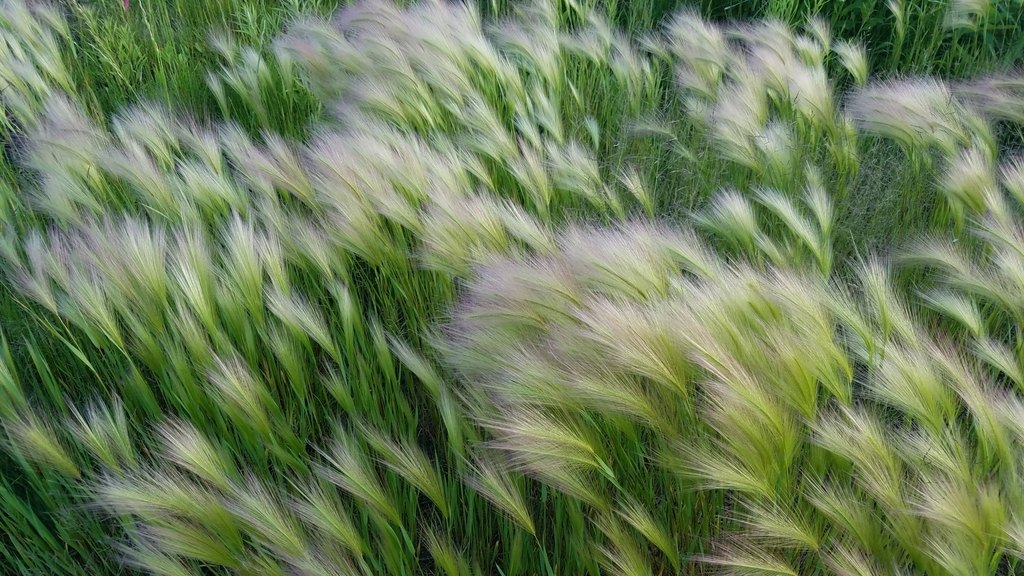
LATIN NAME: Hordeum jubatum
COMMON NAME: Foxtail Barley
Plant Profile
Hordeum jubatum is a short-lived perennial or biennial grass of the Poaceae, native to eastern Asia and western North America, and widely introduced elsewhere. It grows 40 to 60 cm tall, with narrow leaves and a dense, bristly spike 5 to 10 cm long, covered in long, silky awns.
The awns run from just over one centimetre to seven and a half, longer than those of the meadow barley beside it and far shorter than the ten to fifteen of cultivated barley. Green first, then pink or purple as the seed ripens, then straw. The colour comes from anthocyanins and is strongest in cool, sunny weather.
Growers value the spike and farmers hate the plant. It colonises disturbed ground, tolerates salt, and once established is very hard to remove. It also hosts stripe rust, which passes to wheat and barley, and that is a large part of its reputation. In parts of North America it is listed as a weed of cultivation.
A single plant can shed more than two hundred seeds, and they germinate only from the top seven centimetres of soil, in darkness. In a garden that means seedlings in gravel and in paving cracks; in a meadow it means a colony that returns each year. The habit is useful or tiresome depending on the setting.
Science & Biotechnology
Hordeum is a genus of about 40 species, and it includes the cultivated barley, H. vulgare, which is one of the oldest crops in the world. The genus is characterised by the dense spike and by the long awns, which are an adaptation to dispersal by wind and by animals.
The awns are extensions of the lemma, and they are covered with tiny hooks that catch in fur and in clothing, which is how the seed travels. The same hooks make the grass a nuisance in wool country, and they are the reason the plant is not welcome in pasture.
The species is a polyploid, and its origin is a cross between an east Asian barley and an extinct relative of the Californian Hordeum brachyantherum. That hybrid ancestry is why it varies so much across its range, and why the taxonomy of the North American barleys has never settled. It behaves as a short-lived perennial and often as a biennial.
It accumulates salt in leaf and root tissue and grows on soils from pH 6.4 to 9.5, withstanding sodium chloride at one per cent. That tolerance is why it appears on road salt, on slough margins and on irrigated ground gone saline, and why it has been studied as a plant for reclaiming such land. For more of the Poaceae, the list offers Hordeum murinum, Melinis nerviglumis and Beckmannia syzigachne.
Uses & Benefits
It is used in borders, meadows and gravel gardens, where its silky spikes and its pale colour are valuable, and it ranks among the best grasses for drying. The spikes hold their shape and colour for years if they are cut before the seed shatters, and they are a staple of dried arrangements.
The awns are barbed and point upward. In hay they work into the gums, cheeks and tear ducts of horses and cattle, causing ulcers, abscesses and sometimes blindness; the dried spike is the dangerous part, not the green plant. Any pasture with animals in it should be mown before seed set.
People have used it too. The Chippewa and Potawatomi took the roots as a medicine, the Kawaiisu ground the seed and ate it dry, and Iroquois children put the ripe spikes down each other’s sleeves. For a plant with a bad reputation, it has a long record of being handled.
Growing from Seed
Sow direct in early spring or autumn at 15 to 20 °C, covering the seed lightly. The tray is up in ten to fourteen days. The seed is easy to handle and the seedlings are vigorous from the start. Thin to 20 cm apart, or plant out at that spacing. The plant tolerates poor, dry and saline soil and needs no feeding. It flowers in early summer and sets seed by midsummer, and it dies after setting seed, so it behaves as an annual or biennial.
For drying, cut the spikes when they are fully coloured but before the seed shatters, and hang them upside down in a dark, airy room. For the border, leave them standing into autumn, when they turn straw and catch the light.
If you do not want it to spread, cut the spikes before they set seed. In a meadow or a wild garden, let it seed and it will return every year, often in the best places, which are the ones you would not have chosen.
Our Take
Foxtail barley is a beautiful grass with a bad reputation, and both are deserved. In a gravel garden or a dried arrangement it is superb; in a pasture or a formal border it is a nuisance. Grow it where it can self-sow without doing damage, cut it for drying, and keep it away from livestock. It is a plant that rewards a little discipline with a great deal of light.
Related Reading
Continue exploring with these related plants: