


Pennisetum orientale Seeds | Oriental Fountain Grass
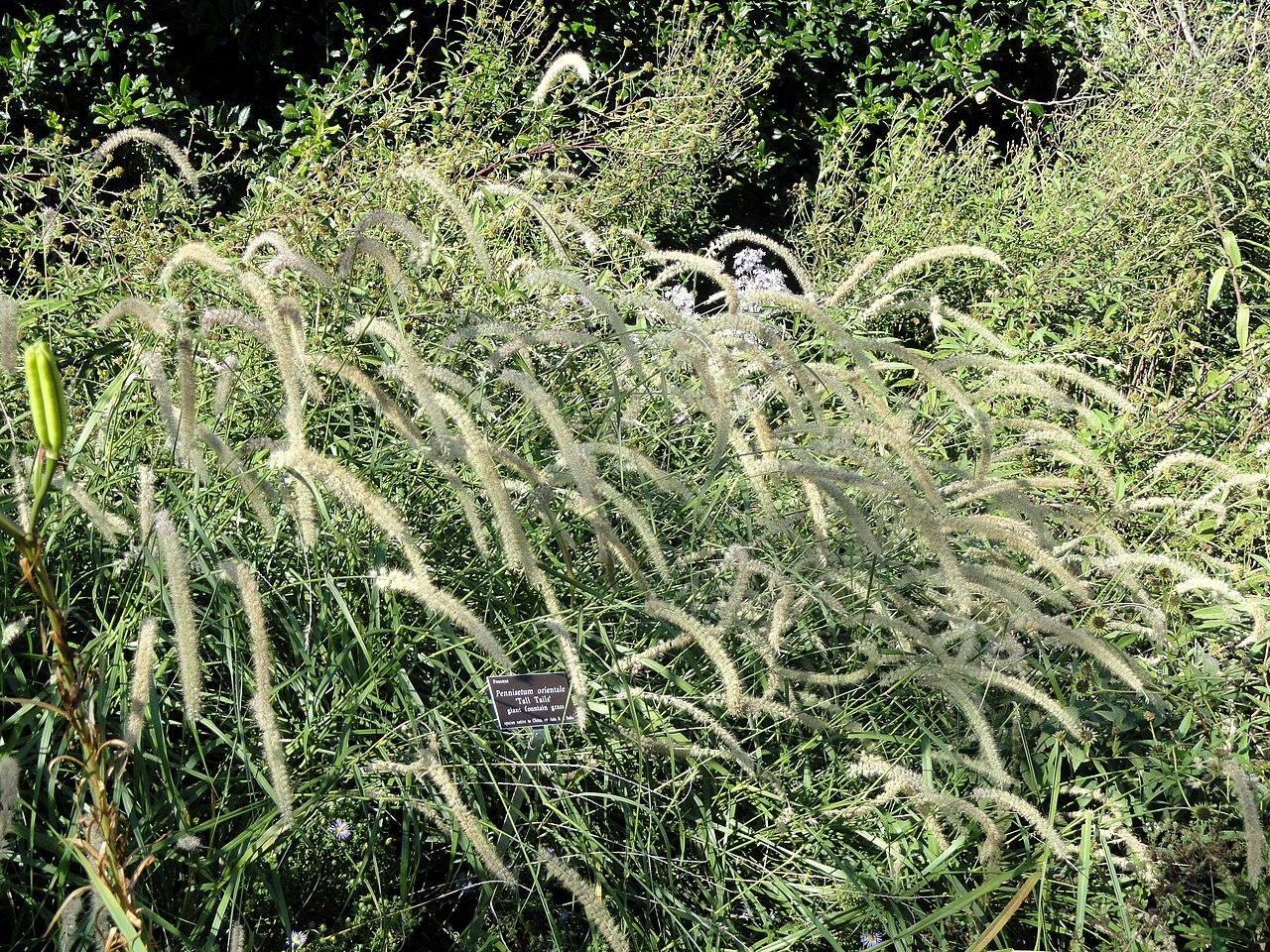
LATIN NAME: Pennisetum orientale
COMMON NAME: Oriental Fountain Grass
Plant Profile
Oriental fountain grass is the smallest of the fountain grasses in general cultivation and the one that flowers first. Pennisetum orientale makes a neat clump about sixty centimetres high and wide, with narrow grey-green leaves and, from June, a crowd of soft pink bottlebrush plumes up to fourteen centimetres long.
The plumes are held above the foliage on thin stems that move in the slightest air, and they bleach from pink through buff to a pale straw as the seed ripens, so a single clump carries three colours across the season. They persist well into winter, which is more than the foliage does.
Its native range runs from Morocco and Algeria across the Middle East to Iran, Afghanistan, India and Nepal, a span that includes some very dry and some very cold ground. Plants from different parts of that range vary in hardiness, and the garden material is not uniform.
The species was moved to Cenchrus in the reorganisation of the tribe, so it appears in current databases as Cenchrus orientalis. The old name is still what the trade uses and probably will be for another generation, which is the ordinary lag between taxonomy and catalogues.
Science & Biotechnology
Pennisetum means feather-bristle, from the Latin for feather and bristle, and the name describes the inflorescence precisely: a dense cylindrical panicle in which the individual spikelets are subtended by long bristles rather than by awns. Those bristles are what give the plume its softness and its ability to catch light.
The genus has been dismantled. Molecular work showed that Pennisetum nests inside Cenchrus, the sandburs, and the two cannot be kept apart without splitting Cenchrus into fragments. The consequence is a series of new combinations that no gardener asked for and that the nursery trade has largely ignored.
It is a C4 grass, so it grows quickly in heat and why it stalls in a cold summer. The pathway concentrates carbon dioxide around the enzyme that fixes it, reducing losses from photorespiration, and it is the reason the plant flowered in June in a hot year and in August in a wet one. Poaceae is well covered here, with Pennisetum villosum, Pennisetum glaucum and Hordeum murinum alongside.
Uses & Benefits
In the garden it is the grass for a small space: a gravel garden, a hot wall, a container that will be moved under cover for winter. It is too short to be a specimen and too well behaved to be a thug, and it fits where the larger fountain grasses would swamp everything around them.
Cut, the plumes last a fortnight in water and indefinitely dry, and they are one of the few grass heads that hold their colour when dried without any treatment. A handful in a vase in November is the plant’s second season, and it costs nothing but the cut.
It has no food or medicinal use, and no toxicity is recorded. Its value is entirely ornamental, which is worth saying plainly in a genus where the best-known species is a serious pasture grass and another is a noxious weed across three continents.
Growing from Seed
Sow in late winter at twenty to twenty-two degrees, on the surface and lightly covered, and expect germination in two to three weeks with a wide spread. Fresh seed comes up in ten days; seed a year old may take a month and give half the plants.
The seedlings are grass-like and slow for the first six weeks, and they should be potted on before the roots fill a nine-centimetre pot, because a root-bound grass never establishes well. Plant out after the last frost, in full sun, in ground improved with grit rather than compost.
It dislikes prolonged freezing and wet cold more than dry cold, so a south-facing wall or a raised bed is worth more than any winter mulch. Cut the old foliage back in early spring, before the new shoots show, and never in autumn, because the crown needs the cover through the worst of the weather.
Our Take
This is the fountain grass for people who have tried the big ones and found them too much. It is compact, it flowers early, it holds its colour through winter, and it does all of that in a space a metre square. The only thing it will not take is wet cold at the root.
Its hardiness is honestly marginal in a cold garden, and the catalogues oversell it. Grown in a pot and moved under cover from November it is reliable; grown in the open in heavy soil it is a plant that survives two winters out of three, and the third one takes it.
Related Reading
Readers interested in Oriental Fountain Grass frequently explore these as well: