


Impatiens hawkeri Seeds | New Guinea Impatiens
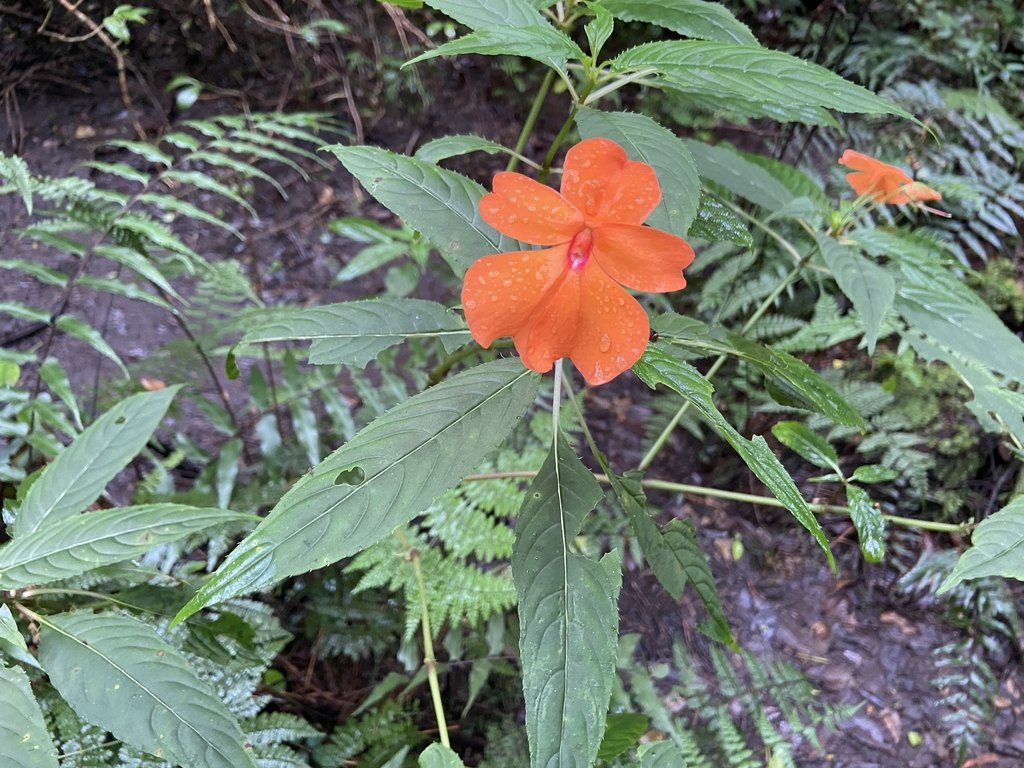
LATIN NAME: Impatiens hawkeri
COMMON NAME: New Guinea Impatiens
Plant Profile
Impatiens hawkeri is the wild plant behind a bedding industry. It was first collected in the Territory of Papua in 1884 and reached European greenhouses soon afterwards, where it was grown as a curiosity for the best part of a century before anyone thought to breed it.
It is a soft-stemmed perennial of about half a metre, with lance-shaped, slightly toothed leaves that are often flushed red or bronze along the midrib, and flat, five-petalled flowers in white, pink, red, orange or lavender. The leaves are glossy and slightly fleshy, and the red flush along the midrib is strongest where the light is brightest.
Fifteen other New Guinea taxa were collected in the years after its discovery, and all of them were eventually determined to be forms of this one species. That collapse of fifteen names into one is why the plant is so variable in the wild, and why the breeding pool was wider than it looked.
The native range is New Guinea, the Bismarck Archipelago and the Solomon Islands, in wet upland forest. It has been recorded as an escape in Costa Rica and Nicaragua, where it persists around settlements without spreading far. In the uplands it grows on wet rock and along streams, so it tolerates shade but not drought.
Science & Biotechnology
The genus name refers to the explosive capsule: Impatiens means impatient, and a ripe pod will fire its seed several metres when touched. The mechanism is a spring of tensioned tissue that releases in a fraction of a second, and it is why the plant is also called touch-me-not. A single plant throws seed across a metre of ground, and the pods ripen over weeks rather than all at once.
The commercial success of the New Guinea group rests on breeding rather than on the species alone. It has been crossed with Impatiens aurantiaca and I. platypetala to improve drought tolerance, leaf colour and flower size, and the resulting hybrids are what the trade sells.
Its most useful trait is disease resistance. The downy mildew that destroyed walleriana bedding across Europe and North America from 2011 onwards does not attack this group, so New Guinea types replaced the old busy lizzies in so many municipal plantings.
Uses & Benefits
In the garden it is a shade plant that flowers as though it were in sun: a bedding subject for north-facing beds, containers under trees, and the dull corner that gets no direct light. Few plants give that much colour in shade for that long.
Records run past twenty thousand and are spread almost evenly across every month, which is the signature of a plant that exists mainly in cultivation and flowers whenever it is warm enough. That flat profile is itself informative: this is a garden plant, not a wild one, in most of the world. It is also a warning, because a plant that depends on people will not naturalise in a cold climate.
The leaf colour is a selling point in its own right. Many strains carry purple, bronze or near-black foliage, and those forms are worth growing for the foliage alone, with the flowers as a secondary effect. They also hold up better in low light than the green-leaved types. Its nearest neighbours on the list are Impatiens balsamina, Primula denticulata and Primula vialii.
Growing from Seed
Sow in late winter at twenty-one to twenty-four degrees, on the surface, because the seed needs light and constant moisture. Cover the tray with glass and keep it out of direct sun; germination takes two to three weeks and is uneven, so leave the tray for a month.
Prick out as soon as the seedlings can be handled, into a moist, free-draining mix, and keep them warm. Cold compost at this stage is fatal, and so is overhead watering, which spreads damping off through a tray in a day.
Plant out only when nights stay above twelve degrees, in shade or partial sun. Water regularly, feed lightly, and pinch the tips once to build a bushy plant. Cuttings root in water or in damp grit at any time in summer, which is the quickest way to keep a good colour. In a cold summer, grow the plant in a pot and bring it under cover at night, because growth stops below about ten degrees.
Our Take
New Guinea impatiens is the answer to shade that has defeated everything else, and it does the job without the disease risk that ruined the old bedding impatiens. That combination is why it is everywhere, and the ubiquity is deserved.
The plant to look for is not the brightest flower but the darkest leaf, because the foliage carries the display for the eight months when the flowers are sparse. Buy one, take cuttings in August, and you will not need to buy it again.
Related Reading
Continue exploring with these related plants: