


Passiflora coerulea Seeds | Blue Passionflower
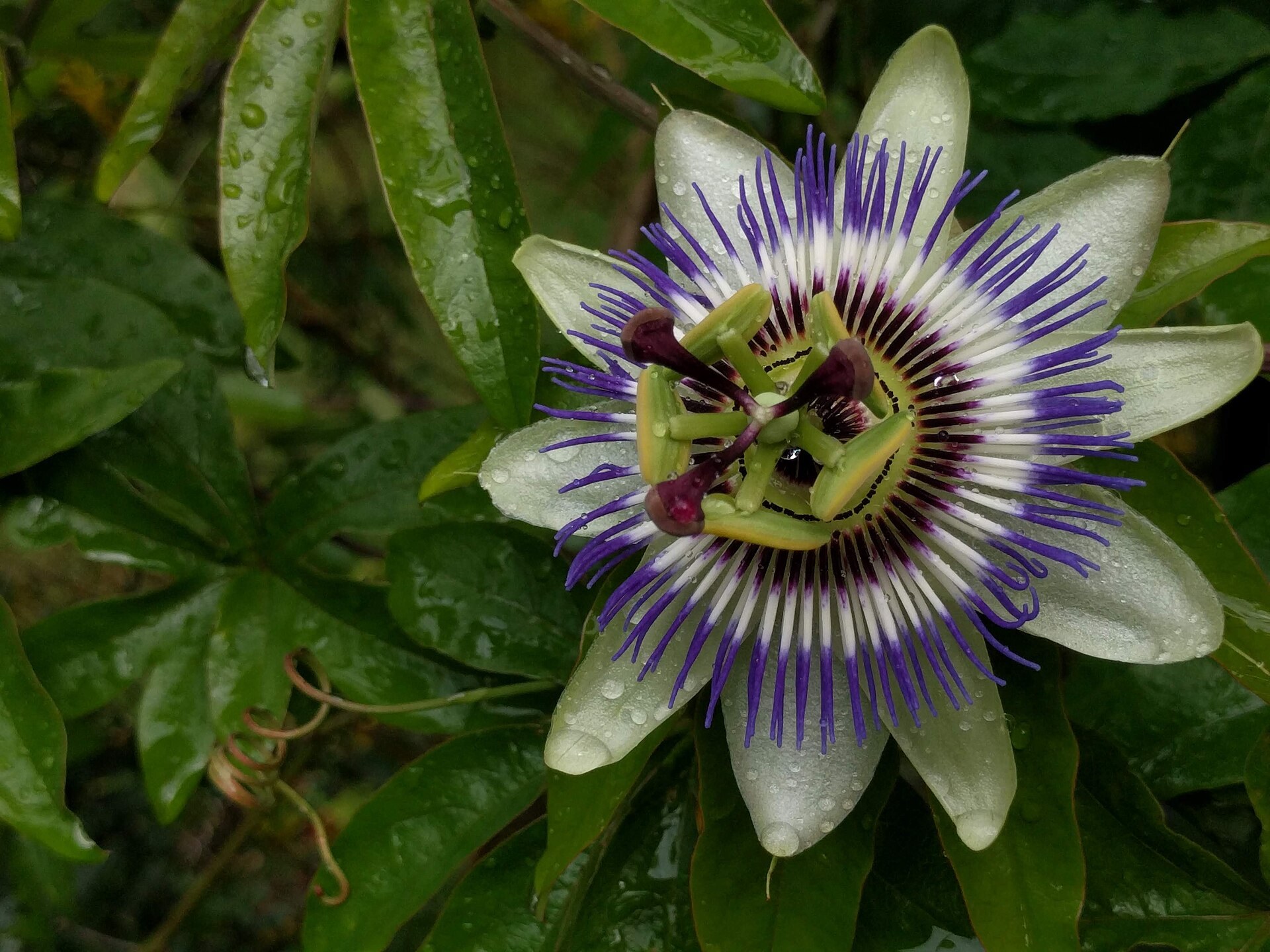
LATIN NAME: Passiflora coerulea
COMMON NAME: Blue Passionflower
Plant Profile
Passiflora coerulea is the older spelling of Passiflora caerulea, and both appear in catalogues. The plant is the hardiest of the passionflowers, a vigorous climber from southern South America that has been grown in Europe since the seventeenth century. It is the one that survives outdoors in London, and the one whose fruit appears on a wall in autumn.
The leaves are palmately five- or seven-lobed, deep green above and paler below, and they are held on long petioles with two glands at the base. Tendrils rise from the leaf axils and grip anything within reach. A plant can cover six metres of wall in a season. It dies to the ground in a hard winter and returns from the root in May.
The flower is six to eight centimetres across, with white sepals, blue petals and a corona of filaments banded in blue, white and purple. The sex organs stand above it on a stalk: five anthers below, three stigmas above. The arrangement is the source of the old missionary reading, in which the parts are the instruments of the crucifixion.
The name caerulea means blue, and coerulea is the mediaeval Latin spelling that Linnaeus and later authors used interchangeably. That is the whole difference. The plant was described from cultivated material, and its exact wild provenance was uncertain for a long time. Southern Brazil, Paraguay, Uruguay and northern Argentina is the modern consensus.
Science & Biotechnology
The flower is protandrous: the anthers shed pollen and bend outward before the stigmas ripen and curve down to meet them. That sequence favours crossing, but the plant is partly self-fertile and will set fruit alone in a good summer, so orange fruit appear on walls in cool cities with few pollinators. The mechanism is a fallback, not a guarantee.
The corona filaments are not ornament. They guide insects to the nectar ring at the base, and their banding is strong in ultraviolet, which bees see and we do not. In South America the pollinators are large carpenter bees, strong enough to push past the anthers. In Europe those bees are absent, so fruit set is sparse and the crop small.
The genus is chemically rich, and several species carry cyanogenic glycosides, which release hydrogen cyanide when the tissue is crushed. Ripe fruit of this species is eaten in South America and is bland rather than dangerous; the leaves and unripe fruit are another matter. The sedative reputation belongs chiefly to Passiflora incarnata, the species in the pharmacopoeia.
Uses & Benefits
On a wall it is grown for the flowers, which open in July and continue until the first frost, and for the foliage, which is dense enough to screen a fence. It needs a warm wall and a grid of wires; the tendrils will not grip a flat surface. In a cold garden the top growth dies each winter and the plant flowers on new wood.
The fruit is orange, egg-shaped and about six centimetres long, and it is edible when fully ripe, though the pulp is thin and the flavour faint. In cool climates it rarely ripens. Gardeners grow it for curiosity and for the look of it against a wall, not for the table. The seeds are hard and the pulp is mostly air.
In cool countries the plant is also used as a rootstock, because its roots are hardier than those of the commercial passionfruit. Passiflora edulis grafted onto it will crop in a cold greenhouse where it would otherwise die. That is a quiet, practical use that matters more than the flowers to growers in marginal climates. Its nearest neighbours on the list are Passiflora alata, Viola wittrockiana and Rinorea anguifera.
Growing from Seed
Sow in spring at twenty to twenty-five degrees after soaking the seed for a day in warm water. Germination is slow and irregular, from three weeks to three months, and the seed coat is hard. Nicking the seed opposite the embryo helps. Fresh seed from a ripe fruit germinates far more readily than the dry packet seed sold in shops.
Plant out against a sunny wall in any ordinary soil, and water through the first summer. After that the plant is drought-tolerant and almost too vigorous. Prune in early spring, cutting the previous year’s growth back to a framework of two or three buds from the base. Flowers come on the new shoots, so hard pruning is safe.
In cold gardens, plant with the crown ten centimetres below the surface so the buds survive frost, and mulch over the crown in autumn. Container plants should be moved against a wall or into a shed. Cuttings root easily in summer from half-ripe shoots with a heel, in a closed case with bottom heat.
Our Take
This is the passionflower that most people in cool countries have actually seen, and it earns its place. It is fast, tolerant, and generous with flowers in a summer that suits it. The fruit is a curiosity and the medicine is in another species. What it offers is a wall covered in blue from July to October.
The spelling on the packet will be coerulea in older catalogues and caerulea in newer ones, and both are the same plant. Buy it for the wall, not the fruit. Give it sun, wires and a hard prune in March, and it will do the rest without help.
Related Reading
Gardeners who grow Blue Passionflower often pair it with these related subjects: