


Stellera chamaejasme Seeds | Stellera
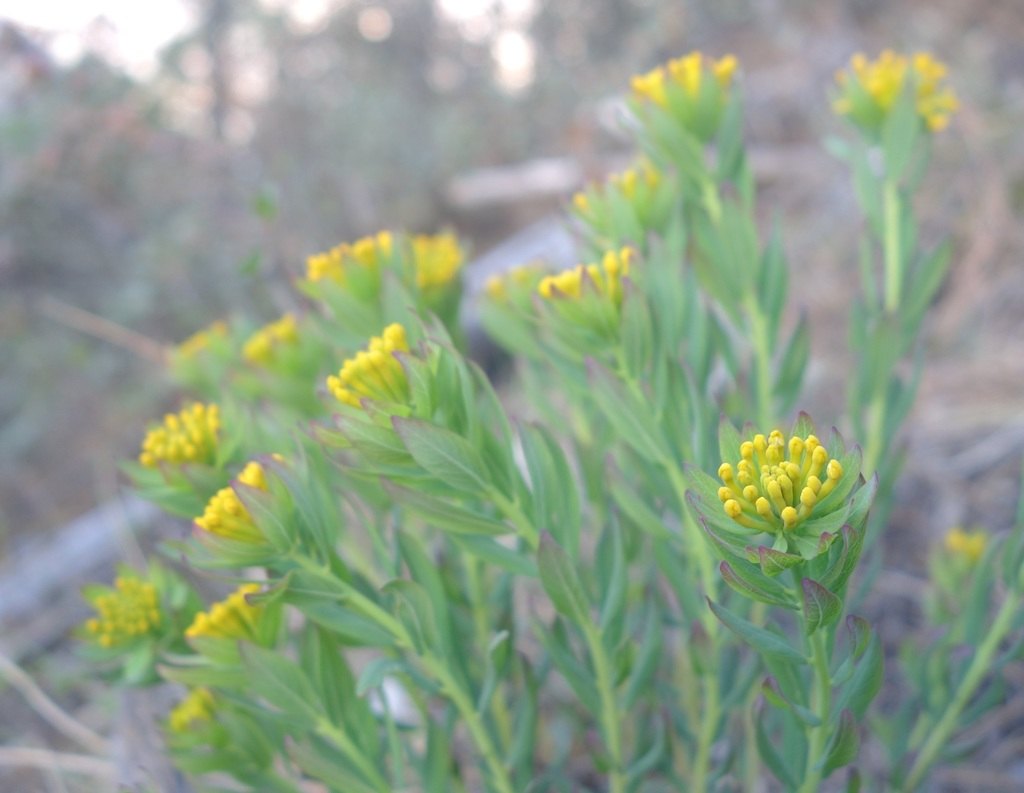
LATIN NAME: Stellera chamaejasme
COMMON NAME: Stellera
Plant Profile
Stellera is a genus with a single species, and that species is found in the mountains of Central Asia, China, Korea, Siberia and South Asia. It is a herbaceous perennial, dying back to a woody crown each winter, and it carries heads of white, pink or yellow flowers that open in late spring and early summer.
The habit is compact and upright, suited to a rock garden or an alpine house, and the flowering heads are dense enough to read from a distance. In the wild it grows on open slopes and steppe, often in thin soil over rock, which is a good guide to what it wants in cultivation.
Its reputation at home is not ornamental. In Mongolia the plant is known as choniin cholbodos, which translates roughly as wolf’s poison, and in Tibetan as rejag. Across the grasslands of western China it is treated as an indicator of degradation: it spreads when grazing pressure rises and good forage species are lost, and it ranks among the plants that takes over.
The root is the part that has attached itself to local folklore. Russian settlers in Dauria valued it highly, and the reason is its shape: it forks and twists into something resembling a crude human figure, more convincingly than mandrake is usually credited with. That resemblance, combined with the plant’s toxicity, gave it a reputation that has outlasted any practical use. Allied plants on the list: Hibiscus grandiflorus, Abutilon and Hibiscus sabdariffa.
Science & Biotechnology
The genus belongs to Thymelaeaceae, a family with a consistent chemical signature, and Stellera fits the pattern. The plant contains diterpene esters of the daphnetoxin type, the same class of compounds that makes Daphne and Mezereum dangerous, and they are present through the root, stem and leaf.
These compounds are skin irritants and, taken internally, severe poisons. Livestock avoid the plant while there is anything else to eat, so it survives when better forage is grazed out, and why poisoned animals are usually the ones that had nothing else.
The toxicity is also the reason for the pharmacological interest. Extracts have shown activity in a range of laboratory models, and the plant has a long record in Chinese and Tibetan medicine, applied externally or in carefully prepared doses. That literature is a long way from a safe preparation, and none of it should be read as an instruction.
Uses & Benefits
In cultivation it is a collector’s plant. The flowering heads are unusual, the foliage is neat, and it fits the narrow gap between a rock garden and an alpine house where few things are happy. It is not a plant for a mixed border, and it will not compete with anything vigorous.
The root has been used in traditional medicine across its range, and it appears in Chinese materia medica under several names. The same root is used in some regions as a fish poison and an insecticide, which is a fair summary of how it should be regarded.
Ecologically it is a marker. A grassland thick with Stellera is a grassland that has been heavily grazed, and the plant’s spread is one of the visible signs of desertification in the headwaters of the Yellow River and across the Tibetan plateau. It is slow to establish and long-lived once it does, so a flowering clump is worth protecting from disturbance.
Growing from Seed
Fresh seed germinates best, and it should be sown as soon as it is ripe, in autumn, on a gritty surface and covered lightly. Old seed goes dormant and needs a long cold period to wake up, so a spring sowing without stratification is usually a wasted tray.
The seedlings are slow, and they should stay in their pot for at least a full season before planting out. Use a compost with at least half grit by volume, and top-dress with gravel to keep the crown dry. Water freely in spring, sparingly in summer, and keep the crown dry through winter.
It is a plant for a cold frame or an alpine house in most of northern Europe. Outdoors it needs a raised bed with sharp drainage and a position that does not sit wet in winter, and even then it is a gamble in a mild, damp climate.
Our Take
This is one for the grower who has a sand bed and a cold frame and wants something nobody on the next allotment has. It is beautiful in flower, genuinely dangerous to eat, and it carries a story wherever it grows. What it is not is a plant for a beginner, or for anyone who waters by hose in July.
Related Reading
More species in the same orbit as Stellera: